
OPS & TRAINING
EXERCISE WALLABY 2008 FORGING AHEAD IN AIR-LAND INTEGRATION
21 Nov 2008
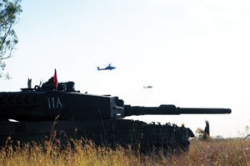
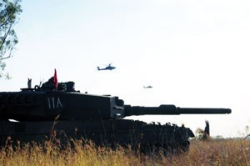
Less than a hundred kilometres away from Rockhampton, more than 3,000 personnel and various land and air assets from the Singapore Armed Forces (SAF) join forces to take out their targets and secure "enemy" terrain. This is Exercise Wallaby 2008.
PIONEER travels to Australia to bring you a slice of the action as the 3rd Generation SAF takes integration levels higher at the Shoalwater Bay Training Area.
Since Exercise Forging Sabre in 2005, the SAF has been honing its ability to fight as a networked and integrated fighting force. In recent years, it has continued to move forward beyond the initial conceptualisation and experimentation stage, conducting various overseas exercises and building upon the integration and operationalisation of its air-land capabilities.
One of the key priority areas guiding this transformation is the development of new technology and systems to achieve greater operational synergy.
Now in its 18th year, this year's Exercise Wallaby focused on enhancing collective situational awareness and strong cross-Service ties as vital components in the ongoing drive to function as One SAF.
Pointing out that the 3rd Generation transformation is at the point which involves training and validating concepts, Exercise Director Colonel (COL) Ishak bin Ismail, Commander 6th Division, said: "Unlike Exercise Lightning Warrior (earlier this year), which centred on tightening the sensor-to-shooter loops, we have brought the level of integration further in this year's exercise with the inclusion of complex land manoeuvres at the brigade level."
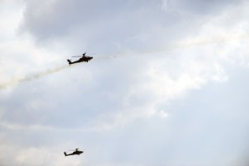
With air-land integration as a key objective of this year's exercise, the Republic of Singapore Air Force (RSAF) has tightly woven 23 aircraft with army operations and increased the number of hours the Air Force commits to supporting these operations, shared Air Exercise Director COL Sunny Yun, Commander Helicopter Group.
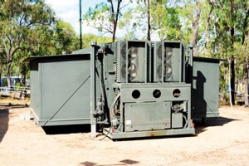
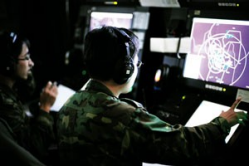
The Air-Land Tactical Control Centre (above: external view, below: interior) provides the coordination required to avoid fratricide during the attack.
Coming together
Drawing together all these different air and land elements means increased complexity in orchestrating operations to safely deliver combat power where and when it is needed.
Information and connectivity thus become more critical than ever in improving communication and making sense of what goes on the battlefield. This, in turn, enables forces from both Services to respond faster and come together as a cohesive whole.
Enter the Air-Land Tactical Control Centre (ALTaCC), which plays a key role in providing troops and commanders with this extra edge in terms of coordination and shared information.
The days of procedural control, where troops had to rely solely on radio sets and maps to find out what was happening in the field, are now a thing of the past.
Utilising advanced technology which gathers information from a wide variety of available sensors, such as Unmanned Aerial Vehicles (UAVs) and mobile land radars, the ALTaCC fuses the live situation pictures of the Army and the Air Force together to produce a synthesised operating overview.
This common operating picture is also relayed to the Land Headquarters in real time, allowing the army to plug into the same map and see the movements of both friendly and hostile forces on the ground as well as in the air.
Explained the detachment commander of ALTaCC, Lieutenant Colonel (LTC) Thiruthakka Devan, who is also Commanding Officer of 201 Squadron (SQN) , Tactical Air Support Group: "What this does at the end of the day is to give us a better situational awareness of what is out there: where our friendly guys are, where's the unknown, and where's the enemy."
Avoiding fratricide
This dedicated command and control system not only allows for faster decision-making in delivering appropriate air support to complement the land battle, but also aids in minimising the risks of collateral damage and avoiding fratricide.
By exercising dynamic air-space management, as well as fluid control over all aircraft and ground-based air defence within the area of operations, ALTaCC can resolve any conflict that may arise between the various air and ground forces.
"The pilots check in with our controllers and we bring them in, controlling them effectively on their missions to keep clear of enemy fire, and also working with our army counterparts to make sure there's no fratricide," said LTC Devan.
According to flying instructor and F-16 pilot, Captain (CPT) Chan Chee Kwang from 145 SQN, this comes in particularly handy during large-scale exercises such as Exercise Wallaby, where there are a number of airborne assets flying at different heights. These range from UAVs to helicopters to fighter jets.
Having a clear awareness of where all the aircraft within the battlefield arena are, the ALTaCC is able to coordinate their movements and get them into place quickly and precisely without compromising any troop's safety.
Commenting on the ALTaCC's contribution to the SAF's fighting capabilities, COL Yun said: It is through using equipment like ALTaCC that we are able to shape the battlefield for the Army...and it has paid off dividends in the number of target hits that we achieved in Exercise Wallaby."
Debut showing
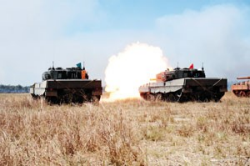
Also making a big bang in Exercise Wallaby this year were the Leopard 2A4 Main Battle Tanks (MBTs) in their debut appearance at a major outfield exercise.
Minister for Defence Teo Chee Hean and his Australian counterpart Joel Fitzgibbon, were on site to witness the new tanks in action as they led the ground assault during an integrated systems live-firing exercise on 25 Oct.
With a fully stabilised weapon system that allows the tanks to fire both while stationary and in motion, the Leopard MBTs also boast greater protection with a multi-layered armour.
They are also highly mobile and capable of travelling at speeds of up to 60km/h even in the rugged outback terrain of Shoalwater Bay Training Area.
LTC Ng Chia Yong, Commanding Officer 48th Battalion, Singapore Armoured Regiment (48 SAR), revealed that Exercise Wallaby was a baby step in operationalising the full capabilities of the Leopard tanks in the Army.
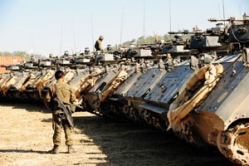
The Leopard tanks (above) starring in their debut appearance in a major exercise, with the armoured infantry (below) as the supporting cast.
"My crew and I are very happy with how the platform is performing," he said. "It is extremely powerful, so we're still trying to build up our basic competencies and grapple with some of its capabilities. That is why we have to come to a place like the Shoalwater Bay Training Area, where we have both the space and terrain for us to manoeuvre as well as conduct realistic training."
LTC Ng added: "After this exercise, I believe we will have greater competency and confidence in handling this platform."
Echoing his sentiment was Private Dominic Tan, a tank gunner from 48 SAR.
The Full-time National Serviceman, who was participating in his first overseas exercise, said: "Training here is much more realistic because the tank can cover a much longer distance, and we get to stretch the strength of the Leopard over a large area of land."
He added: "I think it also helped reiterate the importance of training and integration as a crew. Field training space in Singapore is limited. Over here we get to appreciate fully the importance of our fellow crew members in making the whole machine work. My gunner role cannot function without the tank commander, loader and driver."
Exercise Director COL Ishak explaining to the media how this year s exercise takes air-land integration further.
Improving links
Besides capitalising on new hardware and info-communication technology, another essential ingredient of an integrated and tightly linked 3rd Generation SAF lies in the human element.
For the Army and the Air Force to collaborate and work together seamlessly as a united fighting force, large-scale training exercises such as Exercise Wallaby serve the critical purpose of boosting interoperability and mutual cooperation between the two.
When asked which element in the exercise he found to be particularly outstanding, COL Ishak replied: "Though we often talk about instruments and hardware, I think what I've found outstanding is the heartware... That's what acts as the frame and backbone of the exercise - the ability for us to talk and debate. We may not necessarily agree all the time, but we come up with solutions and a common objective with our people in mind."
Indeed, the sharing of professional knowledge and social interaction between the ground and air forces were some of the aspects that servicemen appreciated about Exercise Wallaby.
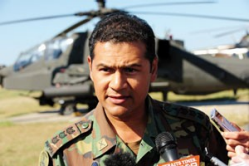
Said Apache pilot CPT Oh Chun Keng, Deputy Chief Planner, 120 SQN: "We've had a lot of interaction and programmes with the Army. 120 SQN has already set up some interactive activities with the Leopard tank company. We discussed tactics and operations, and this has enhanced knowledge between the two Services."
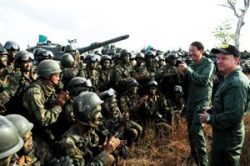
Mr Teo and his Australian counterpart Joel Fitzgibbon visiting the troops during Exercise Wallaby.
Strengthening friendships
This fostering of trust and close bonds also extended towards the local Australian community in Rockhampton.
In a talk with Air Exercise Director COL Yun and Commander Participation Command Brigadier-General Wong Huat Sern, the Mayor of the Rockhampton Regional Council, Councillor Brad Carter, said: "When Exercise Wallaby first began, the local community was somewhat apprehensive of a foreign military force training in the vicinity. However, over time, that sentiment has passed and now, personnel from the SAF are increasingly being seen as part of that community."
He added: "The locals even gather to watch the F-16s take off. In fact, they want to know the take-off schedule so that they can be at the airport to watch the spectacular show every time!"
About 3,600 SAF personnel were involved in this year's exercise, which was conducted from 3 Oct to 16 Nov.
The annual training in Queensland was first conducted in 1990 and is part of an extensive range of interactions between the armed forces of Singapore and Australia, reflecting the strong defence relationship they have.
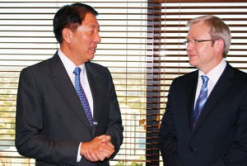
Mr Teo and Mr Rudd discussing regional security issues during his four-day visit to Australia.
Deeper defence ties with Australia
Minister for Defence Teo Chee Hean called on Australian Prime Minister Kevin Rudd in Brisbane on 24 Oct. During the meeting, both leaders reaffirmed the strong and well-established defence relationship between Singapore and Australia.
The two men discussed regional security issues, with Mr Rudd expressing his support for new areas of defence cooperation between the two countries and Mr Teo conveying Singapore's gratitude for Australia s provision of training facilities to the Singapore Armed Forces (SAF).
Mr Teo, who was in Australia from 23 to 26 Oct, also met with his counterpart Joel Fitzgibbon and the Shadow Minister for Defence David Johnston in Canberra.
The two defence ministers visited the Shoalwater Bay Training Area where SAF troops were taking part in a live-firing exercise on 25 Oct. The four-day visit was part of regular ministerial exchanges between Singapore and Australia.
Earlier in August, Prime Minister Lee Hsien Loong and Mr Rudd signed a Memorandum of Understanding (MOU) concerning defence cooperation.
The MOU acts as a framework to manage and build upon existing interactions between the two nations, while promoting new areas of defence cooperation. It also reflects the strong commitment from both countries in the expansion of bilateral defence ties via military interactions and various training arrangements between their armed forces.
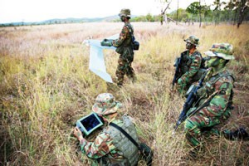
Troops preparing to launch the 5.5kg Mini-UAV.
A bird's eye view for ground troops
One of the new capabilities fielded by the Singapore Armed Forces during Exercise Wallaby 2008 was the Birdeye Mini-Unmanned Aerial Vehicle (Mini-UAV) System. At just 5.5kg, it is highly portable and is used by ground tactical units to obtain a clearer picture of the battle as it unfolds.
As compared to its more bulky UAV cousins, the Birdeye runs on an almost silent electric engine. Another enhancement is autonomous flight - the ability to take off, do a preplanned flight and land on its own. It consists of a small aircraft and a Mini-Ground Control Station (Mini-GCS).
Offering greater flexibility and ease in deployment and recovery, the Mini-UAV can be launched by a two-man team in less than half an hour without the need for a runway.
Its operating range of 8km provides land troops with aerial surveillance and terrain mapping capabilities in real time. Live images captured by the Mini-UAV are directly reflected on the Mini-GCS screen, giving units the advantage of immediate tactical information about possible enemies in the vicinity.
Commenting on how the Mini-UAV helps to enhance soldiers' survivability, Major Lim Kwang Eng, Intelligence Officer HQ 2nd Singapore Infantry Brigade, said: "It will help to save lives because it allows troops to operate from a distance and to pick out the real target that they need to observe without getting too close to the enemy position."

ALSO READ IN OPS & TRAINING
S’pore commandos, Indonesia special forces train & strengthen ties at Ex Chandrapura
08 Jul 2026
From conducting tactical airborne jumps to a coordinated urban raid, soldiers from Singapore and Indonesia deepened their decades-long partnership in this bilateral army exercise.
SAF & Home Team to refresh Medical Classification System
13 Apr 2026
The refreshed system will allow about 1,200 servicemen annually to be deployed for vocations and roles they were ineligible for previously.
Prime Minister Lawrence Wong observes SAF’s sense-strike integrated capabilities
09 Apr 2026
He witnessed the SAF’s ongoing efforts in leveraging advanced robotics and cross-Service integration to secure Singapore’s interests in an increasingly volatile world.