
OPS & TRAINING
TOWARDS BETTER COMMUNICATION IN HADR OPERATIONS
16 Aug 2011
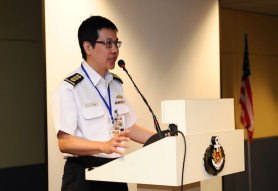
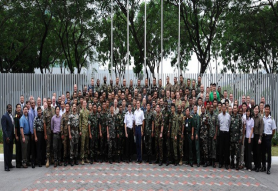
For two weeks starting from 15 Aug, about 300 personnel from 21 countries are gathered at the Changi Command and Control (C2) Centre for a multinational communications interoperability exercise, codenamed Pacific Endeavour.
Led by the United States Pacific Command (USPACOM) and co-hosted by the Singapore Armed Forces (SAF), this annual exercise aims to establish systems and communications interoperability to support Humanitarian Assistance and Disaster Relief (HADR) operations.
High on the to-do list this year are a series of tests and assessments to build on standards set in the 2010 edition of the exercise.
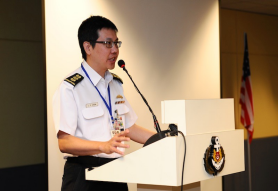
"While we have developed a set of guides and standard operating procedures for HADR operations, different countries use different communications systems. Last year, it was very much a table-top exercise. This year, the various countries have brought their own equipment to assess their level of interoperability," explained Colonel (COL) Chew Lock Pin, Head Command, Control, Communication and Computers (C4) Plans Group, Joint Communications and Information Systems Department (JCISD).
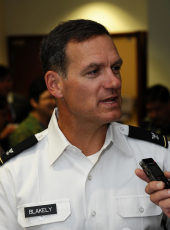
His counterpart from the USPACOM, COL Kenneth Blakely added: "At the end of two weeks, we would have gone through a rigorous testing process to make sure that all our radios and data elements work properly together, documented the process and established the professional contacts we need to move forward when there is a disaster."
Also included in this series of tests is the hardware validation of equipment from non-governmental organisations (NGOs) which are involved in HADR operations.
Participants will also demonstrate the integration of military information systems with civilian ones; rapid restoration of mobile cellular networks which may have been damaged following natural disasters; and the use of SMS (Short Message Service) technologies to help rescuers coordinate their efforts during HADR operations.
New to the exercise this year is the inclusion of a cyber-defence component called Cyber Endeavour. Training sessions organised by the USPACOM will see industry experts speaking to exercise participants on securing cyberspace in the aftermath of natural disasters.
Another series of training sessions called Phoenix Endeavour, which are held concurrently, aim to help participating countries deconflict communications frequencies for HADR operations. These sessions will span six days in total.
"When a natural disaster occurs, international criminal elements swing into action to make money off the situation. Typically, they use tools in the cyber-domain. This component will teach member nations to secure their networks and make sure that they are not distracted from their main mission, which is to alleviate human suffering," explained COL Blakely.
This year's exercise sees the addition of three countries: Cambodia, India and Vietnam. They are joined by their counterparts from Australia, Bangladesh, Indonesia, Japan, South Korea, Malaysia, the Maldives, Mongolia, Nepal, New Zealand, Papua New Guinea, the Philippines, Singapore, Sri Lanka, Thailand, Tonga, Tuvalu and the US.
The SAF has taken part in the annual exercise since 2005 and is co-chairing the information and knowledge management sessions together with the USPACOM.
Participants will also have a chance to tour Singapore on the sidelines. "Singapore is one of my absolute favourite cities and the fact that it is so well-organised and tightly-bound as a nation fascinates me," said COL Blakely.

ALSO READ IN OPS & TRAINING
SAF & Home Team to refresh Medical Classification System
13 Apr 2026
The refreshed system will allow about 1,200 servicemen annually to be deployed for vocations and roles they were ineligible for previously.
Prime Minister Lawrence Wong observes SAF’s sense-strike integrated capabilities
09 Apr 2026
He witnessed the SAF’s ongoing efforts in leveraging advanced robotics and cross-Service integration to secure Singapore’s interests in an increasingly volatile world.
SAF detonates 250kg WWII bomb uncovered at Tanah Merah Coast Road
02 Apr 2026
On 2 Apr, the SAF’s Explosive Ordnance Disposal (EOD) team successfully disposed of an unexploded war relic found at Tanah Merah Coast Road.