
OPS & TRAINING
SPEARHEADING TRAINING TRANSFORMATION
30 Sep 2007
Today's fast-changing world leaves little room for error, and even less space for stagnancy. It is fitting, therefore, that the SAF has committed itself to a journey of continuous growth and development.
Transforming training is essential to sustaining a credible military force. Such training must focus on the men and women of the armed forces, for, in the words of John Nasbitt, "The most exciting breakthroughs of the 21st century will not occur because of technology but because of an expanding concept of what it means to be human."
Changing names and form
Joining the training transformation fray is the Infantry Training Institute (ITI). Established in 1971 as Headquarters Reservist Infantry (HQ RI), ITI was tasked with overseeing the training of Operationally Ready National Servicemen (NSmen).
HQ RI was later redesignated 1st and 2nd Reserve Infantry Training Centre (1 RITC and 2 RITC) to cope with the growing numbers of NSmen.
The growth of the Army has resulted in the introduction of new training centres such as the Basic Combat Training Centre (BCTC), People's Defence Force Training Centre (PDFTC) and Infantry Training Centre (ITC).
In line with the transformation of the Army, these training centres were merged to form ITI on 1 July 2004. Two years later, the School of Infantry Weapons (SIW) was brought under the umbrella of the ITI to maintain and facilitate consistency of standards and practices.
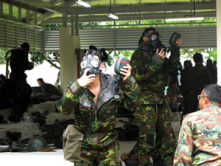
Besides serving as a training institute for NSmen, ITI also assists in training active units. It provides both the facilities and the instructors for battalion HQ training, basic infantry training, weapon qualification courses as well as shooting competitions.
Training transformation
Transforming ITI to meet challenges in our strategic environment requires a 'Learning Army' filled with 'thinking soldiers'.
One way to enhance training, according to Minister for Manpower and Second Minister for Defence Ng Eng Hen, is to equip these 'thinking soldiers' with the skills to respond effectively in an operational environment.
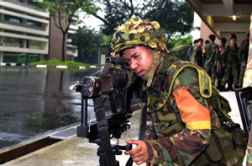
This can be achieved through the introduction of technology for greater training realism. ITI will be utilising technologies such as the Infantry Gunnery and Tactical Simulators (IGTS), Joint Conflict and Tactical Simulators (JCATS) as well as the activity of Paintball to allow soldiers to achieve a higher level of training realism.
The rationale for this is simple: to expect NSmen to sacrifice up to two weeks a year for In-Camp Training (ICT) requires a reciprocal commitment on the SAF's part, said COL (Ret) Chua Peng Tian.
The 51-year-old former Commander of ITI added that this commitment on the SAF's part is one that has clearly been met.
"The challenges facing ITI are many: training units to respond to operational needs; evolving a training cadre that understands and can cater to the evolving needs both of the SAF and NSmen; and maintaining equipment in tip-top condition to facilitate worthwhile and up-to-date training," he said.
ITI not only has to equip Full-time National Servicemen (NSFs) with specific vocational skill sets during their two years of NS, but also has to maintain their proficiency during their 10 years of ICT.
Moving forward
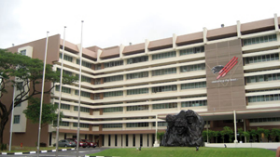
ITI moved out of its former home at Tanjong Gul Camp and into Jurong Camp II on 17 Aug. This, according to Commander ITI COL Anson Lim, is a step in the right direction.
Jurong Camp II, he explained, was entirely designed and renovated by ITI to suit its training needs. Furthermore, Tanjong Gul saw heavy traffic in the form of industrial vehicles, and was situated in an area where sand-blasting was regularly carried out. Jurong Camp II would offer NSmen greater ease of access and better air quality.
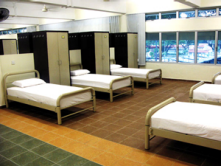
Furthermore, the accommodation has also been modified. Said COL Lim: "The bunks in Jurong Camp II have been designed around an open concept that allows privacy but also better bonding and more cohesion."
CPT (NS) Goh Kee Yong, S3 of 673rd Battalion, Singapore Infantry Regiment (673 SIR), was one of the first NSmen to do his ICT in Jurong Camp II. His verdict?
"There was much consideration taken to improve on what they had in terms of catering to NSmen," he said. "Operations-wise, this is definitely a big improvement."
CPT (NS) Goh, a teacher at Catholic High School, has been attending his ICT at Tanjong Gul for the past six years. This move to a brand new facility pleases both the NSmen and the ITI trainers.
Apart from the upgraded facilities, training itself has also seen a face-lift. ITI now conducts regular force-on-force exercises, in which two NS battalions are pitted against each other. This is much more effective as it allows battalions to face a thinking 'foe'; an 'enemy' who can adapt to battlefield conditions.
NSmen now utilise the Tactical Engagement System (TES) in their training. This system allows simulation of direct fire effects and evaluation of the outcome of each engagement, aided by the latest laser technology. It also provides realistic feedback to soldiers, indicating the point of impact and the type of injuries sustained during the engagement.
At the opening ceremony of the ITI at Jurong Camp II, Dr Ng recounted his own NS experience and how training realism has been heightened since.
"Right now, there's a consequence to your mistake. And that sort of realism maximises your training. People internalise their actions, their rights and wrongs and their consequences; real consequences which are felt at that point in time."
The TES allows commanders and NSmen to evaluate their performance even after the exercise is concluded.
Putting it all together
Perceptibly, ITI has it all: its equipment and facilities are top-notch, its trainers are dedicated and committed. But how do you measure its success over the years?
COL Anson Lim offers an answer: "Their success is our success, but at the same time we're accountable for their failure as well."
It's no secret, however, that the relationship between trainers and NSmen at ITI is an excellent one.
"Our relationship grows as the years go by. The trust and confidence between NSmen and us trainers don't end here; there's a new relationship even outside their ICT," said 1WO Wong Dwan, an assistant company trainer at ITI.
Ultimately, it is the reciprocity of the relationship between NSmen, their trainers and the SAF that allows ITI to continue to pursue excellence.
"Since the NSmen come back for training, here in ITI we are committed to delivering our best to train them. It's a partnership between the NSmen and ourselves," said CPT Gabriel Ong, a company trainer.
New Facilities
NS Battalion Command Block - Provides an NS Battalion with the necessary infrastructure for commanders to conduct activities such as Battalion HQ cell training, map-planning exercises and discussions.
Battalion Planning Room - Provides a more
conducive environment for training NS commanders.
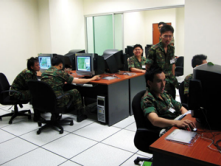
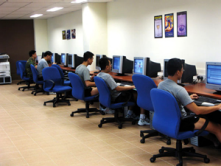
Satellite Interactive Laboratory (SIL) - Consisting of 70 computer workstations, the SIL provides training flexibility. NSmen can undergo computer-based lessons at their own pace. The SIL also allows war-gaming and map-planning exercises.
Business Centre - A hot favourite of NSmen, the business centre provides facilities such as phone, fax and internet connectivity to enable them to respond to urgent work and personal responsibilities during their ICT.
Access to better training areas - Jurong Camp II allows easier access to the Basic Combat Training Centre's training area, Pasir Laba training area and
live-firing areas.


ALSO READ IN OPS & TRAINING
Prime Minister Lawrence Wong observes SAF’s sense-strike integrated capabilities
09 Apr 2026
He witnessed the SAF’s ongoing efforts in leveraging advanced robotics and cross-Service integration to secure Singapore’s interests in an increasingly volatile world.
SAF detonates 250kg WWII bomb uncovered at Tanah Merah Coast Road
02 Apr 2026
On 2 Apr, the SAF’s Explosive Ordnance Disposal (EOD) team successfully disposed of an unexploded war relic found at Tanah Merah Coast Road.
Flying into the unknown: Inside RSAF’s mission to bring S’poreans home from Middle East
28 Mar 2026
Despite the risks and complex challenges of flying in a conflict zone, the men and women of the RSAF pulled off a successful mission through careful planning and hard work.