
OPS & TRAINING
SAF FIELD SURGICAL THEATRE IN OPERATION
11 Jan 2005
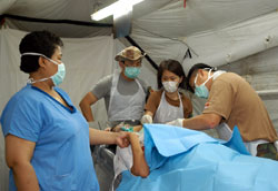
A 20-year-old lady was admitted to the A & E Department of the local Meulaboh hospital on 11 Jan. She told doctors that, for two weeks, she had been coughing, feeling breathless and running a temperature.
Singapore Armed Forces (SAF) team surgeon, Major (MAJ) (Dr) Sean Leo, felt something was amiss and ordered a chest X-ray immediately.
"There were 'cracks' in her left lung, a sound that indicated water in the lung. We suspect she inhaled seawater during the tsunami and that it had been accumulating since then," said MAJ (Dr) Leo, who is part of a 24-member SAF Humanitarian Assistance Task Force (HATF) medical team that is in Meulaboh to provide relief aid.
The fluid in her lung was preventing her lungs from fully expanding. So the doctors decided to do a chest-tube insertion on her to drain out the fluid.
She was the very first patient to be operated on in the SAF dresh tent that was erected just two days earlier to augment surgical needs at the local hospital.
This outdoor field operating theatre is equipped with an environment cooling unit and bright fluorescent lamps.
It is powered by two generators, and a third generator is also used to power an Autoclave device used to sterilize surgical tools.
The medical theatre is also complete with medical stores and equipment, such as an emergency trolley.
During the 45-minue long operation, it was found that the patient had not only water in the lung, but pus too, as infection had already set in.
"She could have had underlying pneumonia that may have caused the condition. If we had discovered this later, sepsis may have set in by then and it could have been fatal," said Dr Yong Wei Sean, a general surgeon from Singapore General Hospital, who had volunteered to be part of the SAF HATF medical team.
The team was glad that the first operation was successful, and more importantly, that a life had been saved.
With the influx of local and foreign doctors to Meulaboh, tsunami-related medical cases are dwindling fast.
It is a welcome change from less than a week ago, when doctors were swamped with injuries sustained during the tsunami.
More heartening news from relief operations includes the road access that large vehicles now have from Meulaboh to Medan.
With this northeast link re-established, humanitarian aid can now flow through the road channel to Meulaboh, instead of being restricted to just air and sea transportation.
As for SAF combat engineers, progress onshore has been brisk and they are now busy clearing an access route to Landing Point 1 where Chinooks can land.
This plot of land near the parade square is still being improved upon and buildings surrounding it are being used to store relief supplies.
Also, they are liaising with Indonesian authorities to see if there are suitable locations where temporary shelters can be built.
The engineers have construction kits to help build simple shelters to house some of the displaced locals whose homes were swallowed by the giant tsunami waves on 26 Dec 04.
These modular buildings, measuring about 20m by 10m each, can be built in about five to seven days - one at a time.
In addition, the United Nations Office for Coordination of Humanitarian Assistance (UNOCHA) has also formed a partnership with Indonesian authorities to coordinate relief efforts from the TNI barracks (POSKO).
Every night, SAF liaison officers also chip in by meeting village chiefs in the vicinity and Kol Geerhan, the local TNI garrison officer, to discuss what the locals need are, and how best to distribute supplies to them.


ALSO READ IN OPS & TRAINING
SAF & Home Team to refresh Medical Classification System
13 Apr 2026
The refreshed system will allow about 1,200 servicemen annually to be deployed for vocations and roles they were ineligible for previously.
Prime Minister Lawrence Wong observes SAF’s sense-strike integrated capabilities
09 Apr 2026
He witnessed the SAF’s ongoing efforts in leveraging advanced robotics and cross-Service integration to secure Singapore’s interests in an increasingly volatile world.
SAF detonates 250kg WWII bomb uncovered at Tanah Merah Coast Road
02 Apr 2026
On 2 Apr, the SAF’s Explosive Ordnance Disposal (EOD) team successfully disposed of an unexploded war relic found at Tanah Merah Coast Road.