
OPS & TRAINING
HEALING HEARTS, HELPING HANDS
30 Sep 2007
To ensure soldiers are kept fighting-fit, a high standard of healthcare in line with existing best practices are a must.
Thus, the Visiting Consultant (VC) Scheme was implemented in July 1995 to allow the SAF to tap the expertise of professional leaders in their respective fields of specialisation.
Up to 25 medical doctors of various specialties can be appointed each time for a period of three years. Besides providing professional input on complex medical cases, they also give advice on medical policies and help develop medical support doctrine. PIONEER finds out what these VCs do during their term of service.
At the height of their careers and swamped with key medical responsibilities at hospitals, they still make time to volunteer their consulting services to the SAF Headquarters Medical Corps (HQMC), giving much added value to the organisation.
Ask them why they do so, and they humbly say it is merely their service to the nation, that teaching is part of a doctor s life or how it would be a pity if the SAF lost such a skilful and knowledgeable talent pool at its peak.
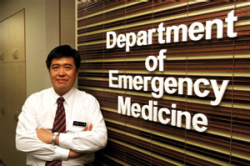
"I think if we can contribute, it can benefit not just the patients, but also the young doctors and medics in the service," said Clinical Associate Professor Lim Swee Han, Head of Department of Emergency Medicine at Singapore General Hospital (SGH), and a newly-appointed SAF VC.
For Dr Teo Wee Siong, being a VC takes away the boredom of doing the same things and seeing patients all day.
"I think it is useful, and what's more, the SAF is part of the Singapore institution," said the senior consultant from the National Heart Centre, who is into his second term as VC.
"We all have children who go for NS. My seven-year-old son will be doing that next time!"
Medics undergoing training to keep their skills up-to-date.
"What we can do as VCs is to contribute in our area of expertise and passion!"
- Assoc Prof Koh (above)
Good morning, sir
Transferring knowledge and skills is perhaps the most basic, yet most essential, role for VCs. They are regularly called upon to give lectures and to conduct courses for medical personnel in the SAF.
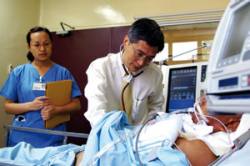
Assoc Prof Lim turns teacher to SAF medical officers (MOs) and senior medics once every few months. He gives training on advanced trauma life-support, acute cardiac care and the automated external defibrillation module at the School of Military Medicine at Nee Soon Camp.
"There's a lot of satisfaction. When you teach, you learn at the same time because it is interactive. They give you feedback or ask questions from an angle that you might never have thought of," he said.
"You also know how to be a better educator and use more straightforward and simple language."
Some of his other contributions include giving talks to MOs to explain the rationale behind the changes in cardio pulmonary resuscitation (CPR) guidelines in 2006 and helping to evaluate resuscitation facilities of all the SAF medical centres, as well as the drugs and equipment they carry.
Improving procedures and protocols
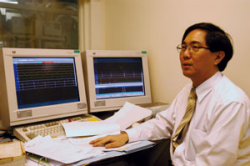
Another example of successful collaboration between VCs and MOs was the revision of the cardiac screening protocol in 2005. Dr Teo Wee Siong was part of a cardiac panel that suggested doing a simple electrocardiogram (ECG) screening for every enlistee that goes through the SAF ranks.
"I'm glad we decided to do it. A lot of armies don't," Dr Teo told PIONEER.
"We are not going to pick up every case and prevent every sudden death incident, but at least we must try our very best to prevent them."
"It is always a tragedy to have someone die suddenly, especially an 18-year-old son. So every time there is a question mark, we refer them for further investigation," he added.
Dr Teo was also quick to commend the successful resuscitation of an NSF who collapsed during overseas training earlier this year (see box story).
"The Army did very well. Because they brought along defibrillators, they saved the soldier s life," said Dr Teo, who started out doing cardiac screening during his NSF days in Medical Classification Centre (MCC) in 1983.
The way ahead
As for further cooperation in the future, MAJ (Dr) Lionel Cheng, Head Health Care, HQMC, said there are plans to involve the VCs in a greater capacity in the training of medical personnel and collaboration in research projects.
It is evident these plans are already underway, with Head of Department of Anaesthesia from Alexandra Hospital Clinical Assoc Prof Koh Kwong Fah looking at the use of simulators to train doctors. Dr Teo is working with MCC on a project to go through all ECG reports to see if they can pick up on some trends and incidences of anomalies, and to interpret them.
Dr Teo also suggested having more channels of interaction among the MOs and VCs, where they can correspond directly when certain expertise is needed.
"We can complement some of the things that the SAF is doing because different paradigms come in as the SAF is moves towards the third-generation force," said Assoc Prof Koh.
"What we can do as VCs is to contribute in our area of expertise and passion!"
Successful resuscitation
On 18 May, an NSF supply assistant was on his way to the cookhouse in an overseas camp when he collapsed. He was found to have no pulse and his breathing was irregular. No blood pressure reading could be taken.
Resuscitation was promptly carried out by unit MO CPT (Dr) Diwakar Davar and MO CPT (NS) (Dr) Ng Chee Yong.
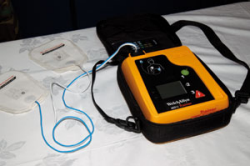
An ECG of the patient showed an abnormal heart rhythm (ventricular fibrillation) and three shocks were delivered via an automated external defibrillator (left). Following that, a normal heart rhythm returned.
He was then heli-evacuated to the local tertiary hospital where his condition remained stable.
Six days later, the patient was flown back to Singapore, escorted by CPT (NS)(Dr) Soh Chai Rick, an anaesthetist from SGH, and CPT (Dr) Diwakar Davar.
He was warded at SGH for further tests, and subsequently discharged.

ALSO READ IN OPS & TRAINING
Prime Minister Lawrence Wong observes SAF’s sense-strike integrated capabilities
09 Apr 2026
He witnessed the SAF’s ongoing efforts in leveraging advanced robotics and cross-Service integration to secure Singapore’s interests in an increasingly volatile world.
SAF detonates 250kg WWII bomb uncovered at Tanah Merah Coast Road
02 Apr 2026
On 2 Apr, the SAF’s Explosive Ordnance Disposal (EOD) team successfully disposed of an unexploded war relic found at Tanah Merah Coast Road.
Flying into the unknown: Inside RSAF’s mission to bring S’poreans home from Middle East
28 Mar 2026
Despite the risks and complex challenges of flying in a conflict zone, the men and women of the RSAF pulled off a successful mission through careful planning and hard work.