
OPS & TRAINING
FLIGHT OF THE TITANS
30 Dec 2008
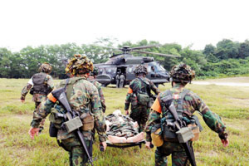
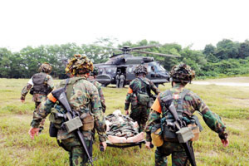
Talk about fighting uphill battles. One group has taken it higher to fighting real-life battles in mid-air, performing intensive-care life-saving procedures and monitoring at high altitudes within the confines of a helicopter. PIONEER looks at the men of 1 Medical Squadron (1MS) as they celebrate their achievement of Full Operational Capability.
In the age of medical science and technology, casualties in both peacetime and hostile operations "may now be kept to a minimum". This decrease can be attributed to the use of air assets such as helicopters and the application of damage-control surgery in attempts to lengthen the "golden hour" of casualties.
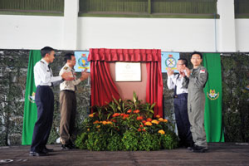
This was the view expressed by Chief of Defence Force (CDF), Lieutenant-General (LG) Desmond Kuek, at the 1MS Full Operational Capability (FOC) Declaration Ceremony on 24 Nov at Sembawang Air Base. The "golden hour" refers to the critical timeframe for medical intervention to preserve a person's life.
From its humble beginnings as a medical centre in 1971, providing health care at Sembawang Air Base, 1MS has grown to a full-fledged squadron capable of HEME (HEliborne Medical Evacuation) and Search And Rescue (SAR) operations.
Placed under the charge of 1MS is also the responsibility to raise, train and sustain men and women from the Singapore Armed Forces (SAF) to carry out HEME and SAR duties.
Getting into top shape
Attaining FOC was a formidable task that took years of preparation, with Major (Dr) Marcus Tan, 1MS's Commanding Officer, testifying to a rigorous training programme conducted during In-Camp Training.
The squadron is helmed mainly by Operationally Ready National Servicemen (NSmen) who are trained in critical care, as well as intervention measures such as Advanced Cardiac and Advanced Trauma Life Support.
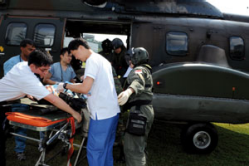
The training also saw the NSmen in helicopter simulations, performing Intensive Care Unit (ICU) type procedures on board the aircraft with equipment such as the Air Mobile Life Support Unit (AMLSU) II.
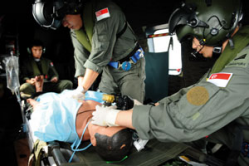
Unlike typical hospital settings, the doctors and medics of 1MS have to grapple with constraints such as the lack of space in the aircraft, and deafening noises generated by the aircraft which they counter with the use of a set of hand signals developed for communications during operations.
The FOC assessment, conducted in January this year, focused on how prepared the NSmen were for HEME operations. 1MS personnel were assessed on their ability to carry out HEME missions in both daytime and night-time.
Keys to success
The use of cutting-edge hardware played an integral part in 1MS attaining FOC. The AMLSU II is a sophisticated piece of medical equipment that has increased the operational capabilities of 1MS.
With it, the HEME teams are able to perform ICU-type monitoring and procedures on casualties within the helicopter, while transporting them from the field to a tertiary hospital.
The employment of such sophisticated equipment, however, does not reduce the role played by the "software" - the people factor. Echoing the words of LG Kuek - good hardware would be useless without good software to complement it - MAJ (Dr) Tan said: "We need to have a group of people with the set of skills to operationalise the AMLSU II, so both assets (hardware and software) are very important."
A more confident SAF
The unveiling of the FOC plaque, and the pinning of the 1MS badge by CDF at the declaration ceremony might have been a proud moment for many of the men in 1MS, but the significance of them obtaining FOC transcends the walls of the squadron and can be felt by the whole of the SAF.
With 1MS having achieved FOC, the operations can now be run like a "well-oiled machine".
"SAF combatants have increased confidence in the battlefield, knowing that we are able to bring them back in a safe and timely fashion," said MAJ (Dr) Tan.
This commitment to caring for soldiers is part of the SAF's core values. "For servicemen who lay down their lives for the nation, the nation must be willing to do everything possible to bring them back to safety," he added with firm resolve.
With HEME operations being a hallmark of 1MS, a peek into one such operation shows the HEME team making its way to the front line of the battle, where the Army mobile surgical team would have already assessed the casualties, and performed damage-control surgical intervention to lengthen the "golden hour".
The HEME team then transports casualties into the helicopters under the watchful eyes of the doctors and medics on board. Equipped with monitoring equipment, the team is ever ready to perform medical intervention should the casualties show signs of deterioration.
Upon arrival at a tertiary hospital, casualties are then handed over for further surgical and medical care.
Bridging a gap
As high profile as HEME operations sound, it is more accurately described by MAJ (Dr) Tan as a "complement to what the Army tries to achieve".
While the Army Medical Service does damage-control surgery first on casualties to stabilise them, there is no unit to transport casualties to tertiary hospitals for further surgeries in a timely fashion while ensuring the stability of their conditions during transportation.
This missing link is effectively plugged by the HEME team, which bridges the gap by performing medical monitoring intervention on casualties en route from the field to tertiary hospitals.
"Prior to FOC, we used to do mainly internal training, where we would board an aircraft and simply perform resuscitation. Now, our scope has widened and we can be incorporated into the Army's exercises," explained 1MS's Training Warrant, Master Sergeant Chua Choon Lin.
The seamless cooperation between the Army and 1MS "is another clear example of the ONE SAF integrated concept of operations", emphasised LG Kuek, and it serves as "a reminder that this working concept is applied (and works) even for back-end support operations."
A professional team
The series of accolades earned is no reason for 1MS to rest on its laurels and plans to develop AMLSU III are already in the pipeline.
"We're always trying to see what we can do to increase our capabilities in order to bring back more injured servicemen (when the need arises)," said MAJ (Dr) Tan.
Such is the professionalism of 1MS as it strives to be a medical squadron par excellence.
An ICU in mid-air
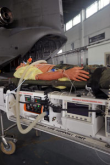
The Air Mobile Life Support Unit (AMLSU) II is an advanced aeromedical evacuation equipment that 1 Medical Squadron operationalises to carry out Intensive Care Unit-type procedures on board an aircraft.
Being rugged and compact, it houses every piece of equipment within a covering framework, helping doctors and medics cope with the tight spaces on board.
Should casualties show signs of deterioration, the AMLSU II is equipped with medical intervention equipment such as a cardiac defibrillator, a ventilator and infusion and syringe pumps to allow the HEME (HEliborne Medical Evacuation) team to perform Advanced Trauma Life Support and Advanced Cardiac Life Support procedures.
This ability of the AMLSU II improves the survivability of casualties, and in turn, significantly reduces the loss of lives in the field.
While the unit is used mainly in helicopters, it can also be configured for use in fixed wing aircraft.
The AMLSU II is designed to be self-sufficient, but for aeromedical evacuations over longer distances with a commute in excess of two hours, it can utilise the aircraft's battery supply, and be hooked up to larger air-certified medical oxygen cylinders.
The operational flexibility of the AMLSU II was demonstrated last year, when two severely injured servicemen were evacuated safely from Taiwan via a KC-135 aircraft.

ALSO READ IN OPS & TRAINING
S’pore commandos, Indonesia special forces train & strengthen ties at Ex Chandrapura
08 Jul 2026
From conducting tactical airborne jumps to a coordinated urban raid, soldiers from Singapore and Indonesia deepened their decades-long partnership in this bilateral army exercise.
SAF & Home Team to refresh Medical Classification System
13 Apr 2026
The refreshed system will allow about 1,200 servicemen annually to be deployed for vocations and roles they were ineligible for previously.
Prime Minister Lawrence Wong observes SAF’s sense-strike integrated capabilities
09 Apr 2026
He witnessed the SAF’s ongoing efforts in leveraging advanced robotics and cross-Service integration to secure Singapore’s interests in an increasingly volatile world.