
OPS & TRAINING
EAST SITE STORY
15 Jan 2005

Changi Air Base (East) is the newest installation for the Republic of Singapore Air Force (RSAF). PIONEER finds out why the air base's opening is significant and checks out some of its features and facilities.
Changi Air Base (East) is the first locally designed and developed RSAF air base.
Jointly developed by MINDEF, the RSAF and Defence Science & Technology Agency (DSTA), the air base is built on 200 hectares of undeveloped land in Changi East, and is an extension of the existing Changi Air Base (West).
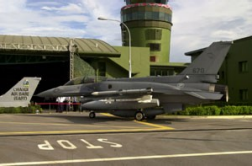
Changi Air Base (East) is home to about 400 RSAF personnel belonging to four squadrons, including 145 Squadron, which flies the F-16D Block 52+ Fighting Falcons.
These fighter jets have enhanced capabilities, including long-range fuel tanks and improved ground-mapping facilities.
Partners in time
Although the development of the base began in 1999, the construction of physical facilities started only in 2002.
According to Deputy Director of the Defence Construction Division in DSTA, Mr Ong Yew Hing (left), this was the main hurdle to overcome.
"Our key challenge was the short time frame given to develop the air base. We began building the physical facilities on the base in 2002 and completed it in 2004. This is a very short time for a project of this nature!"
The original plan was for the base to be completed in early 2005, revealed Base Commander, COL Andy Tan.
"But we (RSAF and DSTA) have been able to work closely together, so much so that we were able to begin operations on the air base in April 2004. So we are extremely pleased!" said COL Tan.
The RSAF and DSTA enjoy an ongoing partnership.
Mr Ong said: "We designed and built the base's facilities in a flexible manner, to allow us to incorporate any changes or new requirements. And there is likely to be more work to be done, so we will continue to build upon our good working relationship."
Go east
Minister for Defence, RADM (NS) Teo Chee Hean, who officiated at the base's opening ceremony on 29 Nov, described the inauguration as a "milestone event in the history of the RSAF".
"Changi Air Base (East) is a unique development," he said. "Its indigenous development allowed the RSAF to define the design to fully meet its requirements well into the third generation of the RSAF's development."
RADM (NS) Teo added: "Changi Air Base (East) enhances the RSAF's operational capability and readiness, for it provides greater operational flexibility and more deployment options for the RSAF's fighter assets."
Before the base's opening, the RSAF operated mainly from either Tengah or Paya Lebar air bases.
"Now, with Changi Air Base (East), the RSAF has the flexibility to launch and recover aircraft from all three bases," said COL Tan (left).
"This flexibility means the RSAF is able to maintain its readiness round-the-clock that much easier."
There are other benefits operating out of Changi Air Base (East). COL Tan said: "It provides the RSAF easier access to training areas over the South China Sea, noise pollution is reduced, and any risk to the populace is also minimised."
Size: About 200 hectares.
Runway: a 3,050m long and 60m wide runway (wide enough to accommodate a Boeing 747 plane), a 2,900m long- and 23m-wide taxiway parallel to the runway.
Home to: 145 Squadron, operating F-16 D Block 52+ Fighting Falcons, a Flying Support Squadron, an Air Logistics Squadron and an Airfield Maintenance Squadron.
Innovative solutions ensure effective, quick and safe operations on the new Changi Air Base (East). Here are five key features:
1) Aircraft arresting system
This is an important safety feature to facilitate safe landings or any unsuccessful take-off. In such emergencies, a two-tier hook cable is activated to latch onto the aircraft to reduce its speed and bring it to a safe stop.
If this fails, a barrier net system, installed at both ends of the runway, is triggered to slow the moving aircraft down.
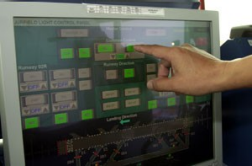
2) Airfield Lighting System and Supervisory Control and Data Acquisition (SCADA) system
SCADA keeps track of airfield lights and the base's power supply. 'Live' information of the airfield is presented clearly on an interactive, touch-screen panel located in the air traffic control tower.
Should there be a failure, the system's safety function will automatically restore the airfield lights, minimising disruption to flight operations and ensuring the safety of pilots and crew.
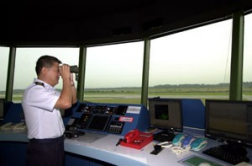
3) Ergonomically-designed control tower console
Crucial control functions on the console are within easy reach for operators.
Lighting and colours used in the room were chosen to optimise visibility, and to allow personnel to work more comfortably and efficiently.
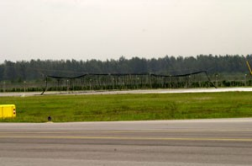
4) Anti-condensation system at air traffic control tower (right)
A system of dehumidifiers and pressure blowers prevents condensation on the glass panels of the air traffic control tower.
This allows personnel in the tower to see the runways clearly at all times, further enhancing flight safety.
5) Energy conserving lighting management system
During off-peak hours when road traffic is low, about 12km of street lights are automatically dimmed, resulting in 25 per cent savings in electricity use.





ALSO READ IN OPS & TRAINING

Prime Minister Lawrence Wong observes SAF’s sense-strike integrated capabilities
09 Apr 2026
He witnessed the SAF’s ongoing efforts in leveraging advanced robotics and cross-Service integration to secure Singapore’s interests in an increasingly volatile world.
SAF detonates 250kg WWII bomb uncovered at Tanah Merah Coast Road
02 Apr 2026
On 2 Apr, the SAF’s Explosive Ordnance Disposal (EOD) team successfully disposed of an unexploded war relic found at Tanah Merah Coast Road.
Flying into the unknown: Inside RSAF’s mission to bring S’poreans home from Middle East
28 Mar 2026
Despite the risks and complex challenges of flying in a conflict zone, the men and women of the RSAF pulled off a successful mission through careful planning and hard work.