
OPS & TRAINING
BEHIND THE BADGE: SPECIALISED SKILLS
06 May 2013
Ever wondered what some of these eye-catching metal accessories signify? In the last of a series on skills and proficiency badges, PIONEER checks out some of the more exclusive ones from the Singapore Armed Forces (SAF).
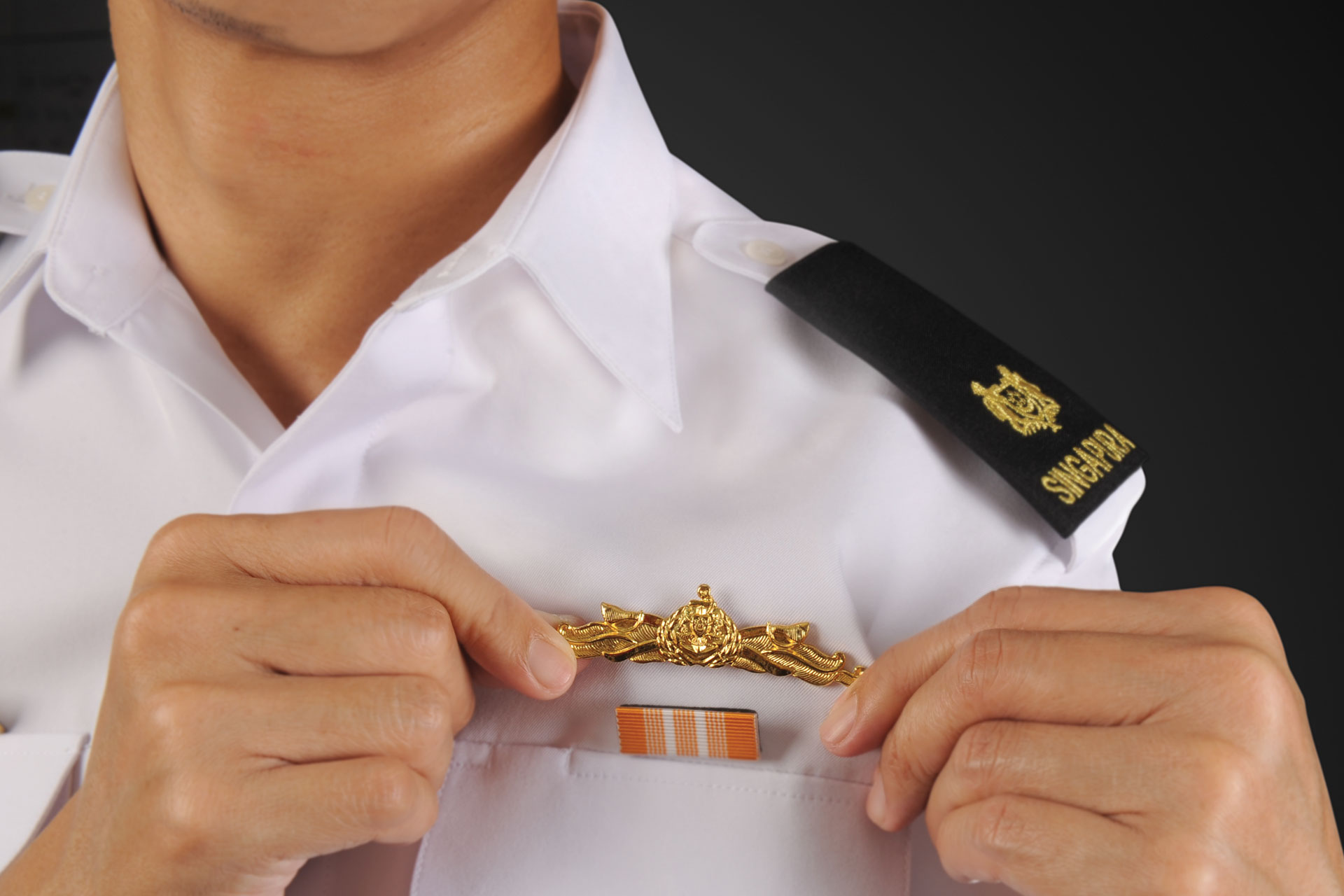
Ever wondered what some of these eye-catching metal accessories signify? In the last of a series on skills and proficiency badges, PIONEER checks out some of the more exclusive ones from the Singapore Armed Forces (SAF).
Naval Warfare Badge
 Who is eligible: All naval combat officers who successfully complete the Naval Advanced Officers' Course at the Naval Officers' Advanced School at SAFTI Military Institute. Officers must also have obtained the Bridge Watch-keeping Certificate (usually attained while under training on board ship after their commissioning) which qualifies them to con or drive a ship independently at sea. They must be fit for shipboard duties with Physical Employment Status (PES) C9N1 and above.
Senior Military Experts whose jobs would benefit from the Naval Warfare Officers' Course (NWOC) training may also be selected to attend the course.
What it takes: Candidates must attend and graduate from the NWOC in order to attain the Naval Warfare Badge. The course prepares officers for the role of Principal Warfare Officer on board a Republic of Singapore Navy (RSN) ship, Watch Controller in the RSN Operations Hub, or Tactical Coordinator on board a maritime patrol aircraft or naval helicopter.
The course syllabus comprises both theory and practical training in conventional warfare domains that range from anti-air, anti-surface and anti-submarine to land-sea warfare. Other topics include operations other than war, maritime security, naval intelligence as well as maritime law and conventions. Besides learning from briefings, case studies and scenario-based table-top exercises, participants conduct battle planning and mission execution at the Naval Warfare Simulation Centre and at sea.
Established in: 1996
Course duration: 19 weeks
Participants per year: The NWOC is conducted twice a year, with up to 20 participants per course.
Course pass rate: About 90 percent
Basic Parachutist Badge
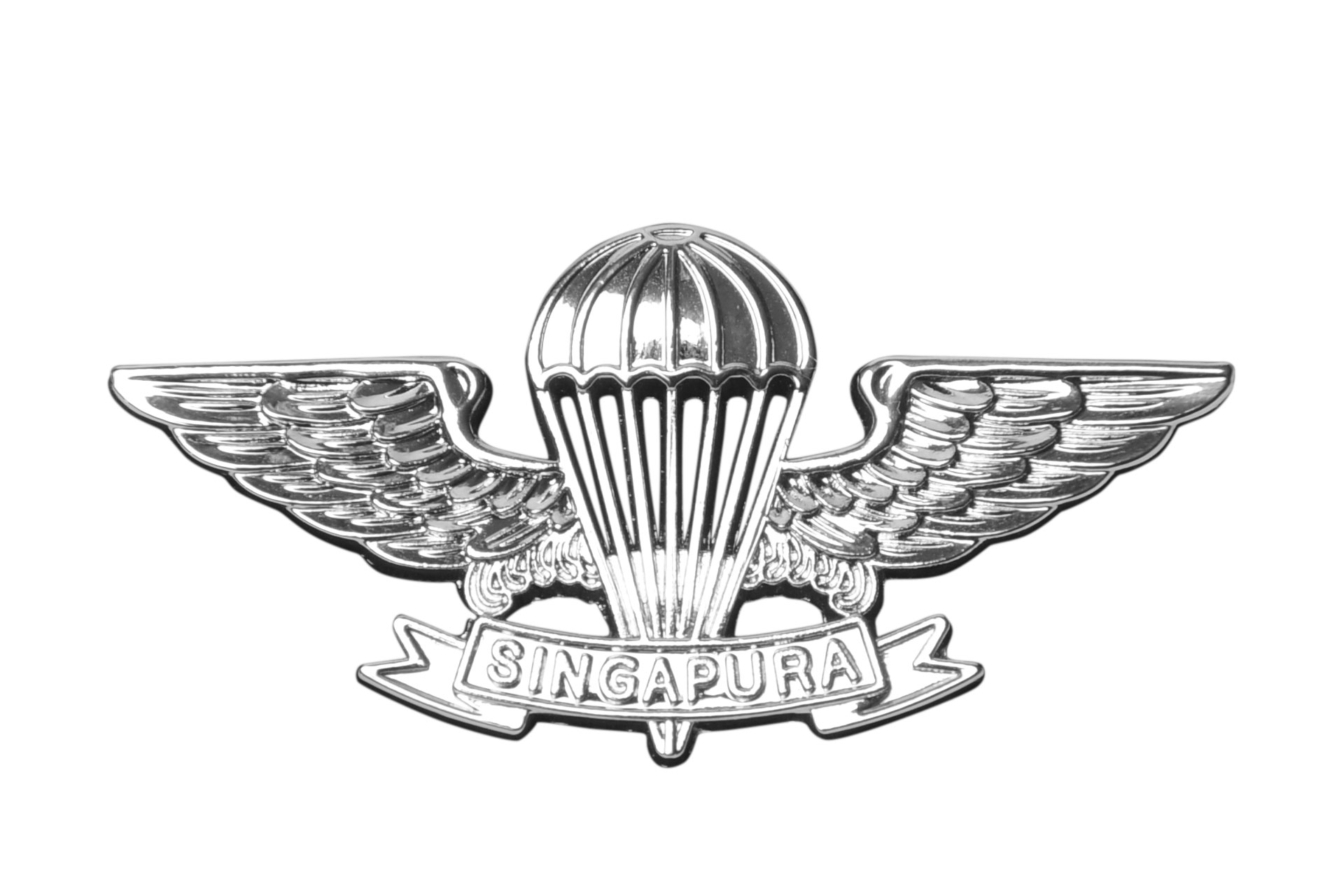
Who is eligible: The Basic Airborne Course (BAC) is open to all combat-fit (PES B and above) servicemen. Commando trainees must hold the rank of Private or above, while those from non-Commando vocations must hold the rank of at least Corporal.
What it takes: Before taking their first jump out of an aircraft in the air, each trainee must undergo 10 days of rigorous ground training in parachute drills.
This includes learning to don their parachute equipment; canopy controls and parachute landing falls when jumping from various heights; and executing emergency safety procedures such as activating their reserve parachute if faced with a mid-air malfunction. The make-or-break point of the course is a four-storey tower jump which will determine the trainees' suitability for parachute live descents.
After clearing their ground and tower jump evaluations, trainees will advance to jumping out of an aircraft at 1,000 feet above ground level. To be qualified as an airborne trooper, participants must clock three live descents (including two day jumps and one night jump). For Commando and Naval Diving Unit trainees, earning the badge requires an additional two live descents (one day jump and one night jump) with full combat load.
All jumps in the BAC are static-line jumps, where the parachute is deployed automatically when the trainee exits the aircraft.
Established in: 1974
Course duration: Three weeks
Participants per year: There are four BACs per year, usually with more than 150 participants each time.
Course pass rate: 95 percent
Silent Precision Drill Badge
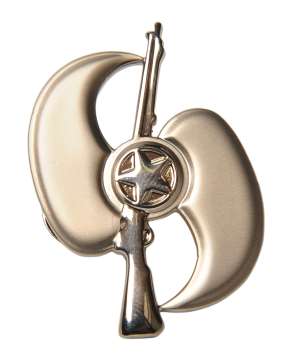
Who is eligible: Open to all combat-fit (PES B and above) Military Policemen.
What it takes: The Silent Precision Drill Squad (SPDS) members use the Mark IV, a 1.2m-long musket that weighs about 5kg, when executing their drills.
The Basic SPDS course is designed to build the participants' strength and psychomotor skills as well as to sharpen discipline and focus through rigorous physical training. Participants will execute continuous drill movements to develop muscle memory of the correct angle and posture. They also have to stay motionless at certain drill positions to cultivate the right posture and project a disciplined military image.
A board of senior instructors will assess participants on 21 different types of drills. Participants must execute a series of drills precisely to the beat of the music, while maintaining good body posture and moving accurately into different formations.
In the final assessment, they must put up a choreographed team performance of about four minutes. They will be evaluated based on various aspects, such as speed, accuracy and posture when executing the drills, as well as team coordination.
Established in: 1999
Course duration: Four weeks
Participants per year: The course is conducted twice annually, with 30 to 50 participants per course.
Course pass rate: About 90 percent

ALSO READ IN OPS & TRAINING


Prime Minister Lawrence Wong observes SAF’s sense-strike integrated capabilities
09 Apr 2026
He witnessed the SAF’s ongoing efforts in leveraging advanced robotics and cross-Service integration to secure Singapore’s interests in an increasingly volatile world.
SAF detonates 250kg WWII bomb uncovered at Tanah Merah Coast Road
02 Apr 2026
On 2 Apr, the SAF’s Explosive Ordnance Disposal (EOD) team successfully disposed of an unexploded war relic found at Tanah Merah Coast Road.
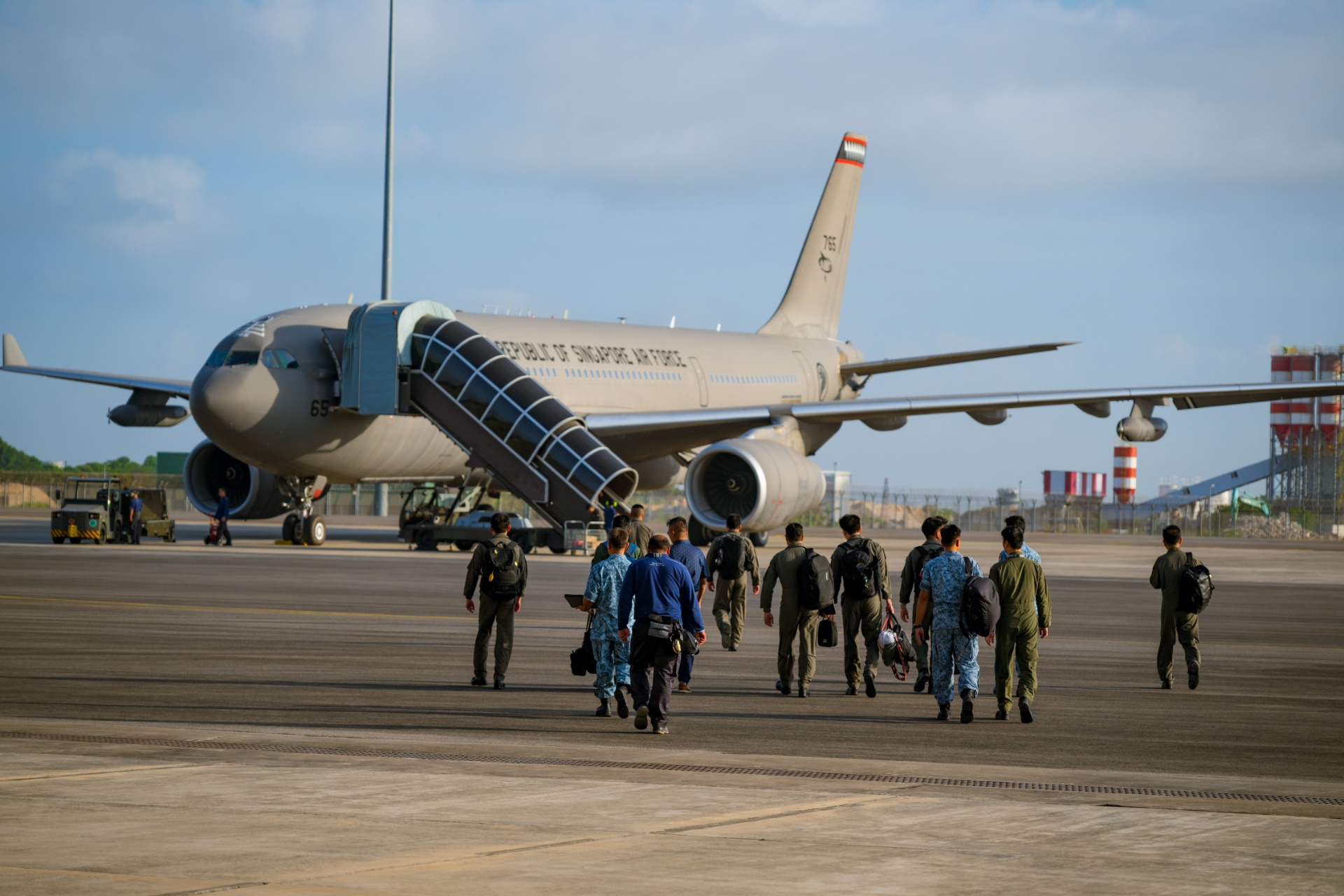
Flying into the unknown: Inside RSAF’s mission to bring S’poreans home from Middle East
28 Mar 2026
Despite the risks and complex challenges of flying in a conflict zone, the men and women of the RSAF pulled off a successful mission through careful planning and hard work.