
OPS & TRAINING
ASSISTANCE IN DISASTER
25 Jul 2006
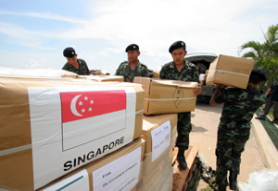
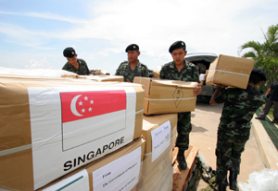
Two months after natural disasters hit northern Thailand and Central Java, the people there are still coming to terms with the tragedies. The earthquake in Central Java had claimed the lives of thousands and left many more homeless, while the flash floods in Thailand destroyed many villagers' houses and crops. The SAF responded by launching not one, but two humanitarian assistance and disaster relief (HADR) missions to Indonesia and Thailand - within 48 hours of each other.
Ask what Deputy Head Joint Operations (Current Ops) COL Tan Cheng Peng has been doing recently and you will most likely hear the words 'earthquake' and 'flood' brought up.
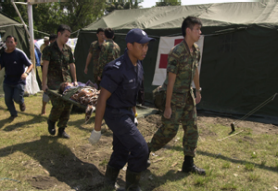
When the flash floods, caused by torrential rain, hit northern Thailand, a medical team and three CH-47 Chinooks were deployed as part of the ongoing HADR efforts there.
COL Tan led his officers at Joint Current Ops Group to spearhead the planning along with other Joint Staff departments, Service Operations department and Policy Office. That was 25 May, with the deployment taking place a day later.
On 27 May, their work had, quite literally, doubled.
An earthquake measuring 6.3 on the Richter scale struck Central Java, near Yogyakarta, a city full of history and cultural heritage. About 6,000 died from the quake and many were left without a home.
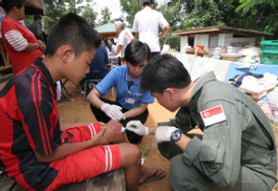
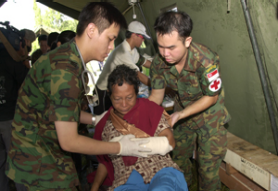
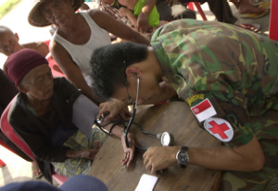
The SAF deployed a 35-member medical team on 28 May and an additional eight SAF doctors on 31 May to help the victims.
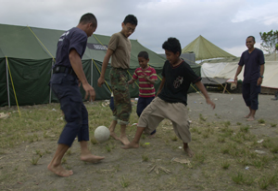
Working closely with personnel from the Singapore Civil Defence Force (SCDF) and the Indonesian authorities, the HADR team in Indonesia treated more than 1,400 patients and performed over 32 surgeries during the mission. They also found time to join the locals for a football game or two.
Balancing aid
CPT (NS)(Dr) Nelson Chua was one of the eight SAF doctors deployed on 31 May.
The anaesthetist with Tan Tock Seng Hospital was preparing for a holiday with his family to Bangkok the following week when news of the earthquake broke out. He eventually postponed the holiday.
"When I saw the suffering in the newspapers, I felt I could go and help," said CPT (NS)(Dr) Chua.
"I knew about this on Monday (29 May), but by that evening, I was already prepared."
Deployment of staff aside, a lot of effort was also required to pack humanitarian aid quickly.
"To help the SAF assess the needs and decide on what assistance to provide, we consulted the local authorities and monitored reports coming out of the affected areas," said COL Tan.
The HADR mission in Indonesia received approximately US$250,000 worth of humanitarian aid, while another US$50,000 worth of aid was delivered to Thailand.
The HADR team in Thailand worked closely with the local authorities in conducting missions such as transportation of basic necessities and providing medical assistance to affected areas.
All these were prepared overnight by the men at Army Logistics Base (ALB) and were quickly delivered to the Air Movement Centre. As a system was already in place, ALB was able to provide quick response - all within 48 hours.
Both HADR missions were completed successfully, and COL Tan attributed this to a high level of operational readiness and the professionalism of the men.
"Operational readiness and professionalism are crucial to the success of HADR missions as well as in war," said COL Tan.
When both teams returned from their respective missions, Minister for Defence Teo Chee Hean thanked them for their contributions.
"I wish to thank all of you on behalf of Singapore and all Singaporeans for the good work that you have done and for keeping the flag flying high," he said.

ALSO READ IN OPS & TRAINING
S’pore commandos, Indonesia special forces train & strengthen ties at Ex Chandrapura
08 Jul 2026
From conducting tactical airborne jumps to a coordinated urban raid, soldiers from Singapore and Indonesia deepened their decades-long partnership in this bilateral army exercise.
SAF & Home Team to refresh Medical Classification System
13 Apr 2026
The refreshed system will allow about 1,200 servicemen annually to be deployed for vocations and roles they were ineligible for previously.
Prime Minister Lawrence Wong observes SAF’s sense-strike integrated capabilities
09 Apr 2026
He witnessed the SAF’s ongoing efforts in leveraging advanced robotics and cross-Service integration to secure Singapore’s interests in an increasingly volatile world.