
OPS & TRAINING
ACHIEVING NEW HEIGHTS AT EXERCISE FORGING SABRE 2011
12 Oct 2012
The stillness of the night was abruptly broken by the tell-tale roar of F-16C/D and F-15SG fighter aircraft as they advanced under the cover of darkness. Just as swiftly as they appeared, the Republic of Singapore Air Force (RSAF) jets destroyed nearby enemy fighter aircraft to gain air superiority. The F-15SGs then launched lethal munitions on enemy headquarters to take it out with deadly accuracy.
At the same time, Unmanned Aerial Vehicles (UAVs) and Commandos on a surveillance mission discovered the unmistakeable movements of enemy artillery units and armour columns. After this information was relayed back to the Command Post, a strike package comprising F-16C/D, F-15SG and Apache attack helicopters was activated within minutes to destroy the enemy assets. Armed with precise information on the enemy's location as well as advanced munitions such as the Laser Joint Direct Attack Munition (LJDAM) and Hellfire missile, the RSAF aircraft achieved a swift and decisive victory.
This remarkable scenario is an illustration of a typical night mission during Exercise Forging Sabre, which is being conducted from 28 Nov to 11 Dec at Luke Air Force Base and the Barry M. Goldwater Range in Phoenix, Arizona, United States. More than 450 airmen and soldiers from Singapore and the RSAF's four training detachments in the US, as well as 25 RSAF aircraft, are involved in the exercise which is into its third instalment since it began in 2005.
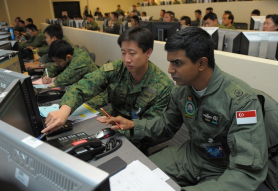
The exercise culminated in an integrated live firing on 9 Dec (US time) which was orchestrated by a Command Post comprising personnel from the RSAF and Army, and witnessed by Chief of Air Force Major-General (MG) Ng Chee Meng and other senior SAF officers. It saw an array of sensor and shooter assets working seamlessly to coordinate manoeuvres and engage targets with precision.
Speaking after viewing the live firing, MG Ng highlighted that the exercise allowed the SAF an excellent opportunity to validate its integrated strike capabilities in a realistic and challenging environment. He said: "I am very impressed by our people's combat proficiency, professionalism and dedication. I saw for myself today how our airmen and soldiers worked to bring together a sophisticated suite of both sensors and shooters, like our F-15SGs, F-16C/Ds and Apaches, to effect an integrated strike against a variety of targets, including mobile targets. This in itself is a very complex operation and I think they have done very well."
This year's Exercise Forging Sabre is unique in the introduction of enemy fighters and surface-to-air threats into the exercise scenario and the deployment of LJDAMs by F-15SG aircraft against mobile targets in day and night missions for the first time. The F-15SG aircraft also made their maiden appearance at the exercise.
Besides employing precision weapons during night missions, Exercise Forging Sabre 2011 also saw smart munitions accounting for about 75 percent of all munitions involved.
Elaborating on how Exercise Forging Sabre 2011 is one of the largest and most complex SAF exercises conducted in the US, Exercise Director and Commander, Air Combat Command, Brigadier-General (BG) Lim Yeong Kiat said: "For this year's exercise, by putting all the elements of 2005 and 2009 together to further develop our integrated strike capabilities, we have increased both the scale and complexity of the exercise.
"We will simulate a war game scenario where we have a "red" team acting as the opposition, as well as a "blue" team which will have to develop an operational plan against them. The "blue" force will have to contest for the airspace, and fight and win air superiority. They will also have to conduct dynamic targeting to destroy military targets such as enemy capabilities as well as dent their will to continue to fight with us."
BG Lim also noted that because of Singapore's land and airspace constraints, overseas exercises such as Forging Sabre are important in meeting the SAF's training requirements. In particular, the Barry M. Goldwater Range, which measures about twice and thrice the size of the ranges where the 2005 and 2009 instalments of Exercise Forging Sabre were held respectively, is also about 19 times the size of Singapore.
"It gives us a vast airspace in which to marshal and manoeuvre our forces, as well as a wide array of realistic targets for us to train against, ranging from airfields to military targets such as headquarters, armoured vehicles, artillery pieces and urban ranges," added BG Lim.
Explaining the challenge of engaging a mobile target, Air Exercise Director and Head, Integrated System Development Group, Colonel Tan Yik, said: "Engaging a mobile target is significantly different because of the guidance required to anticipate a mobile target's movements. As compared to a static target which does not require constant updates to its coordinates, a mobile target's impact coordinates need to be constantly updated in real-time until impact."
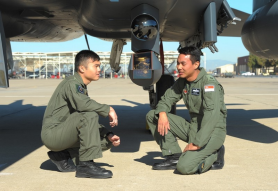
Close teamwork between an F-15SG pilot and Weapon Systems Officer (WSO) is crucial in ensuring the swift deployment of the LJDAM. The WSO verifies that the coordinates keyed into the LJDAM are accurate before the pilot triggers its drop.
Describing the smart terminal guidance capabilities provided by the LJDAM, Major (MAJ) Mark Tan, an F-15SG pilot from the RSAF's Peace Carvin V training detachment and an exercise participant, pointed out: "Once the bomb is programmed prior to release, its own smart logic will take it all the way to impact."
Commanding Officer of Peace Carvin II, Lieutenant Colonel (LTC) Low Say Sim, said that training in the US allows RSAF personnel the benefit of participating in large-scale multilateral exercises such as Red Flag to hone their flying capabilities. He explained: "The size of the airspace lets us put more aircraft in the sky at one time, so that we can train in a large-force employment."
Agreeing with LTC Low, Captain Tan Guan Jin, a WSO with the RSAF's Peace Carvin V training detachment, added: "By training and interacting with personnel from the US Air Force who have valuable combat experiences, my colleagues and myself have learnt much from them and it has contributed to our ability to enhance our competencies in a shorter span of time."
The Forging Sabre series of exercises is a testament to the excellent and long-standing defence relationship between Singapore and the US. Apart from supporting the conduct of training exercises such as Forging Sabre, the US also supports the RSAF's F-15SG, F-16C/D, Apache AH-64D and Chinook CH-47 aircraft training detachments in the US.
View More Photos at our Photo Gallery
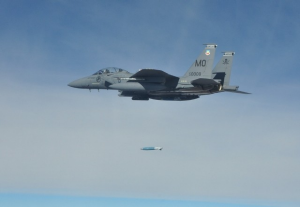
Laser Joint Direct Attack Munitions (LJDAMs)
The Boeing-developed LJDAM is essentially an enhanced version of a JDAM guidance kit, and comes with a laser seeker that provides terminal guidance and improves precision accuracy. It converts an unguided bomb into an accurately-guided, all-weather "smart" munition and can be launched 15 nautical miles from its target.
Like the JDAM, an LJDAM comprises a Global Positioning System and Inertial Navigation System fitted at the tail end of the bomb body as well as aerodynamic body strakes to provide additional stability and lift.

ALSO READ IN OPS & TRAINING

SAF & Home Team to refresh Medical Classification System
13 Apr 2026
The refreshed system will allow about 1,200 servicemen annually to be deployed for vocations and roles they were ineligible for previously.
Prime Minister Lawrence Wong observes SAF’s sense-strike integrated capabilities
09 Apr 2026
He witnessed the SAF’s ongoing efforts in leveraging advanced robotics and cross-Service integration to secure Singapore’s interests in an increasingly volatile world.
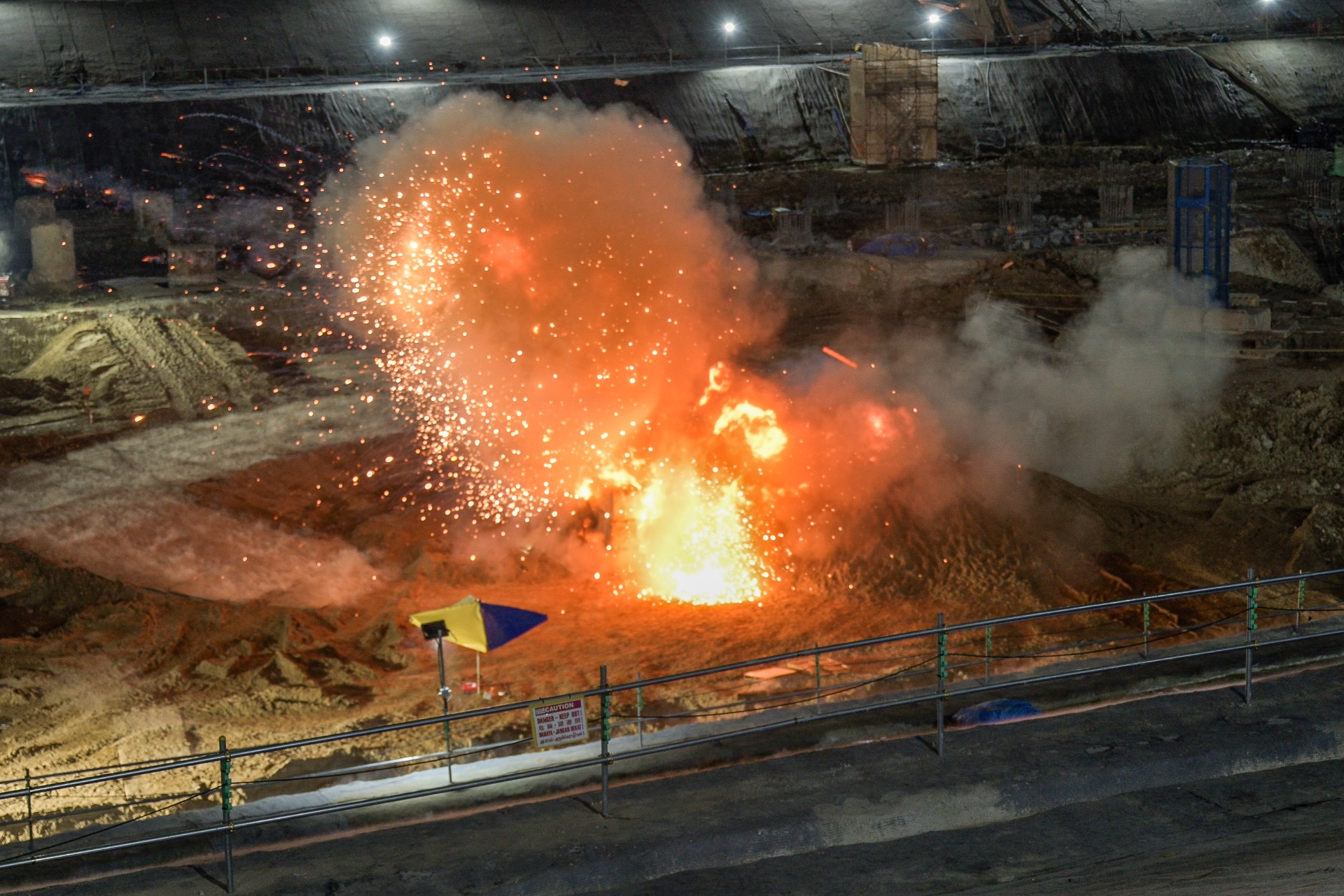
SAF detonates 250kg WWII bomb uncovered at Tanah Merah Coast Road
02 Apr 2026
On 2 Apr, the SAF’s Explosive Ordnance Disposal (EOD) team successfully disposed of an unexploded war relic found at Tanah Merah Coast Road.