
MILESTONES
YOUNG SCIENTISTS INNOVATE IN DEFENCE RESEARCH
30 Mar 2011
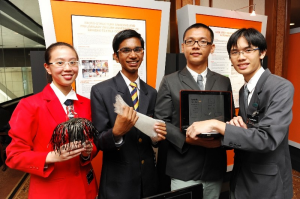
Faster, lighter, stronger.
These are the attributes of the breakthrough enhancements discovered by two of the most outstanding student research teams which participated in a research scheme under the Young Defence Scientist Programme (YDSP).
The teams, which spent the past four months working on their projects under YDSP's Research@YDSP programme, presented their research findings at the annual YDSP Congress held this year at Orchard Hotel on 30 Mar.
The National University of Singapore High School of Mathematics and Science team's research seeks to strengthen the security and robustness of software by helping programmers and security analysts test against malicious attackers and find bugs more effectively.
This improvement is achieved through an algorithm that boosts the processing speed of existing software error detection program KLEE.
The algorithm, developed by 18-year-olds Li Xuanji and Kuan Xiang Wen as an extension to the current state-of-the-art bug-testing program created by Stanford University, has the ability to assess larger and more complicated programs faster and with less required memory than before.
Innovation was one of the reasons the team got through, as they had a minimal understanding of the topic before they embarked on the project. Said Xiang Wen: "We started out on a clean slate with nothing but our initial knowledge on computer programs. Naturally, the ideas and methods we chose from were either created from scratch or developed from other open-source software concepts."
Deputy Prime Minister and Minister for Defence Teo Chee Hean, the guest of honour at the event, said Singapore's survival and progress is intertwined with its ability to find innovative solutions to overcome the inherent challenges in geo-strategic limitations such as resources, manpower and space.
Speaking to the student participants in his keynote address, Mr Teo said: "The YDSP aims to inspire and bring out the innovator in you. It goes beyond textbook learning in the different scientific fields of Physics, Chemistry, Mathematics and Computer Science, and seeks to channel your strong interest and passion in these areas into creative and practical solutions for challenging defence problems."
He cited examples of defence engineers and scientists building up the capabilities of the Singapore Armed Forces (SAF) through innovation, which include the development and enhancement of Singapore's own mini-Unmanned Aerial Vehicle that allow better communication and control of the aircraft system during reconnaissance and surveillance missions.
The research findings of the second team, which comprises 17-year-olds Prakash Prashanth from Anglo-Chinese School (Independent) and Chong Bing Shen from River Valley High School, can eventually be applied in the design and manufacture of stronger and lighter protective equipment, such as light armour, helmets and riot shields.
The duo had researched on the numerous factors that would affect the tensile strength of braided textile composites, a type of fibre material used widely in aerospace and various other industries.
Established in 1992 by the Defence Science & Technology Agency and DSO National Laboratories, YDSP aims to cultivate interest in defence science and technology. It encompasses a diverse range of activities including Research@YDSP, YDSP Science & Technology Camp and World of Science lectures and laboratory sessions.
The congress marks the culmination of the YDSP activities held over the past year, which saw over 400 secondary school and junior college students taking part in the programme to explore science beyond the classroom, and to gain first-hand knowledge under the mentorship of defence engineers and scientists.
At the congress, Mr Teo also presented the YDSP scholarship to 31 third-year Integrated Programme students who excelled in their studies and co-curricular activities. Another 60 students, who achieved outstanding results in Physics and Mathematics, received the YDSP Academic Awards. These awards serve to recognise and motivate students with the interest and the capability to contribute to defence science and technology.

ALSO READ IN MILESTONES


Answering the call to defend Singapore
21 Jan 2026
The Weapon Presentation Ceremony represents a powerful moment when recruits are entrusted with their rifle and begin carrying the weight of the nation’s defence.

Navy launches 1st Multi-Role Combat Vessel
21 Oct 2025
The Multi-Role Combat Vessel will function as a mothership for the command and conduct of unmanned naval operations.
-dsc_2181.jpg?sfvrsn=cf9c6464_2 "1) DSC_2181")
What you need to know about the new CMPB
14 Oct 2025
The new Central Manpower Base (CMPB) at Bukit Gombak officially opened its doors on 14 Oct, welcoming pre-enlistees, servicemen and the public alike to a state-of-the-art, one-stop hub for all things National Service (NS).