
COMMUNITY
UP IN ARMS
30 Oct 2007
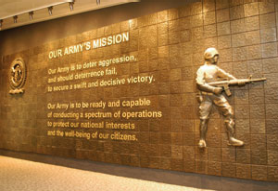
More than just an archive, the new Army Museum of Singapore (ARMS) celebrates the work of pioneering soldiers and inspires Singaporeans to build on their legacy of peace and security. PIONEER checks out its three-storey home on Upper Jurong Road.
Strong wind from an oncoming chopper blows through your hair. Your face gets slightly damp after a fleet of inflatable boats rushes across the sea. After sudden flashes of light, your nose picks up the whiff of freshly-fired artillery shells.
In five minutes, you can know what a battlefield would look, feel and smell like, all in the comfort of the Object Theatre, a highlight of the new Army Museum of Singapore and the only one of its kind in the country.
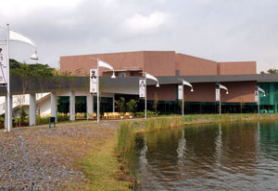
Located near SAFTI Military Institute and the S pore Discovery Centre, the museum was officially opened by Prime Minister Lee Hsien Loong on 27 Sep.
Its three-storey home, designed and built by the Defence Science & Technology Agency (DSTA), was completed in just over a year. Its roof, buttressed by three rock-like units, echoes the nearby lake in a broad arc rising from the ground, symbolising the Army s quest for growth while staying true to its roots.
"What the museum captures and conveys is the fighting spirit and the will of our soldiers, and all the Singaporeans who stand behind them," said Minister for Defence Teo Chee Hean.
"This is the true strength of the Army. This is why the Army Museum is dedicated to our soldiers: the soldiers of the past, the soldiers of the present and the soldiers of the future."
Rough race to the finish
As early as 1977, then-Defence Minister Goh Keng Swee proposed setting up a military heritage complex, an idea that took almost 30 years to take off.
The job of designing the museum fell on DSTA senior architect Pauline Ang in 2005, who wanted a structure that would best express the Army's goals and integrate as much of the surrounding landscape and sunlight as possible.
"I tried very hard to stay away from the very 'closed' look that many museums have, so I incorporated courtyards and views to the surroundings wherever possible," said Ms Ang, who inserted pockets of greenery within the building as well.
She also wanted the museum to be a public space for people to "stroll in unconsciously" and hang out without having to enter the galleries. In line with this thought, much of the site's initial flora was preserved.
While it was finished on time, a few unusually wet months and the sand ban earlier this year threatened to delay construction. DSTA, said programme manager Tang Tat Wah, worked closely with contractors to play catch-up, aided by a stockpile of basic materials.
"These factors were not favourable when we had such a tight deadline, but we had a very experienced team, so we analysed the issues and guided everyone else accordingly," said Mr Tang.
Meanwhile, the museum collected close to 500 sets of artefacts from National Servicemen who donated their keepsakes, and from the vaults of formations and divisions within the Army.
Journey through history
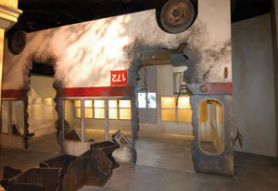
Inside, six galleries chronicle the Army s progress from its early years to the present, with rooms that reflect its operational achievements and future possibilities.
The Army's story, said Head Army Museum Project LTC Kenneth Liow, is the spine on which tales of NSmen are layered: their spirit and commitment, their rite of passage, their shared mission and values.
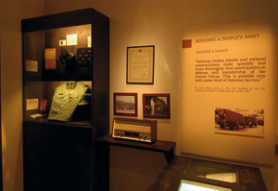
There are replicas of bygone sites, such as the first Ministry for the Interior and Defence office, where you can see the 1967 NS (Amendment) Bill and listen to then-Prime Minister Lee Kuan Yew speak about the necessity of NS.
A mock-up of a Pulau Tekong bunk of the 1970s comes complete with furniture and equipment from that era. Through the slatted window, old black-and-white footage shows recruits training to the tune of their own rhythmic singing.
Visitors can also get some hands-on with a variety of interactive exhibits, including an unmanned aerial vehicle and a shooting game based on the Individual Marksmanship Trainer used in Basic Military Training.
"To round off the museum experience, we wanted something emotive that would convey the enduring nature of NS; how it transcends generations and brings our people together," said LTC Liow about the last gallery, which screens a 10-minute film made specially for the museum by local director Royston Tan.
"Tan's concept, in terms of scripting and cinematography, captures these elements best. His personal passion for the project reflects his own support for NS."
This, however, does not mark the end of the Army's history. "The museum still has some way to go to impart the full richness of the Army's heritage and the NS experience," added LTC Liow. "We welcome feedback, contributions and stories from the public."
In the last gallery, Royston Tan s short film After the Rain depicts the enduring nature of NS.

ALSO READ IN COMMUNITY
S’pore Airshow 2026 takes flight
05 Feb 2026
The Singapore Airshow marks its 10th edition and 20 years of contribution to the global aerospace, defence, and space sectors.
How to survive an NS relationship
03 Feb 2026
Do NS relationships really last? Is getting your girlfriend “stolen” when you’re in Basic Military Training just a myth? Here’s some advice from Singaporeans!
RSAF returns with dazzling aerial display at S’pore Airshow 2026
31 Jan 2026
Visitors to this year’s Singapore Airshow can look forward to 17 thrilling manoeuvres performed by the RSAF’s F-16C fighter jet and AH-64D Apache attack helicopter, and a static display of 10 different assets.