
COMMUNITY
TOP OF THE TREES
28 Feb 2005
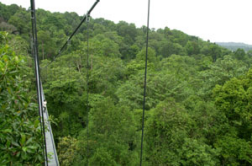
Strolling along the beach and taking a leisurely walk in the park are so last millennium. The new thing-to-do is walking among the tree-tops. cyberpioneer checks out THE walk at the Central Catchment Nature Reserve (MacRitchie).
I have never gone hiking before. Neither have I been to the Central Catchment Nature Reserve (MacRitchie).
So when I heard about the HSBC TreeTop Walk at MacRitchie, I knew it was high time (pun intended) to loosen up my stiffening bones.
Seeing the wood for the trees
Tree-top walking isn't as easy as it appears.
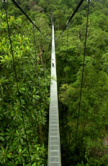
To get to the Tree-Top Walk, where a 250m long free-standing suspension bridge awaits, I had to cover about 5km. After reaching the bridge, it was another 5km back to the starting point.
A 10km walk (or more, depending on the route chosen) for someone who hardly exercises is no joke. But I wasn't about to back out - the desire to be among the tree-tops outweighed the tremendous amount of distance I had to trek.
I set off along the blue route (MacRitchie Nature Trail) and embarked on my hike, donned in walking gear and armed with drinking water.
It was a cool and quiet weekday morning, with a handful of joggers and hikers along the way.
Lots of trees like the fig, bamboo, the Jelutong, liana (woody climbers), ferns and palms lined the trail, with many fallen leaves carpeting the ground. Rays of sunlight shone through the thick canopy formed by the trees.
It was a refreshing environment away from the hustle and bustle of the city (not to mention the busy office!).
According to Mr Benjamin Lee, Senior Conservation Officer of the Central Nature Reserve (National Parks Board), the Central Catchment Nature Reserve, measuring 3,043 hectares, contains about 1,600 species of flora (vascular plants).
As for vertebrate fauna (fish, amphibians, reptiles, birds and mammals), some 400 species have been identified. There are simply too many invertebrate fauna, such as insects, to put a number to. I found these figures astounding - I never knew our nature reserves contained such rich natural heritage.
And how can I forget the monkeys?
I caught sight of two but they were long gone even before I could whip out my camera. If you are thinking of feeding them - DON'T. There are signs around the reserve reminding visitors not to feed them as this would affect the forest ecosystem.
These monkeys depend on the fruits of trees and plants for survival. In turn, they help ensure the continuity of the rainforest when they disperse the seeds of the fruits. This is how nature works. Besides, (over)feeding the monkeys could be detrimental for their health!
Be nurtured by nature
One good thing about the trail was that the ascent was quite gentle. It took some effort on my part but it wasn't overly taxing.
After two hours, I reached the Ranger Station, where clean toilet facilities and a water cooler are available.
Once I had freshened up, I was on my way up a slope on the Peirce Track. This part of the walk was significantly more taxing.
As I huffed and puffed my way up, stopping at intervals for breathers, I wondered whether I was going to make it! But I trudged on with determination as I knew the bridge was nearing.
Halfway up the Peirce Track is a newly built wooden stairway leading to the bridge and I skipped down the steps.
Then, almost immediately, the huge suspension bridge appeared right in front of me. The bridge connects the two highest points (Bukit Peirce and Bukit Kalang) in MacRitchie. As I stepped onto the 0.8m-wide bridge excitedly, refreshing wind blew into my face.
The height from the forest floor varies, with the highest point 25m up. I sauntered along the narrow walkway to the middle, which is supposed to be the highest point.
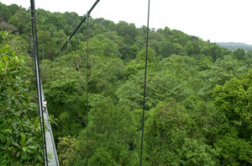
The mass of greenery that can be seen from here is revitalising. I was shoulder-to-shoulder with the tree-tops, and higher than many others! From the bridge, you can even touch some of the trees' leaves. Looking out into the distance, I could see parts of Upper Peirce Reservoir.
The suspension bridge, made of metal and ropes, is very sturdy. It sways slightly from side to side only when you make big heavy steps or when the wind blows strongly. Standing on the bridge among the tree-tops was a calming and soothing experience.
I didn't see any birds flying around, but if you are lucky, you could catch sight of forest birds like the Drongo Cuckoo, Asian Fairy Blue Bird or reptiles like the Clouded Monitor.
Since it opened last November, the Tree-Top Walk has undoubtedly become an attraction, with some 15,000 visitors to date. The first of its kind in Singapore, the bridge has been built as another recreation place for nature lovers. At the same time, I learnt that it is an important avenue for research in forest canopy.
I breathed in as much fresh air and absorbed as much greenery as I could, and finally made my way back on the Petaling Trail. Although the bulk of the hiking trip was spent going through the MacRitchie nature reserve, the view and feeling of being on the bridge certainly made the walk worthwhile.
If you are running out of ideas for a family, friends or even lovers' outing, put on your hiking gear and head for the Tree-Top Walk. It's the perfect activity, which everyone can do since it doesn't require any specific skill. Best of all, it's free. And remember, bring nothing home, leave our natural heritage intact!
The Tree-Top Walk is open from 9am to 5pm. Last entry is 4.30pm. It is closed on Mondays (except public holidays) for maintenance and research work.
Admission is free. Visit www.nparks.gov.sg for more information.

ALSO READ IN COMMUNITY

Your backstage pass to NDP 2026
06 Aug 2026
Ever wondered what goes on behind the scenes of NDP? We take a peek behind the curtain to uncover the hard work that this year’s performers have put in since rehearsals began months ago.

What it takes to be a viral NDP mascot
25 Jul 2026
They’ve been stealing hearts as the lovable mascots at the National Day Parade (NDP). Meet the NSFs behind the costumes and high-energy dance moves.
State Flag Flypast charts new path
05 Jul 2026
For the first time, the State Flag Flypast will fly over the Kallang Basin, bringing this NDP tradition to new audiences.