
MILESTONES
SISPEC GETS NEW NAME AND STRUCTURE
30 Apr 2010
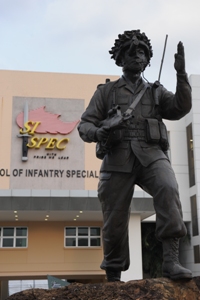
Gone were the days when thousands of Singapore Armed Forces (SAF) soldiers at the School of Infantry Specialists or SISPEC took guidance from the leadership of one commander.
The training institute, tucked in a quiet corner within walking distance of the parade square in Pasir Laba Camp, has been restructured into three Specialist Cadet Schools (SCSs) and one Specialist and Warrant Officer Advanced School (SWAS).
This reorganisation came into effect on 13 Apr, when the newly appointed commanding officers of the SCSs and SWAS took on their new roles at an assumption of command parade held at Pasir Laba Camp.
Explaining the rationale for the restructuring, Lieutenant-Colonel (LTC) Luis Phay who is the Deputy Commander of the Specialist and Warrant Officer Institute (SWI) and the former Commanding Officer of SISPEC, said: "We wanted to increase the quality of supervision because if you want to produce good leaders, then you'll have to be prepared to give quality supervision."
Previously, one commanding officer was responsible for all 12 companies and the Advanced Section Training Wing in SISPEC. Now, there is enhanced supervision and mentorship with three commanding officers taking charge of four companies each in the SCSs and a commanding officer fully dedicated to the SWAS.
With the SCSs, the idea of a centralised teaching strength was mooted. Depending on their specialisations, instructors are either placed in the command team which develops cadets' behavioural competencies comprising soft skills such as leadership qualities and commitment to defence, or the faculty team which imparts outfield and technical skills.
In terms of the name change, LTC Phay told cyberpioneer that much thought had gone into establishing the distinct identity and purpose of the specialist training school.
"The name SCS tells you that you are at the specialist, at the corps level, at the leadership level, rather than infantry-centric as reflected in the previous name. And it's important for a leadership school like us. We are nurturing leaders for the entire SAF," he added.
This is in sync with the SWI's mandate of caring for the professional development of all warrant officers and specialists in the SAF. SWI is home to the SCSs, the SWAS and the SAF Warrant Officer School.
While instructors at the former SISPEC conducted the Basic Section Leader Course and the Advanced Section Leader Course aimed at grooming junior specialists, the SCSs of today boast holistic training with a three-term approach that make up the Specialist Cadet Course (SCC).
The SCC comprises a foundation term where cadets first receive common training which involves honing their leadership skills and developing their combatant competencies. This is followed by a professional term where cadets undergo specific vocational training before culminating in a combined arms term where cadets learn about Combined Arms Operation through experiential sharing and immersion.
With a richer curriculum, the SCSs will look into bringing the best learning sciences and learning strategies to make learning more interesting and purposeful. Learning strategies such as "collaborative learning", will see cadets carry out their own self-directed learning before engaging in small group discussions and concluding with a presentation.
Cadets share their knowledge with each other and learn more in less time. This marks a sharp departure from past pedagogies where content quality was solely determined by the instructor who is considered to be the knowledge authority.
Leveraging on information technology is also a key feature in the revamped curriculum. Cadets are each assigned with a laptop that contains the "textbooks" and are wired up so that they have access to the internet.
"It's no longer about learning from the instructor but learning with the instructor. The instructor cannot monopolise knowledge but has to co-construct knowledge," shared LTC Phay, who was part of the team that oversaw the transformation of SISPEC.
With the revamp of SISPEC, LTC Phay believes that the leadership school is better primed to manage changes because it now has "more hands on deck with better supervision".
He said: "We not only have more people in the team but quality people in the team so that makes us more nimble and flexible to manage changes."
The restructuring of SISPEC is among the slew of changes introduced to the SAF's warrant officer and specialist corps in recent years - such as the introduction of the specialist cadet rank in December 2008 - to better recognise their roles as commanders.


ALSO READ IN MILESTONES

Answering the call to defend Singapore
21 Jan 2026
The Weapon Presentation Ceremony represents a powerful moment when recruits are entrusted with their rifle and begin carrying the weight of the nation’s defence.
Navy launches 1st Multi-Role Combat Vessel
21 Oct 2025
The Multi-Role Combat Vessel will function as a mothership for the command and conduct of unmanned naval operations.
-dsc_2181.jpg?sfvrsn=cf9c6464_2 "1) DSC_2181")
What you need to know about the new CMPB
14 Oct 2025
The new Central Manpower Base (CMPB) at Bukit Gombak officially opened its doors on 14 Oct, welcoming pre-enlistees, servicemen and the public alike to a state-of-the-art, one-stop hub for all things National Service (NS).