
MILESTONES
PUTTING THEIR MINDS TO DEFENCE
25 Mar 2014
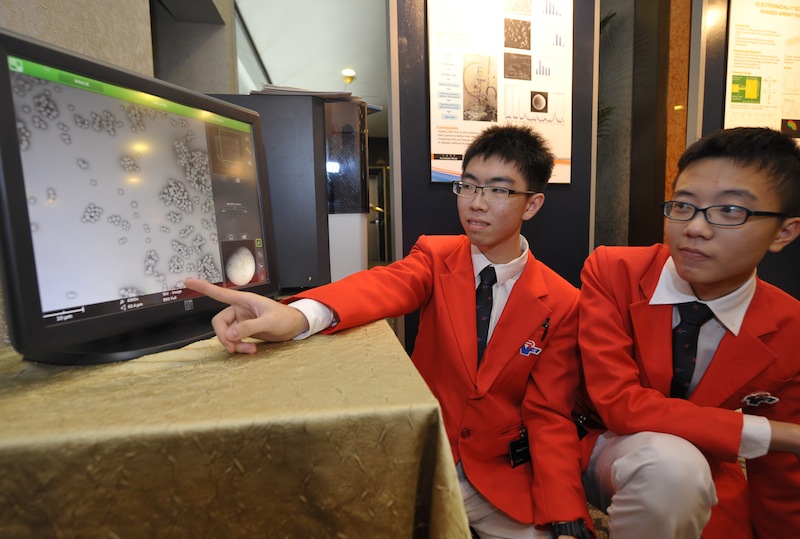
From a love of dinosaur and sci-fi stories in his childhood sprang a mind deeply intrigued by the mysteries of science. At 17, Xia Chen Hao from River Valley High School is already contemplating next-generation materials to protect soldiers in the heat of battle.
Together with team-mate and school-mate Zhong Zhiming, the duo created a process to produce reliably uniform zirconia microspheres which could one day find their way into ballistic vests on the backs of soldiers and material that protects satellites from space debris. Using their process, Zirconia particles 50 times thinner than a human hair can be produced.
"Current methods (of producing Zirconia particles) are costly and they don't produce uniform spheres," explained Chen Hao.
Zirconia is a ceramic which shows promise as a protective material. It is known to be hard and resistant to fracturing among ceramics. The problem is that it needs to be processed into uniform spheres small enough to resist cracking before it can be used in the real world.
Chen Hao presented his team's research findings at the Young Defence Scientists' Programme (YDSP) Conference at the Orchard Hotel on 25 Mar. Theirs is one of the projects under the Research@YDSP challenge which puts promising young minds under the mentorship of research staff and professionals in Singapore's defence science community.
Speaking at the event, Minister of State for Defence Dr Mohamad Maliki Bin Osman said: "The YDSP has, for many years, provided a means for our youth to discover the important role of technology, not just in our everyday lives, but critically, for the defence of Singapore."
Dr Maliki presented YDSP scholarships to 29 students this year and YDSP academic awards to 59 students for exceptional results in Physics and Mathematics. The YDSP is an initiative by the Defence Science & Technology Agency (DSTA) and DSO National Laboratories, which aims to stoke students' interest in defence science and technology.
In his keynote address, Dr Maliki reminded the 450-strong crowd of the importance of defence technology. "The challenge for our defence scientists and engineers is to prepare the Singapore Armed Forces to meet its future challenges and operational needs," he said.
Citing examples such as the Air Force's F-15SG fighter aircraft, Dr Maliki said without the work of Singapore's defence scientists, the F-15SGs would not be as capable as they were today. "Our DSTA engineers upgraded the aircraft with the latest avionics, sensors and advanced weapons," he said.
Other projects by the students looked at ways of using smartphones to allow soldiers to pinpoint accurately their locations in indoor environments where traditional location technologies are unavailable. Meshing together a technique used in robotics, the pair from NUS High School of Mathematics and Science - Garret Tok and Girish Kumar - found a way to use the existing sensors found in today's smartphones to map indoor positions.
"All you need is a smartphone. As you move, the software will map the surroundings and tell you your location at the same time," explained 16-year-old Girish. Their research could one day pave the way for soldiers to track movements and enhance their operations in urban environments.
Said their mentor, Ms Sharon Ang, who works in DSTA: "The students were very resourceful in looking for solutions in what can be described as a very challenging project."
Another brainy pair - Aaron Quak and Xie Haoyu from Raffles Institution - applied their grey matter to develop a lightweight radar antenna which can be mounted on Unmanned Aerial Vehicles. Weighing only 50 grams, the radar antenna is about the size of half a sheet of A4 paper. It can detect large objects such as vehicles even when these are camouflaged or hidden by fog or smoke.
With minds like these in our midst, the future of Singapore's defence technology is in good hands.

ALSO READ IN MILESTONES

RSN launches 2nd Multi-Role Combat Vessel
23 Jul 2026
Just like the vessel and her namesake, Commanding Officer LTC Low is following in a strong family tradition of naval service.
Lifelong learners in the SAF
21 Jul 2026
Meet Senior Military Experts ME4 Muhammad Fikri Bin Suhaimi and ME4 Bai Ruiliang who are proving that you’re never too old to learn something new and chase your dreams.
Booming in the Basin: Bringing the Presidential Gun Salute to Kallang for NDP 2026
19 Jul 2026
This year’s National Day Parade (NDP) brings the power and precision of the Presidential Gun Salute closer to spectators at the Kallang Basin.