
OPS & TRAINING
PROTECTORS OF PEACE
21 Jun 2005
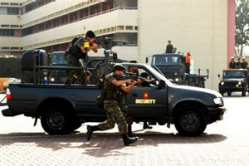
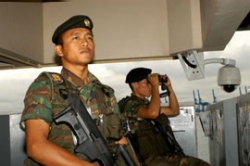
Since last November, specially trained and equipped soldiers from the 6th Battalion, Singapore Infantry Regiment (6 SIR) have been deployed at various key installations throughout the island. PIONEER follows these soldiers for a day, to see how they train and operate, in order to provide round-the-clock protection for all Singaporeans.
Do you have an eye for details? How much can you notice and remember?
PTE Soh Wei Siang was standing guard protecting a key installation when he noticed a person in a bus taking photographs of buildings in the installation.
Since unauthorised photography is not allowed, PTE Soh's senses were immediately sharpened. Instantly, he mentally noted the person's appearance, his approximate age, his attire, his height, where he was seated in the bus, the bus' license plate number, and the direction the bus was heading.
All this was done in barely five seconds as the bus moved past and away from the 22-year-old Full-time National Serviceman.
PTE Soh then alerted his commanders and gave them a detailed description of the suspicious character. They then contacted the Police.
Thanks to the information provided by PTE Soh, the SAF and the Police were able to quickly stop the bus and accurately identify the photographer and speak to him, to investigate the matter further.
It is this combination of alert soldiers and good co-operation with other security agencies like the Singapore Police Force and CISCO Guards, that keep vital installations like Jurong Island, Sembawang Wharves and Changi Airport safe from potential threats.
An Infantry battalion and more
Since late 2001, SAF soldiers have been patrolling key civilian installations to beef up security. But faced with increased threats of transnational terrorism and low intensity conflicts, as well as part of a peace-time re-organisation, the Army felt that it would be necessary to dedicate and train an active battalion to meet the challenges of such threats and dedicated to the protection of installations (POI).
6 SIR was the battalion chosen for this important task. While its soldiers maintain basic Infantry capabilities, 6 SIR has certain unique characteristics.
2 PDF HQ reconfigured as Island Defence HQ
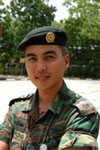
"Essentially we have an enlarged force," explained Commanding Officer, 6 SIR, MAJ Wong Weng Kong (left). "We have a Chemical, Explosive, Detection and Isolation (CEDI) platoon whose soldiers are trained to identify explosives and chemical devices accurately, and are able to isolate them safely before calling the Chemical, Biological, Radiological and Explosives (CBRE) team to mitigate the risk."
6 SIR also comprises a Provost platoon which means greater legal jurisdiction in certain areas. And there is a Surveillance platoon that explores technology to bridge gaps and limitations of the human eye.
"In addition, we have a Weapons platoon that trains our soldiers to use sniper weapons, shotguns and automatic grenade launchers. This enhances our firepower, so we can engage any perpetrators from short, mid or long range," said MAJ Wong.
Soldiers are sent for specialised skills training with the respective units. For example, the soldiers from the Provost platoon train at the School of Provost before returning to 6 SIR.
Forget-me-not
6 SIR's role is to protect designated military and key civilian installations as part of the Army's homeland security efforts. Hence, the soldiers are trained in homeland security measures and are equipped with skills to provide vigilant around-the-clock watch.
What are some interesting skills that 6 SIR soldiers learn in their eight months of training?
MAJ Wong revealed that his soldiers are well-trained in rules of engagement, so they know how to approach different situations appropriately.
Another interesting skill is 'keep in memory' abilities.
MAJ Wong explained: "Through computer-aided programmes and role play, we help train the soldiers' cognitive and psycho-motor skills."
"Essentially, we want to strengthen their memories. The soldiers are trained to notice 'out of place' things and remember important details like vehicle models, license plates, height of the suspect, his clothing...We want them to report the details accurately so we can follow up quickly," said MAJ Wong.
While most suspicious characters turn out to be innocent but misinformed persons, MAJ Wong stressed that the action taken by PTE Soh was the right thing to do.
He said: "In security, we have to take every incident that is 'out of place', very seriously, because you never know where or who the real enemy is."
"And unlike conventional operations where soldiers can normally refer to higher command to make decisions, the nature of POI operations requires our soldiers to be more independent. Hence junior commanders and ground troops are expected to make split second on-the-scene decisions, for instance, deciding that the situation is not right and reporting it," MAJ Wong added.
Firm but effective
By patrolling and standing guard in civilian installations, 6 SIR soldiers come into contact with non-military personnel daily. MAJ Wong said that managing civilians requires important people skills.
He said: "We have thinking soldiers who understand the seriousness of their task, and know what are out-of-bounds areas when dealing with civilians. Hence they are able to respond effectively to civilians, to remain polite yet firm."
MAJ Wong continued: "There will always be a couple of civilians who become agitated or are unco-operative. But our soldiers have been able to calm them down and explained why certain actions must be taken or procedures followed. Most of the time, we get their full co-operation after we explain the rationale to them."
The Spartan (middle) underwent various trials to test and hone its capabilities.
What about the relationship with commercial companies? How do they feel about military personnel guarding their compound?
MAJ Wong replied that perhaps, initially, there might have been some discomfort.
"But now, our civilian counterparts recognise the possible threats we face and how significant security is. They understand that the SAF, together with other homeland agencies, enhances the security of their areas. They tell us they feel relieved when they see our soldiers, and are impressed by the professionalism and skills demonstrated by the soldiers."
MAJ Wong is also glad to note that 6 SIR has established strong ties with external agencies like the Police or the Coast Guard who protect the installations alongside the SAF troops.
"Through joint exercises, regular meetings and training, we understand each other's operating procedures and tactics better, and have built very close friendships and working relationships with other agencies," he said.
"We are able to enhance the inter-operability of the SAF with other homeland security agencies, and I am confident that, together, we have multiplied our effectiveness and efficiency to deal with any situations."
Protecting Singaporeans
Planning ahead, MAJ Wong hopes to leverage on technology as a force multiplier. Working with relevant agencies, he said his soldiers are currently trying out new technology and procedures to boost their capabilities.
For instance, they are trying out tracking devices and surveillance systems like mobile cameras, to enhance their situational awareness and command and control of troops on the ground. Simulators could also be used to enhance the soldiers' skills.
Six months after turning operationally ready, how does MAJ Wong evaluate his soldiers' performance?
He replied thoughtfully: "I am very proud of them. I can see that they understand the importance of their job and they take it very seriously. They have been able to adapt and learn among themselves, to enhance their knowledge."
"Furthermore, in public, they have been able to maintain a very positive image of the Army, yet deal with situations firmly and politely. All this shows that the training we give them is useful and the soldiers are motivated to do their job well."
What this all means is that the good work of 6 SIR soldiers allows for all Singaporeans to go about their daily routine, assured that there is a specialised and dedicated force that is effectively protecting key installations, indirectly protecting us all.
(1)
(3)
(2)
(4)
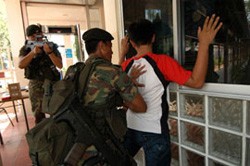
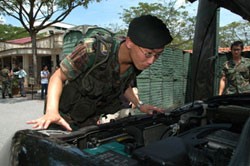
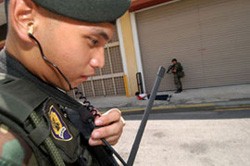
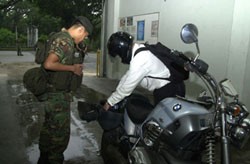
In the morning, 6 SIR soldiers are being trained for their role in POI operations:
(1) Soldiers are trained to conduct body searches. (2) An unauthorised person has been spotted with a suspicious package in the installation! While a soldier keeps watch over the suspect, another cordons off the area and calls for back-up. (3 & 4) From cars to motorcycles, soldiers know how to conduct proper vehicle searches, identify vehicle bombs, and react correctly to such threats.
(5)
(6)
(7)
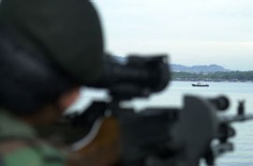
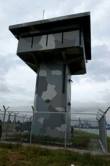
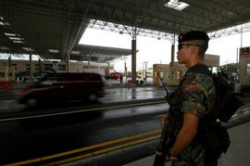
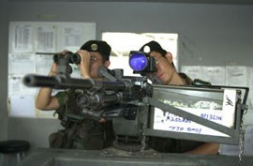
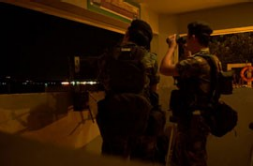
In the afternoon, 6 SIR soldiers are on duty at Jurong Island: (5 & 6) At this watchtower observation post, soldiers keep a close watch over vessels entering and leaving Jurong Island. (7) Armed and ready, a soldier keeps his eyes peeled for anything amiss at the Jurong Island Checkpoint.
(8)
(11)
(9)
(12)
(10)
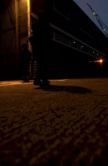
As dusk settles, soldiers in Sembawang Wharves provide seaward defence:
(8 & 9) While the Police Coast Guard provides the first layer of defence, 6 SIR soldiers communicate regularly with them to provide additional protection against possible threats entering the basin at the wharves.
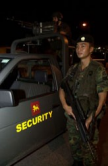
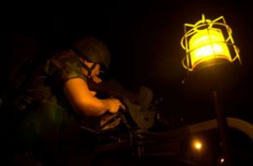
(10 - 12) As most Singaporeans prepare to turn in for the night, the soldiers remain alert, patrolling the wharves, watching over the dark seas while adopting a vigilant watch during its many vehicular patrols.
(On) Site and Sound
How do the NSFs of 6 SIR feel about their role as protectors of peace?
"It is different doing my duty in an urban area instead of out in the field. My friends in other units tell me about their jungle training, and how different it is from mine! But it feels good protecting the installation, to be in a real situation."
PTE Abdul Razak Bin Saman
"I am honoured to be part of 6 SIR, to be protecting our people and country. And while I am on duty, I have learnt more about the situation around the world, and our role in it, how we can help to detect and deter threats. We deal with real situations, it is no longer just training."
PTE Ronald Low Wee Kiat
"It is a heavy responsibility but I feel proud. Our training has taught us to be tough but effective, and we are expected to be alert, 'on the ball' and independent in making decisions. We need to be able to adapt to any situation."
PTE Soh Wei Siang
How do the tenants of Jurong Island feel about 6 SIR's presence?
"I don't feel any discomfort with the soldiers around. For the staff, they have accepted that the soldiers are deployed here to protect the island and make us feel more safe, and at ease. To potential terrorists, the soldiers act as a real deterrence, to make them know that Jurong Island is a hard target to hit."
Mr Ho Chee Fook, Manager (Fire and Security), Seraya Chemicals
"Before 6 SIR was permanently deployed on the island, with new units coming in and out, there was no continuity. But now, lessons are learnt faster and problems rectified on the spot. This is one area that the SAF has responded very well; it is quite a feat to reconfigure 6 SIR in less than two years!"
Mr Wong Wah Yan, Assistant Head (Risk and Security), Specialised Parks Development Group, JTC Corporation





ALSO READ IN OPS & TRAINING
S’pore commandos, Indonesia special forces train & strengthen ties at Ex Chandrapura
08 Jul 2026
From conducting tactical airborne jumps to a coordinated urban raid, soldiers from Singapore and Indonesia deepened their decades-long partnership in this bilateral army exercise.
SAF & Home Team to refresh Medical Classification System
13 Apr 2026
The refreshed system will allow about 1,200 servicemen annually to be deployed for vocations and roles they were ineligible for previously.
Prime Minister Lawrence Wong observes SAF’s sense-strike integrated capabilities
09 Apr 2026
He witnessed the SAF’s ongoing efforts in leveraging advanced robotics and cross-Service integration to secure Singapore’s interests in an increasingly volatile world.