
MILESTONES
INSPIRING YOUNG MINDS FOR DEFENCE
21 Apr 2015
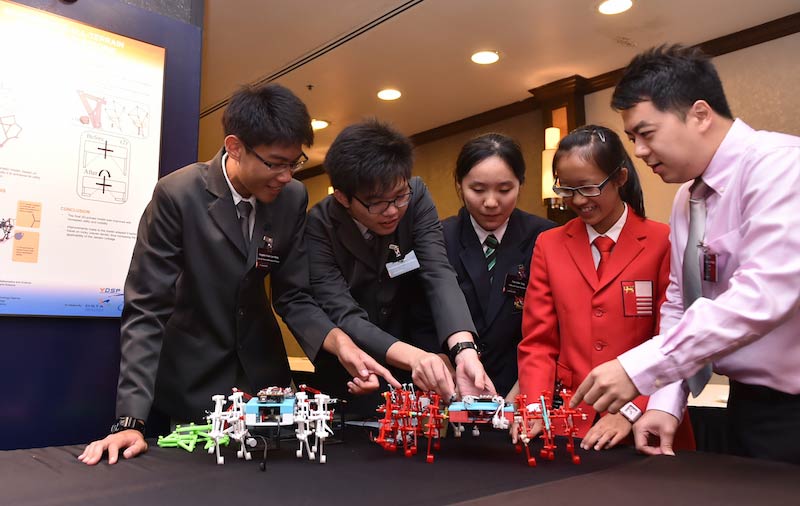
This year's Young Defence Scientists Programme (YDSP) has broken new ground by boldly going where no wheeled vehicle has gone before.
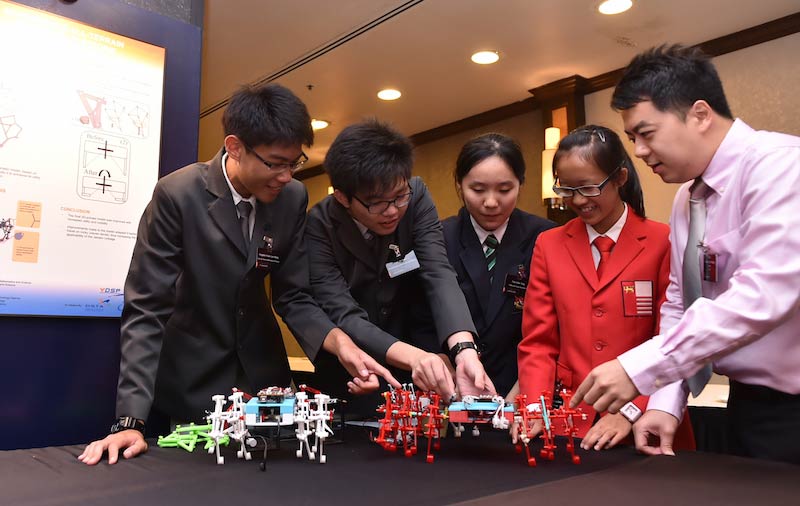
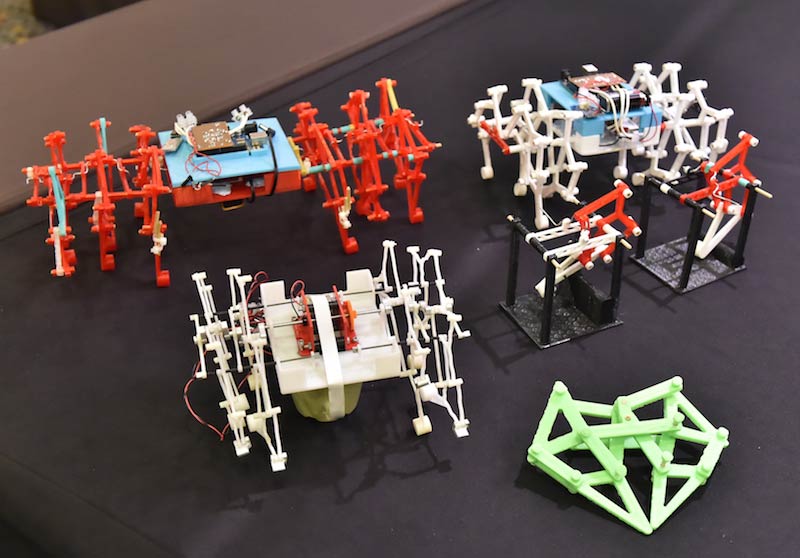
With the aid of 3D printing technology, a group of students designed an eight-legged walking robot. The robot might eventually end up helping soldiers transport heavy weapons and even act as a mobile communications relay to transmit data from remote locations.
Explaining the design, NUS High School of Mathematics and Science student Lee Jia Hern, 17, said: "Leg mechanisms are more stable than wheeled designs in uneven terrain". He is part of a four-member team which also comprises students from National Junior College and Raffles Institution.
The team took about six months to come up with their working model named "3D Printed Biomimetic Model" under the Research@YDSP mentorship programme. "These are things we don't learn in school and I'm glad for this experience," said team-member Kingston Kuan, 17, also from NUS High School.
"We were made to think out of the box and, along the way, we met with challenges which we had to think of ways to overcome," said team-member Sharon Tan, 17, from National Junior College.
For example, the team had initially designed a two-legged mechanism but soon found that more legs gave more stability and utility. They ended up with an eight-legged design with rounded "feet" so that objects on the ground would not catch the robot's legs.
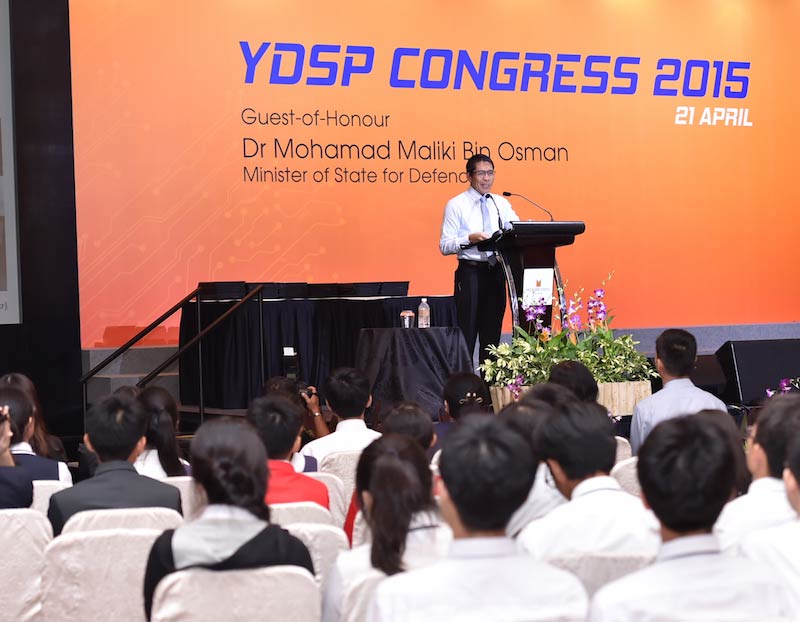
Speaking at the YDSP Congress held at Orchard Hotel on 21 Apr, Minister of State for Defence Dr Maliki Bin Osman said: "Without our defence engineers and scientists working quietly behind the scenes, the SAF would not be what it is today."
"The work of our defence engineers is never complete. Bigger challenges await, and we have given YDSP participants the opportunity to explore them during the Science and Technology Camps, and research projects."
Dr Maliki also presented 30 YDSP Scholarships to outstanding students and another 70 academic awards to students for excellence in Physics and Mathematics.
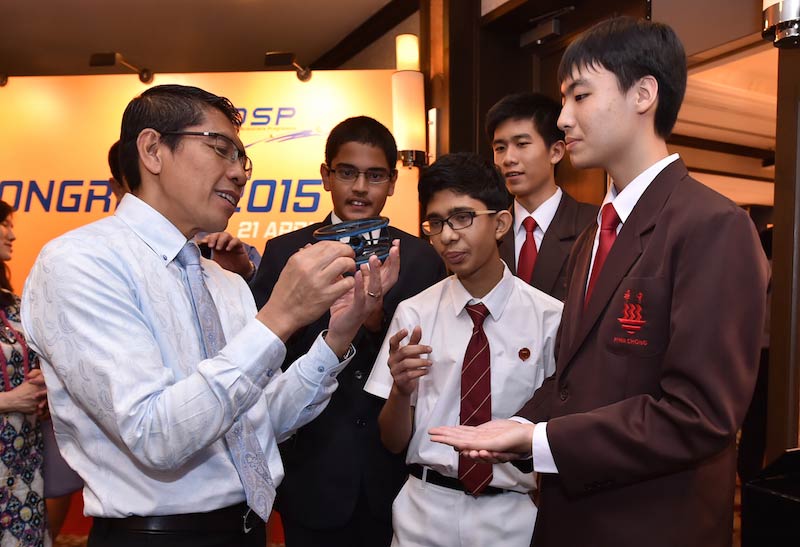
This year's YDSP activities also included three camps that introduced students to 3D printing technology and Space. Students at the week-long 3D printing camp had the chance to assemble their own 3D printers to use in the final challenge of designing an Unmanned Aerial Vehicle.
The judges eventually picked a cylindrically-shaped design that stacked two rotor blades on top of one other as the winner.
"One of unique features of our design is the use of collective-pitch which changes the angle of the (rotor) blades to manoeuvre the UAV," said Anglo-Chinese School (Independent) student Mudit Mishra of his group's simple but effective design.
The group of four 16-year-olds Hwa Chong Institution's Peng Yanjia and Richard Xiong, as well as Victoria School's Shah Dhruv Nilesh.
Guiding the students in their projects were experienced mentors from Singapore's defence technology ecosystem like Mr Clarence Tan.
The 32-year-old, who guided the team working on the walking robot project, said: "It's about guiding the students and sharing our insights from working in the defence engineering community."
"It's fulfilling for me to help the students see how engineering (knowledge) can be used to help the country maintain a strong defence," said the engineer who works for the Defence Science & Technology Agency's Land Systems Programme Centre.
"At the end of the day, we hope to inspire them to want to take up bigger roles in defence engineering."

ALSO READ IN MILESTONES

NCC marks 125 years with new campus & enhanced curriculum
26 Aug 2026
Singapore’s oldest youth uniformed group will see a refreshed NCC2030 curriculum to equip future generations of cadets with essential skills to meet evolving security challenges.

RSN launches 2nd Multi-Role Combat Vessel
23 Jul 2026
Just like the vessel and her namesake, Commanding Officer LTC Low is following in a strong family tradition of naval service.

Lifelong learners in the SAF
21 Jul 2026
Meet Senior Military Experts ME4 Muhammad Fikri Bin Suhaimi and ME4 Bai Ruiliang who are proving that you’re never too old to learn something new and chase your dreams.