
COMMUNITY
FLYING HIGH - SINGAPORE AIRSHOW 2008
31 Mar 2008
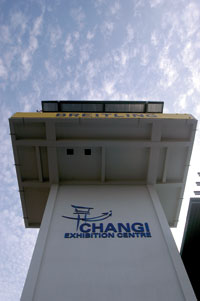
The Singapore Airshow was a soaring success when it took off for the first time last month. PIONEER was there to capture the high points of the show.
Housing a behemoth
The organisers, Singapore Airshow and Events, were well aware of the challenges they faced: how in the world do you fit dozens of aircraft and hundreds of exhibitors into existing facilities?
Singapore Airshow and Events decided to build an entirely new venue. This brand new exhibition ground, the Changi Exhibition Centre, was custom-built to suit the specifications of the Singapore Airshow.
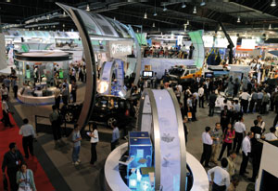
Designed to cope with anticipated visitor traffic of over 30,000 trade visitors and 50,000 aviation enthusiasts, the Changi Exhibition Centre was built on reclaimed land. The 30-hectare site featured a 40,000-square metre (sqm) exhibition hall as well as a 90,000-sqm static display area. Roads were designed to be wider than normal to accommodate both land traffic as well as taxiing aircraft, notably the Airbus A380.
The high society
The Singapore Airshow saw the who's who of the aviation industry attending, and with good reason. Touted as Asia's largest aerospace event, the show brought together dozens of important names within the aviation and defence industries.
The illustrious attendees included 225 overseas delegations, 21 airline chief executives, 10 transport ministers, 12 defence ministers, three heads of government, and the heads of the International Air Transport Association (IATA) and the International Civil Aviation Organisation (ICAO). Locally, senior officers and officials from MINDEF hosted social and official visits from visiting dignitaries.
Minister for Defence Teo Chee Hean hosted a lunch for His Majesty Sultan Haji Hassanal Bolkiah Mu'izzaddin Waddaulah of Brunei at the Singapore Airshow. He was received by Chief of Defence Force LG Desmond Kuek at the show, and given a tour of the SAF's static display.
Industry and defence: a vital partnership
It's no secret that national defence requires the support and cooperation of various sectors of society. And chief among these is industry.
In order to ensure the lasting support of industry for defence, Minister of State for Defence Koo Tsai Kee hosted a lunch for key members of industry at the Singapore Airshow.
Among the visitors were members of the Government Parliamentary Committee for Defence and Foreign Affairs (GPC-DFA) and the Advisory Council on Community Relations in Defence (ACCORD), the SAFRA Management Committee, Members of Parliament, as well as local and foreign business leaders.
PIONEER asked one of Assoc Prof Koo's guests, Vice-President (Asia Pacific) of the Boeing International Corporation, Mr Douglas H Miller, for his thoughts on the airshow.
"I would describe this show as a dating service because it gets people together," said Mr Miller. "Customers and suppliers get together very effectively and we're able to talk to people we need to speak with to promote business opportunities."
Boeing, a leading player in the international aerospace industry, had a strong presence at the Singapore Airshow. Its aerospace involvement also extends beyond civil aviation into the military realm.
Reflecting on the relationship between industry and the defence sectors, Mr Miller, who also sits on the American Chamber of Commerce, commented on the ease of doing business with the Defence Science & Technology Agency (DSTA), the Republic of Singapore Air Force (RSAF) and the other Services.
"They have a high degree of professionalism and we really enjoy working with them," he said.
Black Knights
One of the major attractions of the Singapore Airshow was the RSAF Black Knights, the RSAF's aerobatic team (for more on the team, see the Top Story in our February issue). The six-man team performed daily to thronging crowds. Locals, aviation enthusiasts and casual watchers alike were drawn to the stunts of the Black Knights.
Beyond Changi - the future of air power
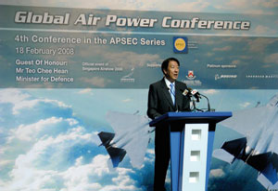
A number of conferences were held in conjunction with the Singapore Airshow. These brought military leaders and air force chiefs from numerous countries together to foster greater understanding through the exchange of knowledge and information. Speaking at the Global Air Power Conference, Mr Teo (above) reminded his audience that as air power evolved to embrace new concepts and capabilities, air forces needed to be more tightly linked with surveillance, intelligence, strike and ground elements to ensure greater mission success.
"Deeper and broader cooperation", he said, was needed to combat transnational threats that could affect the world and to "protect our shared interest in peace and stability".
"The inherent characteristics of air power - flexibility and mobility - make it well suited to meet today's expanding and varied challenges," he added.
With the "rising significance" of unmanned aircraft and other technological advances, air power has grown into "a powerful tool in humanitarian assistance and disaster relief".
Held at Suntec City on 18 Feb, this one-day event was supported by the RSAF and the S Rajaratnam School of International Studies (RSIS).
The C4I challenge
On 18 Feb, the C4I (Command, Control, Communication, Computers and Intelligence) Asia Conference 2008 was also held in conjunction with the Singapore Airshow.
In his keynote address, LG Kuek (left) said advances in C4I technology would have a "profound impact on the shape and structure of military forces, as well as the doctrine and tactics in the concept of operations".
That was why many armed forces around the world have, in recent years, been developing concepts for force transformation based on the promise and potential of communications and information technology.
According to LG Kuek, C4I enhances military operations in three fundamental aspects: effective command and control and decision-making; a knowledge-based environment; and a systems approach to operations.
"With digital communications and networks, the transfer and promulgation of information across the battlespace can be achieved more precisely, more cogently and more speedily," he explained.
"Greater flexibility can be derived in the command and control arrangements, affording more options and agility for forces to be configured for their missions."
Defence procurement
The third conference held in tandem with the airshow was the International Defence Procurement Conference 2008 which was attended by some 300 key leaders and delegates from the global defence procurement community.
Speaking at the conference, Minister for Manpower and Second Minister for Defence Ng Eng Hen (above right) advocated the framework of a "defence ecosystem" - a symbiosis between commercial partners, procurement agencies, and military end-users.
Citing a local example of cooperation between the SAF and DSTA, he said that commercial partners should be "brought on board early in the planning stage to conceptualise requirements and provide innovative ideas".
A soaring success
If we were to look at what the Singapore Airshow set out to do - bring aviation to the masses and the industry and military together, the event was a roaring success. The crowds have come and gone, and the major players and partners have met, conferred, and come up with a slew of new efforts for cooperation.
The Singapore Airshow will return in two years, and it promises to be even better than its inaugural instalment.


ALSO READ IN COMMUNITY
Your backstage pass to NDP 2026
06 Aug 2026
Ever wondered what goes on behind the scenes of NDP? We take a peek behind the curtain to uncover the hard work that this year’s performers have put in since rehearsals began months ago.
What it takes to be a viral NDP mascot
25 Jul 2026
They’ve been stealing hearts as the lovable mascots at the National Day Parade (NDP). Meet the NSFs behind the costumes and high-energy dance moves.
State Flag Flypast charts new path
05 Jul 2026
For the first time, the State Flag Flypast will fly over the Kallang Basin, bringing this NDP tradition to new audiences.