
MILESTONES
DEFENCE RESEARCH BREAKTHROUGHS FROM BRIGHT YOUNG MINDS
08 Apr 2010
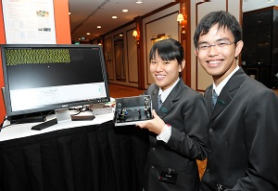
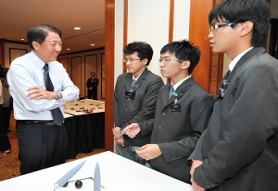
Not many students can bask in the opportunity to present their research to the Deputy Prime Minister and Minister for Defence Teo Chee Hean and this was precisely what two student research teams did.
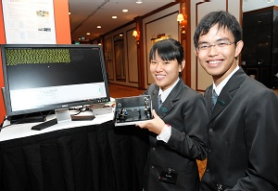
Eighteeen-year-olds Ng Yuting and her partner, Lim Gan Shun, both from the NUS High School of Mathematics & Science, came up with an original algorithm for a True Random Number Generator that was more efficient than what is currently in use. This could be a step in making quantum cryptography a part of our daily lives.
Quantum cryptography is a new generation of encryption technology that can enable electronic communications, such as emails and SMSes, to be virtually hack-proof.
The duo presented their research findings to Mr Teo at the annual Young Defence Scientist Programme (YDSP) Congress, held at Orchard Hotel on 8 Apr.
Mr Teo, who was the Guest-of-Honour at the event, said that the YDSP hopes to establish a life-long passion for science and engineering by giving young people the opportunity to work first-hand on the latest technologies and interact with defence scientists and engineers.
"At YDSP, we also encourage you to push the boundaries of your creativity and imagination, for your dreams and ideas are seeds for the technologies of tomorrow," he said.
The YDSP is an initiative by the Defence Science & Technology Agency (DSTA) and DSO National Laboratories (DSO) which aims to cultivate students' interest in defence science and technology. The YDSP Congress is the culmination of a series of YDSP activities held over the last 12 months.
The second team - Ang Yong Qin, Rion You and Shoun Tan - did a study that proved dimpled surfaces, such as those of a golf ball, can improve aerodynamics. Their discovery could possibly pave the way for dimpled surfaces to be used for aircraft and rockets.
The trio, who also hailed from the NUS High School of Mathematics & Science, told cyberpioneer that they felt very privileged to be presenting their research to Mr Teo.
"We had spent a lot of effort in this project. This is not only a recognition, but it is also an opportunity to share our ideas with others, especially our juniors and hope that they can continue to finish what we have started," said 17-year-old Yong Qin.
The two projects presented were under the Research @YDSP, a four-month research programme which offers students the chance to learn experimental techniques and experience laboratory work under the mentorship of research staff and practising professionals in DSTA, DSO and other local establishments, such as the National University of Singapore, the Nanyang Technological University and research institutes.
Besides Research @ YDSP, the YDSP programme includes other activities such as the YDSP Science and Technology Camp, World of Science lectures and laboratory sessions, which aims to spark off creativity and a spirit of innovation among bright young minds.
Mr Soh Kong Pheng, Chief Executive of DSTA and Chairman of YDSP said, "Each year, YDSP adds new activities and opportunities to engage our participants. The number of participants has grown from year to year."
In 2009, there were about 350 students taking part in the activities compared to about 300 in 2008. The increase was also largely due to a new initiative last year to reach out to 14-year-old IP Year Two students for the first time.
Mr Soh added that he was very encouraged that participating students continued to give "very positive feedback on our programmes and activities, and have found them exciting".
During the YDSP Congress, Mr Teo also presented the YDSP Scholarships to 30 Integrated Programme (IP) Year Three students for their outstanding achievements. In addition, he presented the YDSP Academic Awards to another 57 students who have excelled in Physics and Mathematics.
These awards serves to encourage and recognise students with interest and potential to contribute to defence science and technology.
08 Apr 10 - Keynote Address by Deputy Prime Minister and Minister for Defence Teo Chee Hean at the Young Defence Scientist Programme Congress 2010

ALSO READ IN MILESTONES


Answering the call to defend Singapore
21 Jan 2026
The Weapon Presentation Ceremony represents a powerful moment when recruits are entrusted with their rifle and begin carrying the weight of the nation’s defence.

Navy launches 1st Multi-Role Combat Vessel
21 Oct 2025
The Multi-Role Combat Vessel will function as a mothership for the command and conduct of unmanned naval operations.
-dsc_2181.jpg?sfvrsn=cf9c6464_2 "1) DSC_2181")
What you need to know about the new CMPB
14 Oct 2025
The new Central Manpower Base (CMPB) at Bukit Gombak officially opened its doors on 14 Oct, welcoming pre-enlistees, servicemen and the public alike to a state-of-the-art, one-stop hub for all things National Service (NS).