
COMMUNITY
AMAZING IDEAS BROUGHT TO LIFE AT SCIENCE CHALLENGE
25 Aug 2016
"Singapore is a small country with limited resources. To overcome our limitations, we must continue to evolve (and) cultivate an innovative mindset and continue to be curious about the world around us."
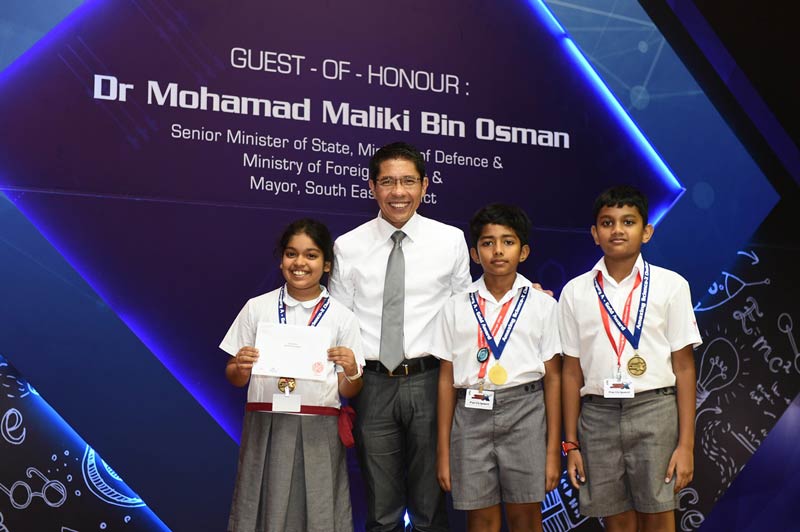
Senior Minister of State for Defence Dr Mohamad Maliki bin Osman said this in his speech at the Amazing Science-X Challenge (ASXC) held at Science Centre Singapore (SCS) on 25 Aug.
Dr Maliki emphasised the importance of innovation in the defence field, by citing examples such as the Navy's Littoral Mission Vessel and the Air Force's Hermes 450 Unmanned Aerial Vehicle, which he described as "cutting-edge technologies".
He said: "Besides defence, we have started to embrace an innovative culture in other aspects of lives. The Smart Nation initiative is one great example of how we are building a future-ready Singapore that incorporates technology seamlessly into our lives to improve the way we live."
Under the initiative, several ideas were developed, such as the My Smart HDB Home@Yuhua, which allows residents to monitor their utilities usage, and switch appliances on or off with their mobile phones through the Utilities Management System.
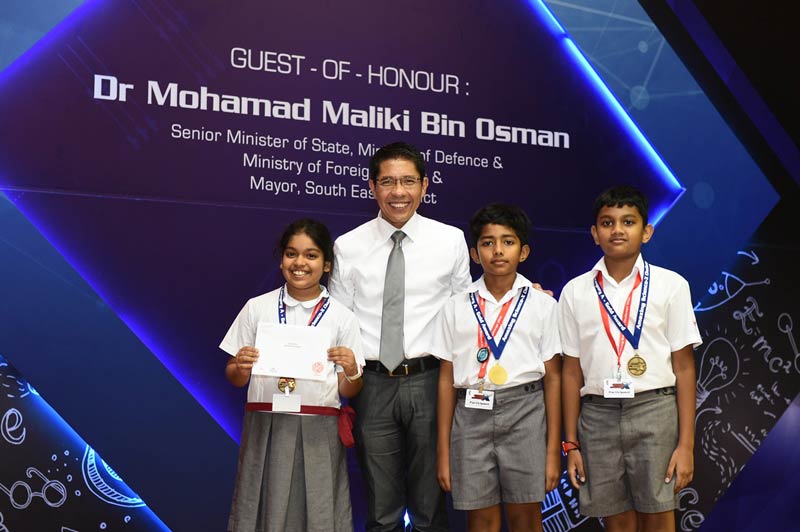
Possessing the same innovation spirit is Sarvesh Sridhar, leader of team Alpha Ybis which won the Gold medal in the Challenge. When asked how he felt about winning, the Yuvabharathi International School student said: "I feel really happy because it shows that the hard work that our team has put in has paid off."
His team's project, named Magic Box, features an important property of light, which is that it travels in a straight line. With this, his team used a series of mirrors to reflect the light in a curved path around the object to be hidden, thus achieving an effect which allowed the object to be hidden in plain sight.
However, things were not all bright and breezy for the team at the start, as they encountered some challenges. The 10-year-old said: "We had doubts about our project at first, as we were not sure if our idea would work. In the end, things turned out very well and we even won a medal, so I'm very happy."
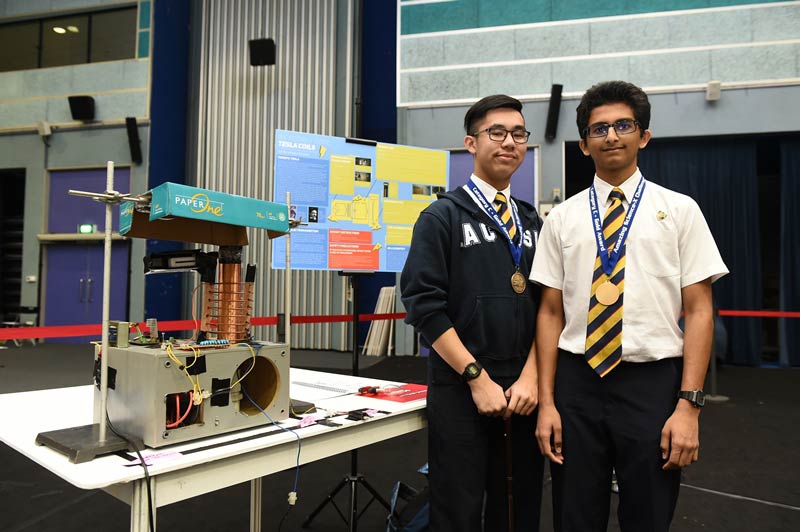
Another team that overcame its own challenges was ACTeam Sham. Team leader Shamoeel Aliasgar Moochhala said: "For the construction stage, we had to salvage a lot of materials from household appliances and even had to buy some of the parts from hardware shops."
"For example, we got the circuits off a CRT Monitor while some of the parts were taken off a lamp. The wood was picked up from around my neighbourhood and the primary coil was bought from an air-conditioning shop."
The team's efforts paid off and they clinched the Gold medal in their category. Their project enables electricity to be transmitted wirelessly across short distances to a lamp, to light it up.
"With a bigger coil, electricity can be transmitted to as far as a few kilometres away and this would supply electricity to power drones which can be used to carry payloads, thus acting as a force multiplier," said Shamoeel.
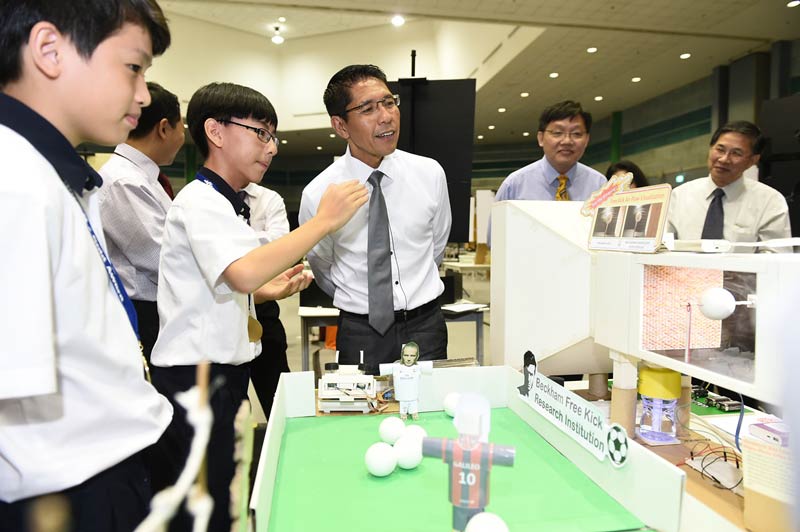
Winning is not everything for Mika Lam, leader of team Galileo Obiettivo!. He enjoyed participating in the science competition. He said: "I think it (the competition) helped me to learn time and project management skills, and it also gave me a reason to learn things outside of my (school) syllabus (that are) interesting to me."
His team's project breaks down the physics behind retired soccer star David Beckham's lethal free kick through the use of concepts such as centripetal forces.
He explained: "We tried to make our exhibit as relatable and interactive as possible. We wanted to illustrate a phenomenon which can be observed in our daily lives and create a machine that is intuitive and user-friendly, and not a complicated contraception that only the creator knows how to use."
The ASXC is organised by the DSO National Laboratories (DSO), National University of Singapore's Faculty of Science and SCS. It challenges the participants to create an engaging and interactive exhibit that best explains a physical science phenomenon.
This year, a total of 162 teams comprising 486 students from 38 schools and institutes of higher learning took part in the competition. Teams were grouped into four categories category A for Primary One to Six; category B for Secondary One to Four; category C for Junior Colleges and Integrated Programme students Year Five and Six; and D is an open category.
The ASXC is part of the DSO Amazing series of competitions which aims to unlock creativity through fun and interesting projects.

ALSO READ IN COMMUNITY


Your backstage pass to NDP 2026
06 Aug 2026
Ever wondered what goes on behind the scenes of NDP? We take a peek behind the curtain to uncover the hard work that this year’s performers have put in since rehearsals began months ago.
What it takes to be a viral NDP mascot
25 Jul 2026
They’ve been stealing hearts as the lovable mascots at the National Day Parade (NDP). Meet the NSFs behind the costumes and high-energy dance moves.

State Flag Flypast charts new path
05 Jul 2026
For the first time, the State Flag Flypast will fly over the Kallang Basin, bringing this NDP tradition to new audiences.