
MILESTONES
FUELLING STUDENTS' INTEREST IN DEFENCE SCIENCE
28 Mar 2012
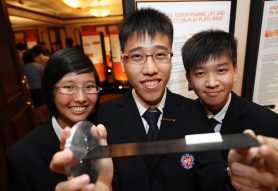
It just takes a tiny flap to enable an aircraft to fly better.
That's what three students from Dunman High School discovered during a project that investigated lift effect in aircraft through the addition of a flap in the wing.
Eighteen-year-old Lester Tan spoke about what inspired the team: "When birds fly, their feathers prop up to help them fly better, so we added a flap to aircraft wings in order to generate better lift."
On the usefulness of the project, he said: "We hope that our findings can be applied to micro aerial vehicles which are used in operations that can be hazardous for manned aerial vehicles."
The team's project was one of three projects presented at the annual Young Defence Scientists Programme (YDSP) Congress at Orchard Hotel on 28 Mar. The other two projects were a computer simulation to analyse port security tactics and the use of quantum mechanics to strengthen communications security.
Jointly organised by the Defence Science and Technology Agency (DSTA) and DSO National Laboratories, the YDSP is aimed at cultivating interest in defence science and technology among students through various camps as well as research programmes and attachments.
Last year, 117 students from 11 schools participated in 73 research projects under the mentorship of defence engineers and scientists.
In his speech at the congress, Minister for Defence Dr Ng Eng Hen noted that the YDSP aims to inspire and bring out the innovator in students.
He said to participants: "You have been given opportunities to work with our defence scientists and engineers, to have a sense of what they're doing and how they're pushing the envelope.
"As the 3rd Generation SAF (Singapore Armed Forces) leverages on networked systems and technology more intensively, we will need to nurture the next generation of defence engineers and scientists who will continue to give us cutting-edge technologies for us to stay ahead."
An example of this next generation of defence engineers is Ms Ong Xin Cai. As a YDSP participant in 2006, her research on the effect of wave propagation in soil boosted the SAF's capability to construct and maintain underground protective structures that can withstand various types of shocks that travel through soil.
As a DSTA engineer today, Ms Ong works in the modelling and simulation department of the C4I (Command and Control, Communications, Computer and Intelligence) Development Programme Centre. This centre develops solutions to enhance the situational awareness and operational effectiveness of SAF units.
When asked how she benefited from her involvement in YDSP, she replied: "Definitely the research experience, because in school, we learnt mostly theory without knowing how to apply them."
"Participating in YDSP allowed me to put those theories into practice and see their potential applications in real life. Through that, I realised that I have a keen interest in technology, which is why I became an engineer," she added.
At the congress, Dr Ng also presented awards and scholarships to some of the brightest sparks in the YDSP to recognise their academic achievements and encourage them to contribute to defence science and technology.
This year, 31 third-year Integrated Programme (IP) students received the YDSP Scholarship, and another 59 students in their third to sixth year received the YDSP Academic Awards.
This is the 20th instalment of the YDSP since it was established in 1992.

ALSO READ IN MILESTONES

NCC marks 125 years with new campus & enhanced curriculum
26 Aug 2026
Singapore’s oldest youth uniformed group will see a refreshed NCC2030 curriculum to equip future generations of cadets with essential skills to meet evolving security challenges.

RSN launches 2nd Multi-Role Combat Vessel
23 Jul 2026
Just like the vessel and her namesake, Commanding Officer LTC Low is following in a strong family tradition of naval service.
Lifelong learners in the SAF
21 Jul 2026
Meet Senior Military Experts ME4 Muhammad Fikri Bin Suhaimi and ME4 Bai Ruiliang who are proving that you’re never too old to learn something new and chase your dreams.