
PEOPLE
HE HAS THE DNA FOR DEFENCE SCIENCE
14 Nov 2005
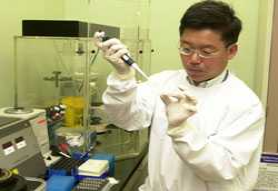
By understanding the DNA sequence of a person, we can understand him better his strengths, weakness, and what makes him an individual.
Perhaps if we could examine the DNA structure of Dr Eric Yap, we can then learn more about the deep passion he has for his work. After all, since the early 1990s, Dr Yap, 41, has been a key figure in developing Singapore's capabilities in population genetics and biological defence.
For his significant contributions and breakthroughs achieved in these two fields, Dr Yap, currently the Head of Population Genetics Laboratory in the Defence Medical & Environmental Research Institute at the DSO National Laboratories, receives the Defence Technology Prize Individual (Research and Development) Award this year.
Dr Yap's work in genetics has helped address the problem of myopia in Singapore Armed Forces (SAF) soldiers. He also spearheaded R&D in DNA fingerprinting to identify human remains in mass casualty or missing-in-action incidents.
Putting his research into action, Dr Yap spent 17 days in the tsunami-stricken region of Aceh, Indonesia, earlier this year. He worked in a SAF field laboratory to aid the World Health Organisation, United Nations, and other medical relief agencies in the surveillance of potential disease outbreak among survivors living in temporary camps.
In biological defence, Dr Yap's work has resulted in a quicker diagnosis of melioidosis, a soil disease that can affect soldiers. He was also part of a team that developed new means of analysing biological agents, which proved vital during the Anthrax scare in 2001 and the SARS outbreak in 2003.
With the growing threat of an avian-flu outbreak, Dr Yap's work will again have critical implications.
"One unanswered question in avian flu is how a virus that starts off as an infection in birds, crosses the species barrier and affects humans."
"The viral RNA is known to mutate, so if we can better understand the RNA sequences and the mutations involved, this can give us a clearer idea of what the next strain influenza that affects human will be like. We can then develop new tests that are sensitive to the new strain," Dr Yap explained.
RNA or ribonucleic acid is the substance in living cells essential for the synthesis of protein.
Biological threat is one such challenge that lies ahead in his work, revealed Dr Yap. Another challenge is to explore new cross-disciplinary opportunities.
For instance, Dr Yap has been involved in evaluating and acquiring several commercially available off-the-shelf instruments used for DNA amplification and analysis.
Working closely with engineers, Dr Yap has adapted a piece of equipment, a thermocycler that is used for the heating, cooling and analysis of DNA samples, to make it more user-friendly.
"While my training is primarily in medicine and biological sciences, I have a wide range of interests. I am driven by the need to solve a problem, so if the solution involves some new knowledge, be it in mathematics or light and optics, I will go into these areas by working with colleagues who specialise in these fields," Dr Yap said.
"Knowledge today is so advanced and sophisticated that it is impossible for a single individual to be both broad and deep. The way to go is to work in teams across different disciplines. You find a rich fertile ground in the interface between different bodies of knowledge."
He continued: "Many inventions and new developments come out of this cross-fertilisation of ideas. And from this point of view, you will never be short of work to do."
"This is an exciting time to be in research. There are always new things to discover and depending on one's ingenuity and drive, new things to invent."
14 Nov 05 - Recognising the best of S'pore's defence technology talents
14 Nov 05 - 'Brains' made smarter

ALSO READ IN PEOPLE
From PES C to command school
14 Apr 2026
Despite being assigned PES statuses that disqualified them from holding combat roles, 3SG Joel Quek and OCT Braden Phua strived to “up-PES” as they felt they had more to contribute in NS.
NS commander, national athlete
18 Mar 2026
He flew Singapore’s flag high at the SEA Games and shone a spotlight on a little-known sport, all while being an NSF commander. Meet national Kabaddi athlete 3SG (NS) Yathukulan Ahdhitthyan.
Becoming an officer & following in Dad’s footsteps
14 Mar 2026
Inspired by their fathers’ fond memories in service, 2LT Aleena Binte Aidil and 2LT Timothy Ng were determined to do well in the Officer Cadet Course.