
PEOPLE
DOCTORS OF THE DEEP
18 Mar 2005
It is said that when one dives beneath the sea's surface, one is transported into another world - one that is removed from daily cares and characterised by tranquil depths filled with marine life. However, the very calming waters can turn on you in an instant. That is why the Republic of Singapore Navy (RSN) spares no effort in ensuring that premier medical support is provided for our men who descend underwater - divers and submariners.
The Naval Medicine and Hyperbaric Centre (NMHC) is an RSN specialist medical unit that comprises four branches:
- Naval Hyperbaric Centre (which provides treatment and medical support for different groups of divers)
- Undersea Medicine (Submarine and Diving)
- Human Performance (Research and Occupational Medicine)
- Radiology & Safety (X-ray services and Organisation Excellence efforts)
According to Head, NMHC, LTC (Dr) Gregory Chan, the centre was set up in the late 1980s and originally named Naval Medicine Research Centre (NMRC).
It started off with basic medical research, before delving into the development of Hyperbaric Medicine - treatment that involves high-pressured oxygen.
Currently, operations are divided between Sembawang Naval Base and Changi Naval Base, with the main focus on providing medical support and treatment for submariners and divers. NMHC is also responsible for human performance research and occupational health.
NMHC facilities are equipped differently from conventional medical centres, and their patients are mostly those with diving-related problems, or those who work in difficult environments.
Submarine Medicine - Submarine Hyperbaric Chamber Vessel
Medical support for 171 Squadron, the submarine squadron, is based at Changi Naval Base.
Its peacetime role is to ensure that medical cover for the submarines is maintained through constant training and drills for the team, and that submarine chambers are maintained and serviceable, explained Head, Submarine Medicine Branch, CPT (Dr) Tor Phern Chern.
There is a mobile Recompression Chamber (RCC) facility situated within a designated Landing Ship Tank (presently RSS Endeavour) to support the submarines. This ship is known as the Submarine Hyperbaric Chamber Vessel (SHCV).
The RCC is made up of two chambers which can accomodate 45 men and medical gas containers, and is powered by its own generators.
There is also a high-dependency ward installed on the ship. The medical capabilities are manned by a diverse 36-man medical team, which comprises Medical Officers, Nursing Officers, Paramedics and Chamber Technicians.
In this way, the submariners are well covered in the event of emergencies. If the submarine is disabled and they have to escape, then facilities will be on hand to support them.
Power to the people
The men who keep the chambers humming are senior medics like Submarine Medicine Warrant Officer, SSG Edmund Chua, and technicians from the Naval Hyperbaric Centre.
SSG Chua, who has been with the Submarine programme from the start, is responsible for ensuring that all medical supplies for the SHCV are ready to go.
"All equipment must be checked regularly to ensure operational readiness. At the press of a button, we will load up the personnel onboard the ship to go out to provide medical support. Whenever we are on standby, we are on two hours' notice to move," he said.
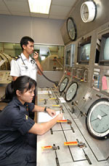
As for the technical team, Chief Naval Hyperbaric Technician, 1WO Paul Bangar, explained that their role was to ensure that the medical personnel get all their basic supply of electricity, sound communications and good quality air for treatment.
There is a technical team who runs and maintains both the RCC and the chambers at the Naval Hyperbaric Centre in Sembawang Naval Base, to ensure its operational readiness. The difference between the two is that the RCC is a mobile chamber and self-powered. Technicians also ensure the smooth running of the generators and medical gas containers.
"We must be self-reliant on the ship. In terms of operational readiness and troubleshooting, we must be able to pinpoint what is the problem and rectify it, get the thing operational as soon as possible," said NHC technician, SSG Simon Khoo.
Well-drilled
In the event of an emergency, the RSS Endeavour crew are responsible for driving the seaboats, while some are also tasked to be stretcher-bearers.
Submariners making an emergency exit will be decked in bright orange submarine escape suits called the MK10. The sea boats will pick them out from the sea and ferry them back to the tank deck of the ship, before they are transferred by elevator to the flight deck, where the triage area is located.
The doctors and medics will then diagnose them and direct them to the RCC or the high-dependency area, depending on the severity of their condition.
Chief Radar Navigation Specialist, SSG Lestor Low, and Chief Naval Supply Assistant, SSG Nigel On, help organise the four teams of four stretcher-bearers. Transporting the patients is not as easy as it seems.
"When the escape suits are filled with water, they are very heavy. If it is a controlled escape, two people pop up at once, but if it is a 'rushed' escape, up to 30 people can come up at one go. So the timing and anticipation is very important," said SSG Low.
"We also train the stretcher bearers to watch their backs, and they need to have good coordination and movement because the ship hatches they go through are small."
Every second counts, so there must be a good understanding between the ship crew and medical personnel. To keep everyone on their toes, drills are carried out every month, and if the ship is out at sea with the submarine for an exercise, a drill will also be carried out once.
- Medical Officers have to attend the Naval Medical Officers' Course, a three-week in-house course. Regulars will be sent to either the United States, Canada or Australia for further training to become diving physicians.
- Hyperbaric Nurses and Medical Specialists are sent primarily to the Royal Adelaide Hospital in Australia for training and attachments which last up to three months. The Hyperbaric Nurses undergo a basic hyperbaric course while the Medical Specialists attend the medical technician's course, where they learn how to operate the chambers and its medical aspects.
- Undersea Medics are paramedics who undergo a three-week Underwater Medic Course. They have to be fit to withstand diving pressures, because they have to accompany the patients at different 'depths' during the treatment process. Regular Medics may be selected to undergo further specialised training with the US Navy to become Independent Duty Corpmen for the submarines or surface ships.
'Super-medics' to the rescue
Similarly, no effort is spared for medical support within the submarine.
As there is no space for a medical centre and no doctors onboard, an Independent Duty Corpman (IDC) from the NMHC is attached to each submarine. They are highly-trained medics who can deal with medical emergencies independently.
These medics are specially selected by the RSN and sent to study with the US Navy for a year. They are the only medics in the entire SAF who are allowed to perform life-saving procedures, like inserting chest tubes, independently.
"They are allowed to do it under very specific conditions - when they are deployed, when there is no way anyone can get to them," explained CPT (Dr) Tor.
So far, the IDCs have been able to handle the situations they were in, and there has been no need to deal with surgical procedures.
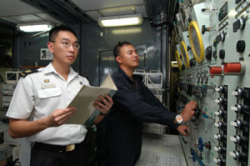
What is more important during these long periods of sailing is a listening ear, as 1SG Tang Wee Kiat (left), an IDC with RSS Conqueror for more than three years, found out.
"We basically look out for all aspects of their welfare onboard the ship; we provide counselling when there is a need to. They also seek all kinds of medical or dental advice from us, be it for themselves, their families or even their pregnant wives," he said.
In addition to medical duties, they are also cross-trained to operate some of the combat systems as well as certain emergency valves and safety devices, on the submarine.
"The submarine functions only when the entire crew is well-integrated, so IDCs can't be seen as outsiders. Both 171 Squadron and us have made a conscious effort to integrate them with the crew," said CPT (Dr) Tor.
Diving Medicine - The Naval Hyperbaric Centre
The Naval Hyperbaric Centre (NHC) is located in the heart of Sembawang Naval Base, where the Navy divers are based.
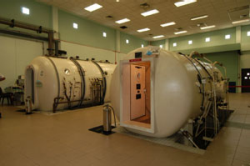
Equipped with three 10-men chambers, it provides Hyperbaric Oxygen Therapy (HBOT) - 100 per cent oxygen treatment at high pressures - for diving-related conditions and some clinical diseases.
Treatment process and common ailments
Head, NHC, CPT (Dr) Ho Boon Hor, explained that during the course of treatment, the pressure in the chamber is brought down to that of a certain depth, depending on the patient's condition.
He is then given pure oxygen to breathe - the body will then saturate itself with oxygen. This helps to reduce swellings and facilitates wound healing, since tissues need oxygen to heal.
The duration of treatment usually ranges from two to seven hours, depending on the severity of the condition. If the patient responds very well to it, repeated treatments may be administered.
"How well they respond depends on certain factors. If the patient comes to us more than 24 hours after their last dive, then their chances of improvement, even with hyperbaric oxygen therapy, may be minimal," said CPT (Dr) Ho.
He pointed out that the most common condition faced by divers is middle-ear barotrauma, where they experience ear pain due to pressure changes.
One of the most severe diving-related illness the centre sees is pulmonary barotrauma, more commonly known as a burst lung - a result of a rapid ascend or if divers hold their breath while scending.
When that happens, air bubbles are released in the bloodstream and goes to the head and causes localised tissue damage - arterial gas embolism - similar to that in a stroke.
Serving the community
Besides treating RSN divers, NHC also caters to recreational divers. The centre is part of the international Divers Alert Network, so divers and health practitioners from all over the world can actually contact an RSN diving physician through a 24-hour telephone hotline.
"We have quite a lot people calling, especially during the dive seasons; about five to ten in a month."
"A diving physician will be on hand to give them advice and if they need further treatment, they need to work out a way to get to us or the nearest chamber facility in the country they are in," said CPT (Dr) Ho.
The centre also receives calls from the International SOS or hospitals, which seek their advice on possible referral cases, since the centre always has a hyperbaric medical team on standby to assess and treat patients.
Currently in Singapore, only Tan Tock Seng Hospital and Camden Medical Centre have small hyperbaric chambers that can see up to two patients at a time.
Hospital referral cases are usually based on clinical conditions, such as poor wound healing, and certain acute emergencies like carbon monoxide poisoning.
The international Undersea and Hyperbaric Medical Society has established 13 clinical conditions that have been proven to benefit from HBOT.
As a national resource in diving treatment, the NHC extends its services to non-SAF patients.
"Since we have the facilities and expertise, we do our utmost to help whenever we can by providing the best service and treatment. It does not really matter whether they are from the SAF or not," said CPT (Dr) Ho.
- Arterial gas embolism
- Carbon monoxide poisoning
- Gangrene
- Traumatic injury
- Decompression sickness
- Enhancement of healing in selected problem wounds
- Severe anemia
- Fungal brain abscess
- Badly infected body tissue
- Bone infection
- Delayed radiation injury
- Skin grafts and flaps
- Thermal burns
Diver support services and research
Besides providing HBOT, the chambers are also used for screening and training divers, as well as dive research.
"With the chambers, we can provide a simulated and controlled environment, so that potential divers and divers can acclimatise to pressure changes without facing the hazards of the open sea," explained CPT (Dr) Ho.
Naval divers, pre-enlistees and submariners, for example, will undergo a rigorous diving medical examination, and need to clear the 'bounce dive'.
They are seated in the chamber and subjected to a pressure the equivalent of being 10m underwater - to see if they can clear their ears and adapt to a claustrophobic environment - before they are certified as fit to become divers or submariners.
The chambers are also essential for diving studies and research. Studies conducted include the evaluation of HBOT in the management of soft-tissue injuries like ankle sprains, wound healing and sudden sensori-neural hearing loss.
An ongoing study looks at the suitability of corneal refractive surgery in the Navy. The physiological effects of the hyperbaric environment are being evaluated, and the surgery of choice to correct myopia in divers determined.
LTC (Dr) Chan (left) feels the NMHC has to keep evolving.
"We began with the creation of the Naval Hyperbaric Centre to support the naval divers. We then went on to provide clinical hyperbaric oxygen treatment and compressed air works consultancy for the community."
"When the Navy set up the submarine squadron, we had to look at how to support the submariners, and we did that using the mobile compression chambers and specially-trained medics," he said.
"The 3G SAF will involve new capabilities, new operational systems, alternative work processes and perhaps even new work environments."
"Force protection and performance enhancement becomes more important, and the NMHC will be instrumental in Navy environmental health and translational medical research."
"The NMHC is the flagship of the RSN Medical Service. We will continue to propel ourselves forward, and I can confidently see ourselves becoming regional centres of excellence in Undersea and Naval Medicine in the near future," he added.
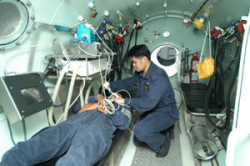
A chamber attendant will be with the patient at all times to ensure the patient's comfort and safety.

ALSO READ IN PEOPLE

Brewing up the perfect blend for a hit comedy
09 Sep 2026
The cast of microdrama Hard Mode are bringing Singapore life to the world with a simple question: “Do you want your iced yuan yang hot or cold?”
Stepping up for the place he calls home
02 Sep 2026
From getting his pink IC in early 2024 to becoming an NSF of the Year and embarking on a career in the SAF, OCT Bandaru Yashwanth Naga Sai didn't just find his place in Singapore, he found his calling.
Paw-tners in service
24 Aug 2026
This International Dog Day, we meet four canine-and-handler duos to find out what goes on behind the scenes in the SAF's Military Working Dog Unit.