
MILESTONES
30 YEARS OF PRIDE AND GOING STRONG
28 Jun 2011
Some good products are borne of an "eureka" moment, while others come from a quieter stock. However, these ideas are often rooted in the same desire: to make the world a better place to work and live in. And that's exactly what the Productivity and Innovation in Daily Efforts (PRIDE) movement seeks to set about doing.
Though now in its 30th year, the movement shows no signs of flagging. In the past year, it has netted savings of almost $137 million for the Ministry of Defence (MINDEF) and Singapore Armed Forces (SAF).
At the MINDEF PRIDE Day 2011 award presentation ceremony held at the National Library Building on 28 Jun, Minster for Defence Dr Ng Eng Hen highlighted that the movement continued to be relevant and had become part of a larger national thrust to improve national productivity.
"The way forward for Singapore to maintain our comparative advantage must be productivity- and innovation-driven. We must leverage on our human resource to more than make up for our higher costs of production," said Dr Ng.
"As the SAF continues to operationalise its 3rd Generation capabilities, we will need to generate greater operational capacity through efficiency and innovation."
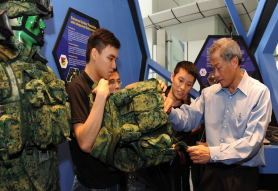
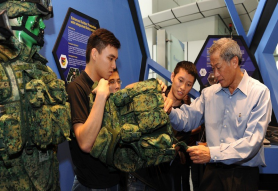
His message was definitely not lost on the award recipients. For example, the Integrated Body Armour (iBA) project literally takes weight off the shoulders of SAF soldiers. In the past, SAF soldiers faced with high threat levels were required to don a 10.5kg set of protective gear which comprised a Load Bearing Vest worn over a bulletproof vest.
But the more svelte iBA - at 6.5kgs - is no lightweight when it comes to features: pockets for the swift insertion of hard and soft armour plates allow soldiers to customise levels of protection, while a jettison strap allows soldiers to quickly discard the entire vest during emergency situations.
The team spent many months gathering feedback from soldiers and personally going on route marches in their own prototype designs in order to arrive at the iBA which soldiers now use from Day One of their military life at the Basic Military Training Centre.
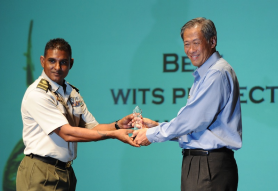
For their efforts, the team from Headquarters 9th Division Infantry won one of seven Best Project awards under the Work Improvement Team Scheme (WITS).
Bagging double honours - the MINDEF Innovation award and one of the Best WITS Project Awards - was a team from the Republic of Singapore Navy who custom-built a testing kit for Exercise Mine Disposal Charges.
Team leader Military Expert (ME) 2 Gary Choo was not exaggerating when he said that the kit enabled them to "bring the sea to the workshop". For live exercises and training which involve usage of these charges, functionality checks have to be conducted before they are handed over to Mine Counter-Measure Vessels.
While the majority of the components can be tested on land in workshops, other components require a certain level of water pressure to activate hydrostatic switches. This meant that the charges had to be brought out to sea so that they could be submerged to the required depth - a tedious and time-consuming affair.
"To do that, we had to coordinate between multiple parties. We had to make sure a ship was available and get safety clearances from a few agencies before we could conduct the tests," said ME2 Choo about the challenges which the old system posed.
With the new kit in place, testing has become a two-man affair which takes only about three hours to complete - a dramatic decrease from the several days such test work used to take.
"Through this project, the team also acquired in-depth knowledge of the EX MDC system and it has given us more confidence in handling the system," added ME2 Choo.
Another project, from the Republic of Singapore Air Force, helped to increase the confidence levels of pilots and air crew when landing Super Puma (SP) helicopters.
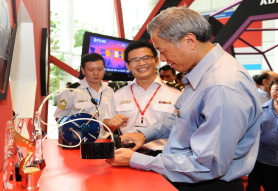
The team developed a Radio Frequency (RF) Badge for SP helicopters which allows the air crew to "see" invisible Electro-Magnetic (EM) emissions.
High levels of these EM emissions are potentially fatal to SP helicopters during landing. While the emissions do not cause problems to EM-hardened aircraft like the Sikorsky S-70B naval helicopter, the cables of SP helicopters are not shielded from such emissions.
Although ships are required to shut off all high powered emitters when an RSAF SP helicopter is landing, there was no way to for the air crew to verify that the environment was free from interference-causing EM emissions. In a worst-case scenario, an SP helicopter could crash while attempting to land in a high EM emission environment through no fault of the pilot or aircrew.
To prevent that from happening, the team took cues from the ubiquitous Electronic Road Pricing systems found on Singapore roads. Using commercially available RF badges , the team tweaked the sensitivity levels on the badges which were originally designed to warn workers of high EM environments.
"An SP helicopter's threshold for EM emissions is obviously different from a human's. There was also a need to set the RF badge at the correct levels so as to be accurate and prevent false alarms," explained team leader ME6 Ken Chua.
Once dangerous levels of EM emissions are detected, pilot and aircrew on board can then carry out remedial actions such as asking the ship to power down their equipment.
Keeping in line with its theme 30 years of PRIDE - Better, Stronger, this year's exhibition highlights notable projects from the past alongside a range of other innovative ideas from individuals and teams from MINDEF, the SAF and Singapore Technologies Engineering.
The MINDEF PRIDE Day Exhibition is open to the public from 28 to 29 Jun from 9am to 9pm, and on 30 Jun from 9am to 3pm. Visitors can look forward to exciting games hosted by Power98FM and Jia 88.3FM deejays, as well as performances by the SAF Music and Drama Company and SAF Military Police Command.
For more information, please visit the official site at www.mindef.gov.sg/pride

ALSO READ IN MILESTONES
NCC marks 125 years with new campus & enhanced curriculum
26 Aug 2026
Singapore’s oldest youth uniformed group will see a refreshed NCC2030 curriculum to equip future generations of cadets with essential skills to meet evolving security challenges.
RSN launches 2nd Multi-Role Combat Vessel
23 Jul 2026
Just like the vessel and her namesake, Commanding Officer LTC Low is following in a strong family tradition of naval service.
Lifelong learners in the SAF
21 Jul 2026
Meet Senior Military Experts ME4 Muhammad Fikri Bin Suhaimi and ME4 Bai Ruiliang who are proving that you’re never too old to learn something new and chase your dreams.