
COMMUNITY
WETLAND PARADISE
30 Dec 2007
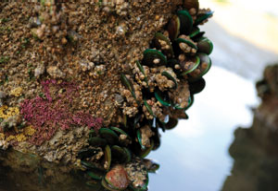
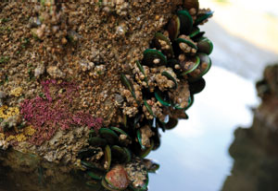
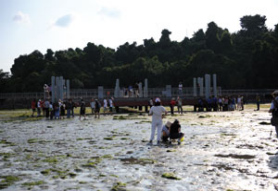
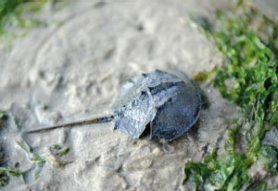
Marine treasures revealed during the lowest of tides, the large expanse of sand and mudflats teeming with diverse animals and plants usually only seen by divers. Chek Jawa Wetlands, located off the eastern coast of Pulau Ubin, is a unique nature enclave with one of the richest ecosystems in Singapore. PIONEER embarks on a journey of discovery and is awed by what nature has to offer.
"Can this be eaten?"
This is the most common question posed to Pulau Ubin volunteers Mr Robin Low and Mr Tan Teck Chye, whenever they take visitors on the guided tour of Chek Jawa.
The question gives volunteers the opportunity to draw links from what visitors are seeing to something familiar. One of the examples they like to give is the Nipah Palm, where you get the attap chee in ice kacang.
"The best moments are when they connect what they are seeing to day-to-day life, and their faces light up," said Mr Tan, a retiree who also volunteers at Sungei Buloh Wetland Reserve. "You then know you have brought the message across."
Chek Jawa was slated for reclamation in 1992, but after a nature enthusiast chanced upon the rich biodiversity of the land in December 2000, the government announced that reclamation works on the island would not proceed as long as the land was not needed for development.
Over 20,000 people have since thronged the inter-tidal flats, going on limited small-group guided tours during low-tide periods for a few times each month. This strict control is necessary to minimise damage to the fragile ecosystem.
"Even so, the many visitors in the past caused compaction of the sand flat and mud flat," said Ms Choi Yook Sau, the Senior Conservation Officer (Pulau Ubin) from National Parks Board (NParks).
"The compression is not good because it destroys habitats."
In view of the strong interest in the area, the government invested $7 million to put in place a long-term sustainable visitor management plan for Chek Jawa. Launched in July this year, the new amenities include a visitor centre with a viewing jetty, a boardwalk which is more than one kilometre in length, a floating pontoon and a 20-metre viewing tower.
New amenities at Chek Jawa were built with minimal impact on the environment. The use of simulated timber, energy-efficient lights, motion-sensor lights and solar-powered battery cells was deemed worthy of the Green Mark Gold Award.
"The whole development took two years," Ms Choi told PIONEER. "We had to be very careful where we piled - avoiding the sensitive areas and bedrock - and we needed to work with the tides."
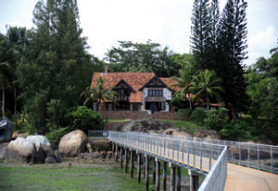
Members of the public can now begin their nature tour from the visitor centre, a Tudor-styled house built in the 1930s. Affectionately known as House No. 1, it was designated as a Conservation Building by the Urban Redevelopment Authority on 1 Dec 03.
The visitor centre is home to the educational exhibits and the Rescue Tank - a temporary habitat to allow injured marine organisms to recover before their release back to nature.
Visitors can then make their way to either the Coastal (600m) or Mangrove (500m) Loops to view the six different ecosystems in Chek Jawa - the rocky shore, sea grass lagoon, sand bar, coral rubble, coastal forest and the mangrove - all within an area of one square kilometre.
Keep your eyes peeled for the distinct red claw of the Fiddler crabs, the green carpets of sea grass and the nondescript sand dollar. Many of these plants and animals can no longer be found on mainland Singapore.
Learn how mangrove trees excrete salt through their leaves and how the sea hibiscus tree bark can be used to make string to tie up crabs. Some of the animals and plants also have medicinal value, which is invaluable in the search for new medicine and drugs.
Enjoy walking along Singapore s only natural coast, where the frys of fishes swim freely in the seagrass lagoon, protected by the sand bar. Watch how they hide among the mangrove roots from big predators when the waves recede.
The boardwalk route is generously peppered with educational panels and directional signs, as well as rest points and shelters. For a bird s eye view of Chek Jawa, head up the seven-storey-tall Jejawi Tower, named after the native Malayan Banyan that grows right behind the tower.
A DIY tour can be done any day of the week from 8:30am to 6pm, and should take about an hour-and-a-half to complete.
Visitors who wish to go off the broadwalk and onto the sand bar still need to sign up for guided tours with NParks.
"With the boardwalk, people can come as many times as they want and re-confirm what they see and learn," said Mr Low, who views Chek Jawa as an important conservation area for public education.
"This is especially important since Singapore is largely built-up, with children having limited exposure to nature," he said.
"The next generation have a right to see for themselves nature as it is."
To get to Pulau Ubin, take the bumboats from Changi Point Ferry Terminal. They operate from 6am to 8pm and each ride takes about 10 minutes. It costs $2 for a one-way trip. There are no fixed departure times as the bumboats only set off when there are 12 passengers.
From Ubin jetty, visitors can choose to cycle or hire a van to Chek Jawa. Walking there is also an option, but it would take almost 40 minutes. For more information, visit www.nparks.gov.sg.

ALSO READ IN COMMUNITY


Your backstage pass to NDP 2026
06 Aug 2026
Ever wondered what goes on behind the scenes of NDP? We take a peek behind the curtain to uncover the hard work that this year’s performers have put in since rehearsals began months ago.

What it takes to be a viral NDP mascot
25 Jul 2026
They’ve been stealing hearts as the lovable mascots at the National Day Parade (NDP). Meet the NSFs behind the costumes and high-energy dance moves.

State Flag Flypast charts new path
05 Jul 2026
For the first time, the State Flag Flypast will fly over the Kallang Basin, bringing this NDP tradition to new audiences.