
TECHNOLOGY
TAKING PRIDE IN INNOVATIONS
09 Oct 2013
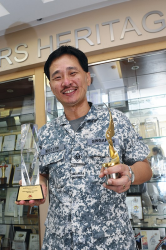
Since 1981, the PRoductivity and Innovation in Daily Efforts (PRIDE) movement has promoted a culture of innovation and excellence within the Ministry of Defence (MINDEF) and The Singapore Armed Forces (SAF). Here's a look at the three innovative projects and teams from this year which have come up with brillant solutionsfor a more effective SAF.
The virtual guardhouse
If you've been to an SAF camp, you will know that you have to pass through various checks at the guardhouse to enter the camp.
Now, imagine this in a networked computerised scenario, where the firewall acts as a guard against unauthorised access. If deployed correctly, it should be the last equipment that all users and information will pass through.
This is where the team from the Command and Control Information Systems, Signals Institute, comes in. They are the ones who set up the firewall system for the SAF and train SAF personnel to use it for operations.
Led by Master Sergeant (MSG) Murugesan Subramaniam, Team Specialists developed a simulation software that recreates the full capabilities of a firewall.
"Previously (with four hardware firewall devices in the training labs), about 10 trainees would just observe a firewall demonstration and didn't have much opportunity for hands-on training. When they went for exercises, the instructors had to accompany them, causing additional workload for both groups," said the 36-year-old Advanced Signals Specialist.
After eight months of development, the new software was implemented in July 2012. Trainees can now undergo a simulated hardware firewall training lesson to configure and deploy firewall devices, resulting in increased training effectiveness and efficiency.
"It gives us more confidence as we get to try out the firewall devices instead of just watching a demonstration," said Private (PTE) Gerald Ho, a member of Team Specialists.
The team also built in an auto-checking component to detect errors automatically and inform the trainees. In the past, instructors had to monitor the trainees' work closely and tell them whenever they made mistakes configuring the firewall.
Once troops master the skill of setting up the firewall during training sessions, they can transfer this knowledge into an actual operational environment where they manage an outfield network, thus supporting the SAF's information security structure on a division- or brigade-level setup.
A passion for innovation
Unit: Force Readiness Squadron
"Do things better and do better things." To the folks of the Force Readiness Squadron (FRS) from the Republic of Singapore Navy (RSN), it's a motto that they constantly uphold to come up with innovative ideas to make their work better.
"With these awards, the (FRS) guys tell me that they are more keen to contribute to the overall PRIDE," added ME3-3 Poh, who is Lead Engineer of the Electronic Warfare Branch.
"They want to go for higher awards and participate in national conventions. And when they're there, you can see that they really have a passion for their projects, and they're doing it for the pride of their unit."
Helping these teams is the FRS Innovation Team, otherwise known as the Inn Team. Made up of volunteers, it helps other teams when they encounter problems such as a lack of knowledge on getting funding and resources.
The deputy chairman of this two-year-old committee, ME3-3 Poh explained: "There is always someone who needs help in funding, resources or even how to enhance his projects. That's why we are here to help them as a facilitator and to network with other agencies."
Over the years, the FRS has introduced several outstanding innovations that have had a huge impact on the unit's work processes.
One such project was the enhancement of ships' Combat Management Systems (CMS). Team Rectifier from the FRS switched the AC cooling fans (used to cool the CMS) to DC ones, which were more reliable. This solution resulted in both improving the reliability of the CMS and enhancing the RSN's overall operational readiness.
Looking ahead, the FRS intends to increase ideas through the sharing of knowledge with the rest of the SAF, as well to spread the word and passion for innovation.
They are also looking to "refresh" the Inn Team with younger individuals, so that new and fresh ideas can be generated.
As for ME3-3 Poh, his passion and beliefs still lie with PRIDE. "As long as they need me, I will continue to stay in the team," he said with a laugh.
Training in virtual reality
Project: Virtual Reality Maintenance Training Simulator for F-16 Flight Line Crew
Unit: 5 Air Engineering Logistics Group
Before an F-16 takes off, a thorough inspection must be done. These include checks such as whether safety pins have been removed, if the movable parts of the wing and tail are working properly and whether the emergency power unit is sufficiently charged to last the whole flight.
Any issue found by the Flight Line Crew (FLC) has to be fixed before the aircraft is allowed to fly.
Pre-flight checks during launch and recovery checks after landing are both part of an FLC's job. And if an FLC trainee messes up the checks or takes too long, their instructor steps in and takes over so that the flight is not delayed further.
"If the pilot is rushing for time or if it's a critical sortie, he won't allow my trainees to launch the aircraft, and we'd lose out on a training opportunity," said ME3-1 Karthikayan. This was one of the reasons the Senior Instructor of Maintenance Training Flight created the Virtual Reality (VR) Maintenance Training Simulator.
Looking as though he is filming for a science-fiction movie, the trainee dons a black full-body harness with small silver camera balls strategically spread all over his body.
The balls form an avatar scheme, or a 3D image of the trainee. The trainee then puts on headgear that immerses him in a virtual space where he can touch and handle parts of the aircraft.
"In the past, we always had to depend on the aircraft's availability, but this VR system is always available for use. It is also not subject to weather conditions, and the trainee can use it as many times as he wants to improve his skills," said ME3-1 Karthik, who led Team Trainer.
Operationalised in mid-October last year, the virtual training simulator is now used across all F-16 platforms for FLC training. Using over 600 images of the actual aircraft to develop a 3D image of it, the VR system is as real as it gets. The team even injected engine noise into the surroundings to make the experience as seamless as possible.
For Corporal (CPL) Ives Chong, this realism in training not only gave him greater confidence in dealing with the actual aircraft launch, but also made training less stressful.
"It feels exactly the same as during an actual aircraft launch. Of course, I feel 'safer' using the simulator as I know that it's okay even if I make a mistake!" said the Air Force technician, who had trained in the facility for about four months (at time of print).
Another advantage of this simulator is the inclusion of 15 malfunction scenarios. These expose the trainees to possible and dangerous problems which could arise, giving them a chance to practise safely on malfunctions which are rare occurrences during actual ground training.
Safety was another key issue for the team of five when developing the simulator. Trainees sometimes experience "falcon-bites" (RSAF lingo for minor injuries from bumping into aircraft) during actual training. In the VR world, this risk may have been completely removed, but it does not mean that the trainee will get away with bumping into the virtual aircraft.

ALSO READ IN TECHNOLOGY
Locked & Loaded: SAF Shooting Contingent weapons
26 Nov 2025
AI joins the fight in national cyber defence exercise
12 Nov 2025
AI and closer collaboration among agencies and industry are taking centre stage in this year’s Critical Infrastructure Defence Exercise (CIDeX).
They built this city
01 Oct 2025
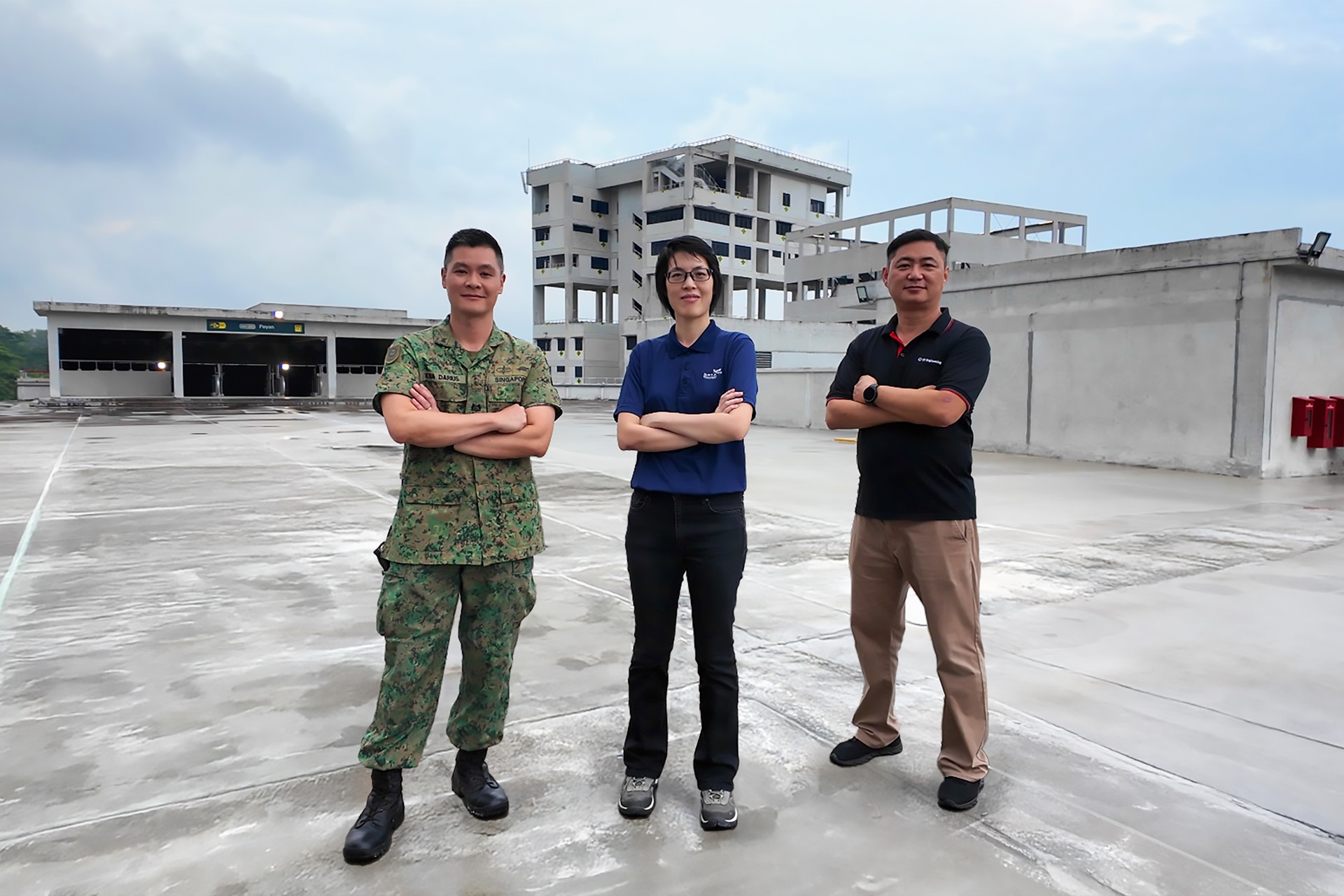
Turning vision to reality: the team behind SAFTI City clinches the Defence Technology Prize 2025 Team (Engineering) Award!