
TECHNOLOGY
NURTURING THE SCIENTISTS OF TOMORROW
17 Mar 2009
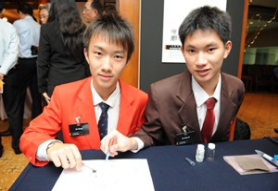
In any research project, practicality is always a top priority and at this year's Young Defence Scientists Programme (YDSP) Congress held at Orchard Hotel on 16 Mar, Minister for Defence Teo Chee Hean commended two teams for keeping this in mind.
One of the teams came up with a hydrophobic membrane capable of soaking up oil while repelling water while the other found a better way to uncover defects in microchips, all in the span of three months.
The two teams were working on these projects under the YDSP, which encourages young, bright students to research defence science and technology.
In his keynote address at the event Mr Teo highlighted the critical role that the Ministry of Defence's (MINDEF's) 5,000 defence scientists and engineers play in Singapore's defence.
He cited various examples of their achievements and added: "One key advantage that our engineers and scientists provide is technological customisation to the unique requirements of the Singapore Armed Forces. Our equipment may look the same as others, but our engineers and scientists allow us to give them that something special, that little extra that gives them the edge - often a decisive one."
The event, organised by the Defence Science & Technology Agency (DSTA) and DSO National Laboratories (DSO), aims to engage bright students at a young age and build a ready and able pool of defence scientists and technologists to aid in the defence of Singapore.
The team that came up with the membrane that would repel water while absorbing organic solvents such as toxic oils comprised Gu Tianyu of River Valley High School and Tan Ding Jie of Hwa Chong Institution.
Said Mr Teo of the project: "Their work will have direct applications such as in oil spills where oil needs to be efficiently separated from seawater."
The other team comprised Fiona Ng Jia Hui and Tan Yang Chong from National Junior College. Their project improved on existing methods of de-layering Integrated Circuit (IC) chips for failure analysis.
Mr Teo commented that "their work will have direct applications in improving the reliability of advanced electronic devices used in modern defence equipment" as IC chips are fundamental components of any electronic device.
Thirty-one students were presented with the YDSP Scholarship and 54 Integrated Programme students, who attained exceptional results in Physics and Mathematics, were given the YDSP Academic Awards at the Congress.
The YDSP has grown from a 20-participant programme to a 300-participant one, featuring the brightest young minds in the nation. It serves as a platform through which Singapore develops and maintains a core group of scientists and technologists to boost its defence endeavours.
In concluding his speech to the budding scientists at the congress, Mr Teo said: "Defence engineering and research and development requires talented individuals like yourselves who have the intellect, dedication and passion to pursue possibilities and break new grounds... I hope that one day, you will join MINDEF and contribute to the defence and security of Singapore."
16 Mar 09 - Speech by Mr Teo Chee Hean, Minister for Defence, at Young Defence Scientists Programme Congress 2009

ALSO READ IN TECHNOLOGY


Locked & Loaded: SAF Shooting Contingent weapons
26 Nov 2025
AI joins the fight in national cyber defence exercise
12 Nov 2025
AI and closer collaboration among agencies and industry are taking centre stage in this year’s Critical Infrastructure Defence Exercise (CIDeX).

They built this city
01 Oct 2025
Turning vision to reality: the team behind SAFTI City clinches the Defence Technology Prize 2025 Team (Engineering) Award!