
COMMUNITY
CHEERS TO THAT!
30 Jul 2005
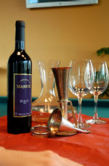
Sipping on that glass of wine at the local pub or at a friend's wedding banquet, not many are likely to ask where it came from and how it was made. In fact, to the uninitiated, the Shiraz and Merlot would probably taste the same. But that's set to change with the increasing number of wine appreciation classes that are sprouting up in community clubs. PIONEER delves into the sophisticated world of wines and checks out one such class offered by SAFRA Town Club for its members.
The wine industry has the movies and media to thank for jumpstarting its engines. Often portrayed as a 'high-class'' activity, the intoxicating allure was hard to resist - anybody who hoped to be somebody yearned for that glass of red or white.
In Singapore, businessmen were one of the first to pick it up. Wine was an effective lubricant for smoothing over business deals and added that extra touch of class. The wine-drinking trend has gone into full gear since then, with the discovery of health benefits and Westernisation of our culture. Now, even housewives and students are discovering the pleasures of wine-drinking.
Taking to the bottle
According to wine expert Mr Mark Foo, Director of Foo's Group, which produces Majestic wines, any fruits or vegetables can be made into wine.
"But when we are talking about red and white wine, we are of course referring to grapes," said Mr Foo, who has organised many wine appreciation courses to help educate the public about wine-drinking.
There are a huge variety of grapes that can be used. Some renowned grapes for making red wine include Cabernet Sauvignon, Shiraz, Merlot, Pinot Noir, Grenache and Mourvedre.
For white wine, we are looking at Chardonnay, Riesling, Semillion and Sauvignon Blanc. Different grapes have different characteristics, so there is a totally different process for maturing them.
"But generally, in wine-making, Cabernet Sauvignon will fall into the top few categories, because basically, it is a grape of complexity. There are different varieties depending on how you actually cultivate the crops - some wine-makers even blend their wines. The Cabernet Merlot, for example, is made using Cabernet Sauvignon grapes with Merlot grapes," said Mark.
"Of the lot, the Merlot comes in the junior category, as it is not such a dominant grape."
From start to finish
Wine is made through a fermentation process and traditionally, the grape skin, stalk and seeds will actually act as natural yeast for the fermentation process. But now, with the introduction of 'New World wine', yeast is added to hasten the process. Also, the preservative that is used in red wine is sulphur dioxide and ascorbic acid for white wine.
With the advent of technology, gone are the days of handpicked grapes. Mechanical harvest machines have since taken over to pluck the grapes and strip the branches. Once the grapes are harvested, they are first sent for crushing, then fermentation for about three to 21 days.
For white wine, the grapes need to be placed in a chiller at about 15 to 18 degree Celsius after plucking, but not for red wine.
After that, they are sent for pressing to extract the juice. For white wine, the grape skin and seeds are removed, but for red wine, everything is used, sometimes, even some stalk.
Next is the maturing process, which can take three to 24 months, depending on the grapes involved. The Cabernet Sauvignon, for example, needs a longer time to mature as compared to the Merlot.
The last few stages involve blending, which takes about a day, then filtration and bottling. The bottled wine is usually stored in the vineyard for one to two years before it is released to the market - depending on the vineyard owners and their foresight (or speculation!) on when it will fetch a higher price.
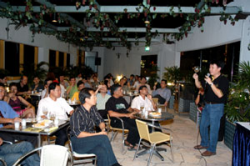
SAFRRA Town Club offers wine appreciation classes.
Wine country
Mr Foo explains that different countries have found their various niches. For example, for Australia, which started producing wine in the 1800s, 'New World wines' that appeal to the masses is the way to go.
In France and Italy, where wine-making has a long history, they tend to make wine in their own tradition - thus not as acceptable to that many palates.
Needless to say, the skill of the wine-maker is also crucial, said Mr Foo, as he is the one who makes key decisions on harvest and production. Other factors that affect wine production include climate and the size of the vineyard.
Climate is important, as different temperatures will cultivate different characteristics in the grapes. Generally, warmer climates are favoured.
As for vineyards, the smaller vineyard (also known as the boutique vineyard) has a smaller harvest yield. This will definitely produce better grapes because there is little competition from other plants for nutrients in the soil and better sunlight.
Good wine is...
Although good wine can be said to be up to each individual's preferences, there is a benchmark for every country.
"Respective wine judges will organise annual or quarterly competitions or wine-tasting (ranging from local estates to international expos). Besides being recognised by judges, a good wine also has to be accepted by the majority of the public," said Mr Foo.
In addition, not all wines taste better when kept longer. For wines that are meant to be kept, it means the maturing process is longer - maybe even 10 to 15 years.
Even though it is bottled, the maturing process is still ongoing. For such wines, the label usually states how long it needs to be kept before it is consumable - for the wine to reach its maximum maturing process and its full flavour to be released.
As for vintage year, it refers to a year where the climate is very conducive for rich vine harvests and thus, the production of good wine.
Fill' er up
For some SAFRA members, wine-drinking has become an integral part of social gatherings and they are also drawn to the health benefits of drinking red wine.
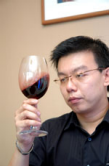
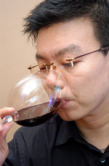
"I enjoy the company I have over a glass of wine and it is supposed to be healthy too," said Mr Gerald Tan (left), who picked up wine-drinking after trying a miniature bottle of Chardonnay on a flight to the US about three years ago.
"From what I heard, it can cleanse your body of toxins and one glass a day is supposed to be good for your heart," added Mr Steve Ngoi (left), who drinks about once a week over dinner or gatherings with friends.
Red wine is said to contain polyphenols, a type of anti-oxidant that reduces cholesterol levels in human beings, prevents cancer and heart diseases.
According to Mr Tan, it is also rich in vitamins and recent studies have shown that drinking red wine can lengthen life span and lead to weight loss.
With such advantages - not only a healthier, but also slimmer body - it certainly seems that wine-drinking is here
to stay.
- Astringency: Sharpness or roughness derived from the tannins, particularly evident in young wines. It can be an indication of the keeping potential of the wine.
- Body: Weight of the wine in your mouth
- Bouquet: Smell of the vapours of the wine
- Finishing: The lasting taste of the wine after swallowing it
- Nose: Aroma of wine, smell of the grapes
- Palate: Taste of the wine
- Tannins: Residue that is derived from the stalk of the grape and even grape skin. It tends to dissipate with time. When we say the tannins is heavy, it means it is a bit rough and aggressive to your throat.
- Texture: Smooth or velvety, or like water with no texture
Prelude:
Wine should be stored in a cool, dark place, away from heat and temperature fluctuation - ideally, in an air-conditioned, insulated shed or cellar. The wine bottles should also be placed horizontally or at 45 degrees to prevent the cork from drying up and spoiling the quality of the wine.
Wine should not be kept too cold because it will then not allow for much oxidation or what we call 'breathing' to dissipate the effects of the preservatives when it is opened. If the wine cannot breathe, the full aroma or the full potential of the wine is not released.
So preferably, for the best taste for good wines, the ideal temperature it should be drunk is at about 18 to 22 degree Celsius.
As for the apparatus for drinking, if you can afford it, go for crystal glasses. The material is thinner so you can taste the wine better and it enhances the palate. If not, get a plain glass and NOT coloured glass so as not to distraught the colour of the wine.
For red wine glasses, get a deep and wide bowl, with the brim tampered out towards your mouth. If the mouth of the glass is wide enough, the aromatic compounds can be released more generously. The deep bowl is for swirling.
It is bigger than white wine glasses because it needs more space to breathe even in a glass, the maturing process is still going on.For wine enthusiasts, a decanter is also recommended to stabilise the wine.
Step one - When you pour wine in the glass, make sure it is not too full, so there is space to swirl the wine. Only hold the stem of the glass because you don't want to warm the wine with your body heat and distraught the taste.
Step two - Put the wine under a light source to see the colour of the wine. For red wine, the older wines start to fade from deep red in the centre to brownish-red at the rim. Bright or striking red probably indicates it is a very young wine as the maturing process discolours the wine.
Step three - Swirl the wine gently to enhance the oxidation / breathing process. This will help release the aromatic compounds of the wine.
Step four - Tilt the glass towards your face and stick your nose slightly into your glass to appreciate the bouquet of the wine for three to four seconds.
Step five - Take a good mouthful of wine and try to spread or roll it around your mouth as thoroughly as possible so the various tastebuds on your tongue will be in contact with the wine. Swallow the wine and if the aftertaste lingers in your throat, it has a long finish the mark of good wines.






ALSO READ IN COMMUNITY


MINDEF launches new network for volunteers to contribute to national defence
12 May 2026
Whether you’re young or old, a Singaporean, PR, new citizen or foreigner, the Singapore Defence Volunteer Network offers new and expanded opportunities to take part in the nation’s defence.

Letters from my mum
06 May 2026
This Mother’s Day, servicemen share the heartfelt letters they received from their mums during their BMT field camp.
Every Singaporean Son IV: Meet our Specialist Cadets
09 Feb 2026
Who are the sons (and daughters) hoping to earn their chevrons? Watch the latest season of Every Singaporean Son, as they enter Specialist Cadet School on their way to becoming leaders in the SAF.