
COMMUNITY
AMAZING SCIENCE IDEAS FROM AMAZING SOURCES
18 Sep 2015
Who says watching TV is a waste of time?
Certainly not Temasek Junior College (TJC) Year One student Soh Su Min. As a matter of fact, she turned a TV serial plotline into a medal-winning idea.
"I was watching a Japanese drama and the lead character of the show was a physics genius. (I got the idea from something) he demonstrated on the show," said the 17-year-old.
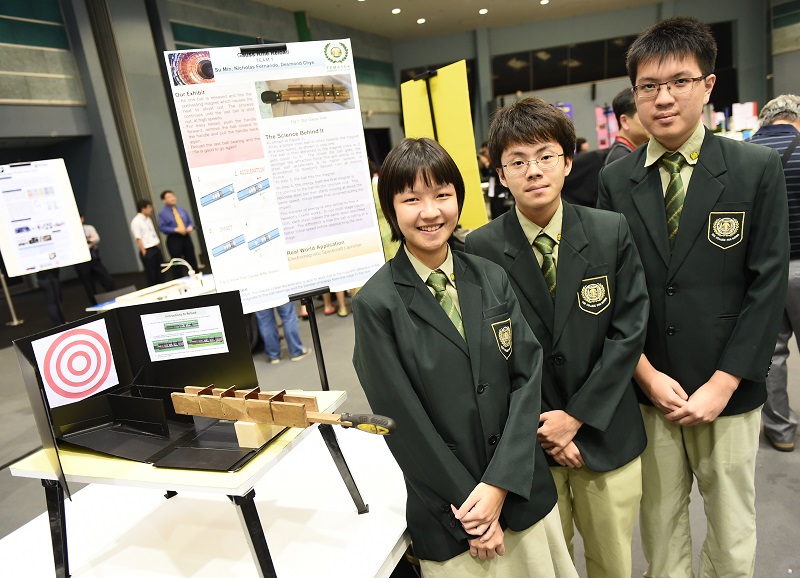
Together with her teammates, Desmond Chye and Nicholas Cristian Fernando, she created a model of the Gauss rifle, a gun that fires steel ball-bearings without the use of gunpowder or explosives. Using a series of magnets and the transference of kinetic energy, a gentle tap can speed up the movement of the ball-bearing towards its target.
On top of being more environmentally-friendly since it does not require explosives, the magnetic gun could potentially be used by soldiers and policemen during training or to slow down an assailant.
"This mechanism, if used correctly, is non-lethal," she explained. "Soldiers might not be able to use it (in a war situation). But if it's for shooting to incapacitate, such as in the case of policemen, this can be used. (It could be useful) for training as well."
This simple and yet ingenious machine won their team the Silver medal in Category C (for Secondary School and Integrated Programme years five to six, Junior Colleges and Institutes of Technical Education) at the Amazing Science-X Challenge (ASXC).
The team from TJC was one of 125 that had participated in this year's ASXC. Organised by DSO National Laboratories (DSO), the National University of Singapore (NUS) Faculty of Science, and Science Centre Singapore (SCS), the ASXC saw students from Primary School to tertiary institutions designing and building exhibits that explained particular science phenomena.
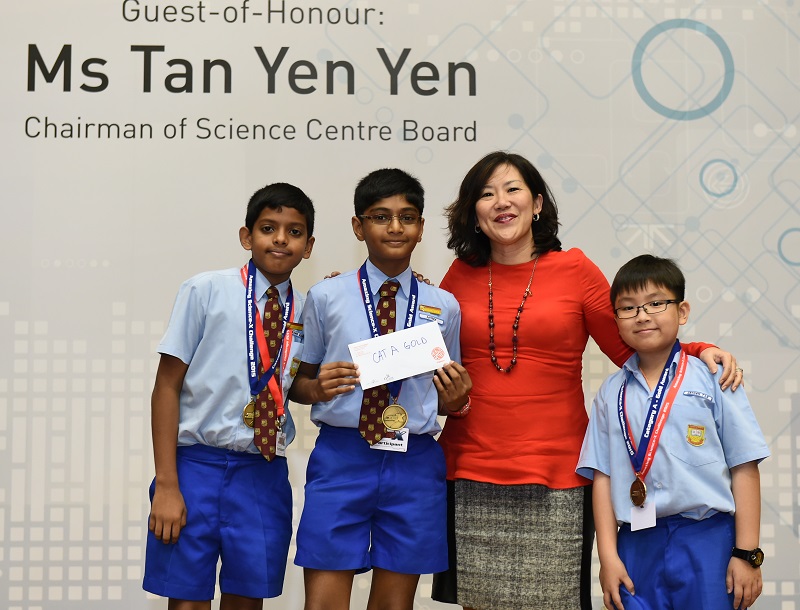
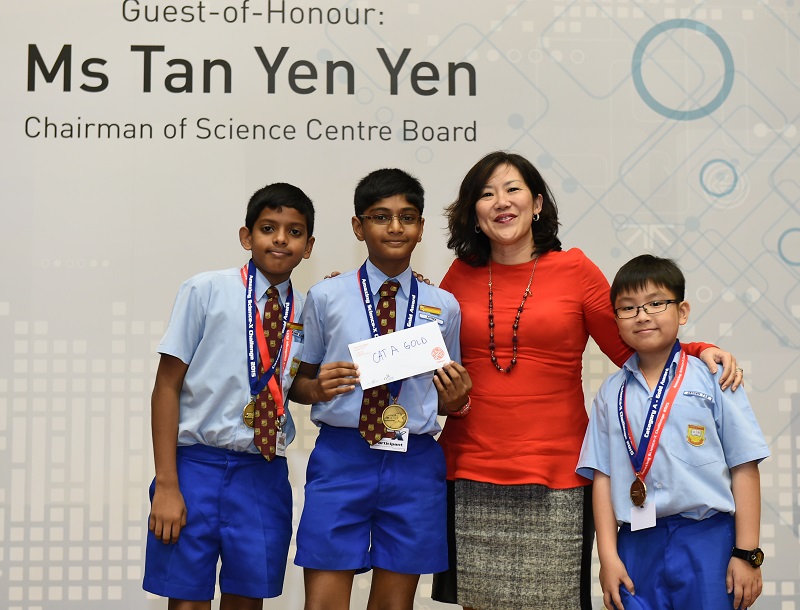
This is the first time, since its inception in 2009, that the ASXC has seen gold medalists in all its four categories. The gold medal is only given to exhibits that satisfy all the judging criteria and display qualities such as clarity and creativity.
Speaking at the prize presentation ceremony at the SCS on 18 Sep, SCS Chairman Tan Yen Yen attested to the high level of quality in the ideas and exhibits presented.
"Over the years, we have seen an increase in the number of teams participating in ASXC. This, coupled with the impressive quality and creativity that we see, has also made us recognise and award medals - Gold, Silver and Bronze - without placing a limit on the number of awards."
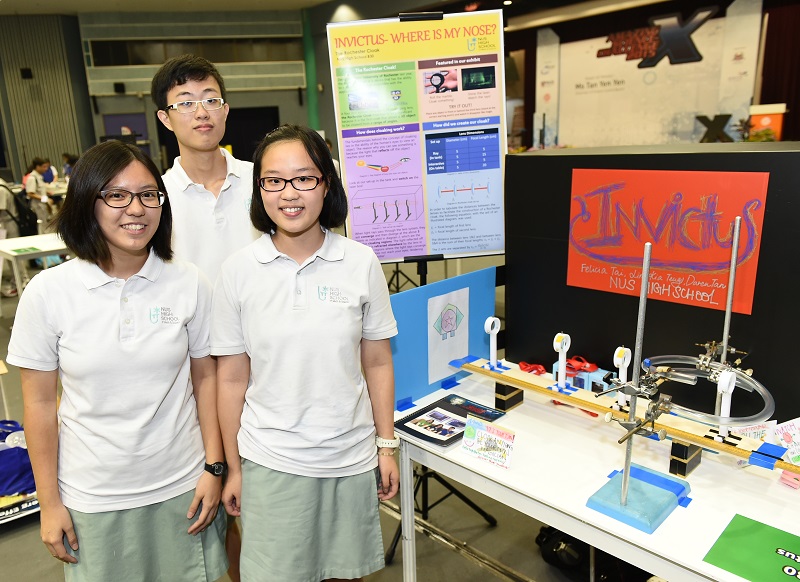
Another team that found real-life applications for scientific concepts is NUS High School s Invictus. The trio of Year Four students, comprising Felicia Tai Ying Fei, Lim Kia Teng and Daren Tan Jun Heng, became fascinated with the Rochester Cloak after coming across an article online. Their interest was further piqued when they discovered that the phenomenon, which takes advantage of the bending of light as it passes through convex lenses to conceal objects from the viewer's line of sight, could be seen in day-to-day tasks.
Said Kia Teng: "The phenomenon of cloaking is new to us. It's an application of what we learnt in physics about how convex lenses work. We also discovered the applications of cloaking, which are used in surgeries and traffic."
The team was pleased to take home the Gold medal in Category B (for Secondary School and Integrated Programme years one to four) of the competition, especially first-time participant Daren. Kia Teng and Felicia had previously won Silver in the same category.
"This is the first time I'm joining and we won the gold, so I'm very excited," he said.
For 11-year-old Sanjaay Babu, his winning idea came closer to home: "My elder brother had done (a similar) experiment in school. He gave me the idea for my experiment."
To demonstrate the concept of eddy currents, Sanjaay and his teammates, Patrick Francis and Zenden Tan from Riverside Primary School, wanted to stop a spinning metallic disk attached to an electrical current with a magnet. Sanjaay improved on his brother's experiment by replacing the compact disk (CD) he used with a round disk made of aluminum foil. This allowed them to stop the disk more quickly.
Despite having conflicting schedules, the Primary Five students learnt to cooperate by taking charge of different aspects of the project while supporting each other in their respective roles.
"Although we had split up the work, it was still a team effort," said Sanjaay.

ALSO READ IN COMMUNITY

MINDEF launches new network for volunteers to contribute to national defence
12 May 2026
Whether you’re young or old, a Singaporean, PR, new citizen or foreigner, the Singapore Defence Volunteer Network offers new and expanded opportunities to take part in the nation’s defence.
Letters from my mum
06 May 2026
This Mother’s Day, servicemen share the heartfelt letters they received from their mums during their BMT field camp.
Every Singaporean Son IV: Meet our Specialist Cadets
09 Feb 2026
Who are the sons (and daughters) hoping to earn their chevrons? Watch the latest season of Every Singaporean Son, as they enter Specialist Cadet School on their way to becoming leaders in the SAF.