
TECHNOLOGY
UNIQUELY SINGAPORE SHIP IS SMARTER, FASTER, SHARPER
03 Jul 2015
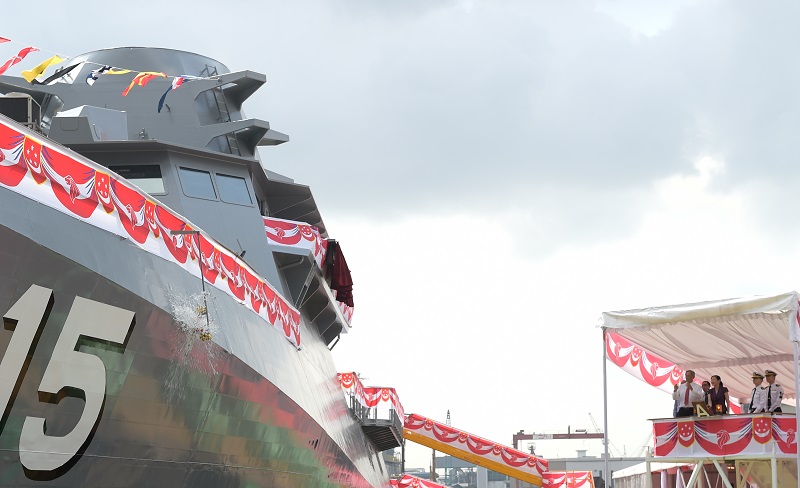
There's a new ship on the horizon. And its name is Independence.
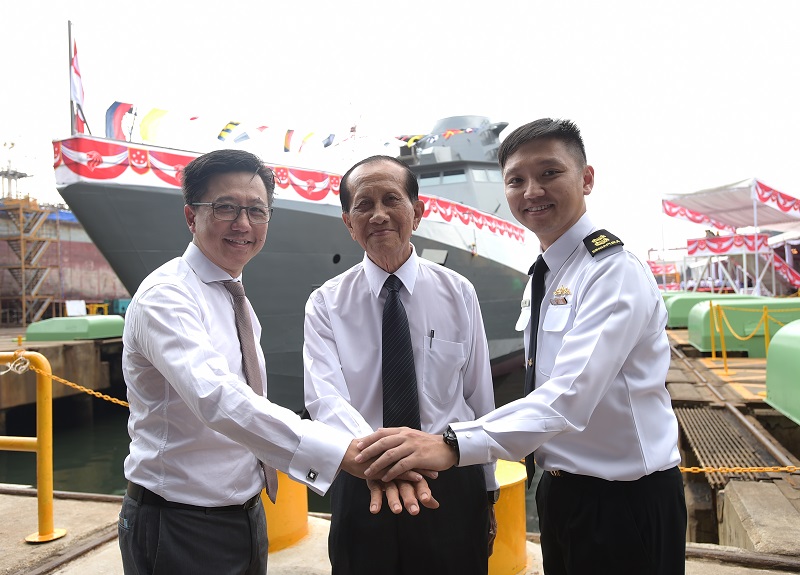
The Republic of Singapore Navy (RSN) commemorated the launch of its newest ship, the first Littoral Mission Vessel (LMV), Independence. Held at the Singapore Technologies Marine (ST Marine) yard on 3 Jul, the launching ceremony was officiated by Minister for Defence Dr Ng Eng Hen. The LMV was launched by Mrs Ivy Ng, wife of Dr Ng.
Addressing the guests at the ceremony, Dr Ng reiterated the RSN's role in protecting Singapore's sea lines of communication, which are vital for the nation's economic well-being.
He said: "It was dominantly due to the fact that the people of the RSN believed fervently in this mission - they believed that they could protect the waters around us - that we have continually moved 'onwards and upwards, never looking back', and that today, we are able to stand here together, amid peace and security of our surrounding seas."
Uniquely Singaporean
In his speech, Dr Ng also highlighted that the LMV was "uniquely Singaporean, having been planned, conceptualised and built locally to meet our requirements".
The launch of Independence marked the first time a Navy ship was completely designed and built in Singapore. A total of eight LMVs, including Independence, would be built by ST Marine locally, based on a design jointly developed by ST Marine and Saab Kockums AB.
The RSN worked closely with the Defence Science and Technology Agency (DSTA) for about three years to determine its engineering, logistical and operational requirements, before contracting ST Engineering Ltd in January 2013 for the LMV construction.
Smarter, faster and sharper
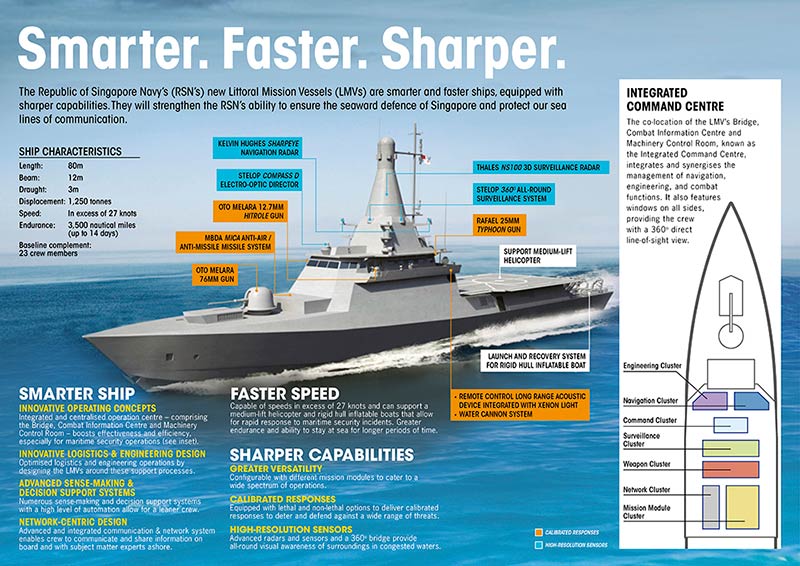
The LMVs are smarter and faster ships, equipped with sharper capabilities. They can be configured with mission modules to suit a wide spectrum of operations. Lethal and non-lethal options also allow them to deliver calibrated responses and defend against different types of threats.
With Singapore's decreasing population, manpower considerations were a priority. Thus, the LMVs were designed to maximise the potential of a leaner crew.
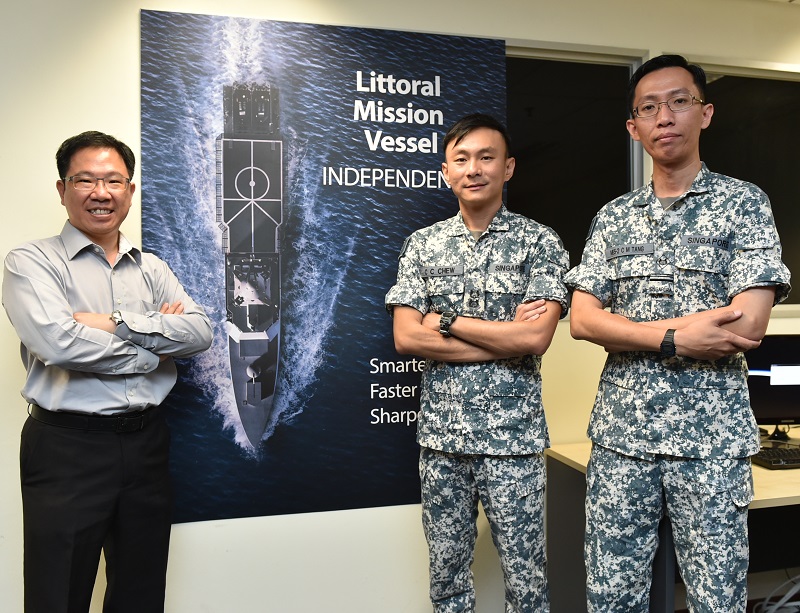
Explained Lieutenant Colonel (LTC) Chew Chun-Chau, Head of the LMV Project Office: "Using technology to replace mundane, low-end tasks allows the crew to (concentrate on) the high-end tasks. This will not only tap on the knowledge of the better-educated crew, but also enable us to operate with a much smaller crew size."
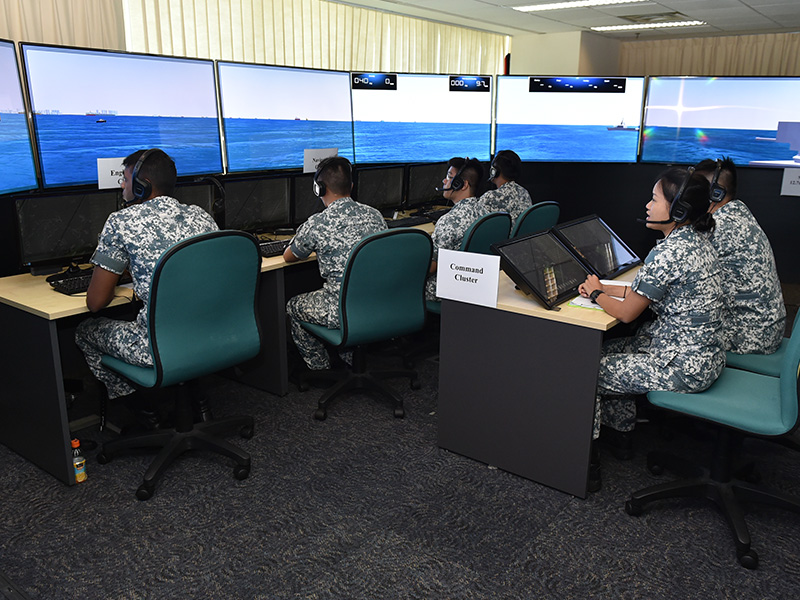
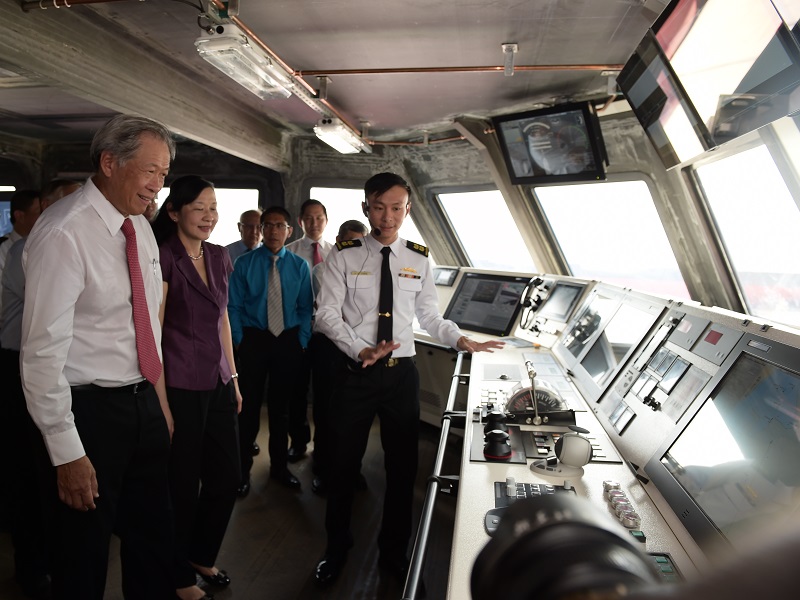
One of the key design features of the LMV is the Integrated Command Centre (ICC). Where previously the Bridge, Combat Information Centre (CIC) and Machinery Control Room (MCR) were located in different parts of a ship, the three would now be co-located in the ICC. This will integrate and synergise the management of navigation, engineering and combat functions.
On top of this, the 360-degree bridge with windows on all sides will provide an unobstructed view of the sea lanes.
Another key feature is in "designing the support", where maintainability of the ship's equipment is a primary consideration. Previously, the ship's design centred on "supporting the design", with emphasis being placed on the ship's capabilities. This meant that the priority was to acquire the best parts and equipment for the ship, while considerations for support and maintenance came after. Crews would have to learn to adapt to the limitations of the equipment.
"This time around, the RSN and DSTA worked together with subject matter experts from our maintenance bases to look at the capabilities of the systems and also the long-term supportability - how the systems could be designed in a more reliable manner, with more robust redundancies and to be more maintainable, so that it's more effectively and efficiently supported in the long run," explained Military Expert 5 (ME5) Tang Chee Meng, Principal Engineer in the LMV Project Office.
"We are moving into a new era where we make designs that are user-centric instead of the traditional technology-centred approach," said Mr Matthew Yong, Programme Director of Naval Systems in DSTA. "We filter what we term 'latent requirements' - not (just) what they ask for, but what they need, and bring it out so that we design to meet their requirements."
With the maintenance and support processed streamlined, real cost and man hours are also reduced, and turnaround time between missions is also shortened. This will enhance the operational readiness of the ship.
"It's a mindset shift to place support in its proper standing," said ME5 Tang.
Passing on the baton
At approximately two-and-a-half times the size of the Fearless-class Patrol Vessels (PVs), the LMVs are set to replace their predecessors in watching over Singapore's waters.
LTC Tay Choong Hern, who will be the first Commanding Officer (CO) of Independence, looked forward to working in the new ICC. He was CO of PV RSS Fearless from 2012 to 2014.
"These (the Bridge, MCR and CIC of the PV) are located separately; and not seeing one another, we rely on communications to make decisions and get situational awareness. With this Integrated Command Centre, we are able to have everybody co-located, using the same Command and Control System and have the awareness that we previously couldn't have."
He added: "The 360-degree bridge allows us to look out further. For the type of operations and the area we are in, it has very much improved the amount of time taken to make a decision, the awareness that we can have out of the window so that we can deliver sharper responses."
LTC (Ret) Lim Hock Chye, who was the first CO of PV RSS Independence, was impressed by the automation level of the new LMVs: "This is the way to go. Automation not only allows you to run the ship efficiently, it is also more effective in terms of speed."
He added: "I must say that the people operating this ship are far more capable, because this new generation is educated, fast, and very sharp. I believe that the LMV will outperform most of the ships from the previous generation."
Independence is expected to be fully operational by 2017, and all eight LMVs, fully operational by 2020.

ALSO READ IN TECHNOLOGY
Locked & Loaded: SAF Shooting Contingent weapons
26 Nov 2025
AI joins the fight in national cyber defence exercise
12 Nov 2025
AI and closer collaboration among agencies and industry are taking centre stage in this year’s Critical Infrastructure Defence Exercise (CIDeX).
They built this city
01 Oct 2025
Turning vision to reality: the team behind SAFTI City clinches the Defence Technology Prize 2025 Team (Engineering) Award!