
COMMUNITY
UNDERWATER TEAM PUCK
28 Jan 2006
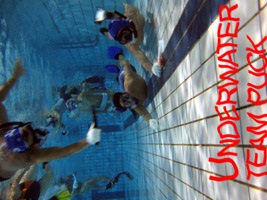
The unique sport of underwater hockey combines swimming, diving and hockey skills. Conceived in the UK during the 1950s to help divers maintain 30 countries worldwide, including Australia, Belgium, the Philippines and the United States.
In Singapore, underwater hockey is still in its infancy stage. In a bid to share their passion for the sport, three expatriates Filipinos Joey Carpio and Christine Alindada, together with Australian Greg Bush introduced underwater hockey to local aquatic sports fans in August 2004.
'On my way here, one of my peers at the Philippines club said playfully: 'Hey, why not start a club there? There is an ex-national player from Australia based there now, why don't you guys hook up?'" said Joey, who also played underwater hockey for the Philippines.
"I thought, why not? We love the sport!"
"We started off with a couple of small groups and brought them down for an evening session," he added.
The club accepts swimmers of varying proficiencies and membership has since grown to about 30 regulars. At the twice-weekly underwater hockey sessions, about 16 to 24 players turn up including two to three female players. The club is also the most diverse worldwide, with players from 10 countries.
Everyone plays together, regardless of age and gender.
"The three-dimensional underwater world kind of neutralises tall people. Height is countered to a certain extent through movement and speed," said Joey (left).
"The 3D aspect is also the fun part about the game. Unlike terrestrial sports where you look left, right, front and back, in this game you can be attacked from above and also get interference from below!"
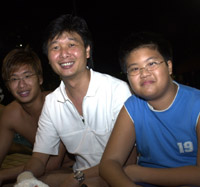
The youngest player in the fold is twelve-year-old Jerryl Twang. Together with his father Mr Twang Say Koon and elder brother Darryl, he started off with mono fin swimming before finding out about underwater hockey during the club's early days.
"I think the interest in water sports runs in the family. We all enjoy it and it is a time for family bonding. The game is also very relaxing and helps to relieve the pressure from work," explained Mr Twang.
As for young Jerryl, he simply likes "everything" about this new sport and looks forward to picking up new skills every week.
The length and breath of it
According to Joey, the first assumption that people usually make about underwater hockey is that it is about holding one's breath as long as possible.
"It is more about holding your breath when it is necessary, and being underwater in the right position," he explained.
"No one can hold their breath forever anyway. A good team is able to alternate their players' diving so they maintain possession of the puck."
But having an astute game sense takes time. Even some veteran players have lapses, especially when fatigue sets in.
"You know where you want to be, but it is one thing knowing where you want to be and another to actually get there. There's always a delay," said Joey.
Beginners normally start by pushing the puck around the bottom of the pool, but as they get better, they soon learn to take advantage of the angled edge of the stick to make the puck fly anywhere from one to three metres.
To excel at this sport, it helps if the player is fit and regularly attends practice sessions to gain experience. A 'killer instinct' and a do-or-die attitude, however, can sometimes make the difference in scoring a goal.
A sport like no other
Many of the club members are drawn to the sport because of the challenge of playing in an underwater arena.
"It is a different level of play as compared to land games," said Ms Huang Huiling (left), one of the club regulars.
"Although they both involve team play and strategy, you need breath control in underwater hockey. It is quite addictive trying to improve on them both!"
"It is already so hard playing on land, passing and scoring goals, so in the water, the coordination needs to be even better."
For Mr Samuel Wong, underwater hockey is one of the few truly anaerobic sports.
"You literally do not breathe when you are playing, and that in itself demands a different type of fitness altogether," he explained.
"It's ideally pertinent to people who dive, who enjoy water sports like snorkeling or free diving. Even for non-aquatic sport lovers, it has its benefits. It is a very low-impact sport, unlike jogging and aerobics, which can strain your joints."
Also extolling the game's fitness benefits was CPT Dickson Kuak (left), who started playing underwater hockey about six months ago.
"Your fitness builds up after each session and I think it is good for people in the Navy as it is good cardio fitness exercise and increases your overall competitiveness and alertness to the situation around you," said the Head of Shipping Research Section from the Republic of Singapore Navy's 180 Squadron.
Watch those flailing fins
Being aware of the environment is important in this sport, especially since players dive to the bottom and up for air at their own time throughout the game.
Underwater hockey is a non-contact sport, but players will still experience some bumping around from flailing fins and limbs.
To minimise the risk of injury, substitutes are also not allowed to just jump into the pool if there are players underneath. Also, nobody is supposed to flick the puck anywhere towards an opponent's invisible box a protected zone from his shoulders to the head.
"We do get scrapes and bruises, but that is to be expected, just like in any other sports," said Samuel (left).
Expanding the pool
The club is currently looking into sharing their passion for underwater hockey with others. One of its main goals is growth through expansion to other organisations sports clubs, schools, military or community groups.
"We are very interested in speaking to the different groups, for setting up their own clubs or coming up with programmes for them," said Joey.
"Of course, we are restricted by the number of people and resources we have, but we will volunteer whatever help we can, to see how we can work with them."
He added earnestly: "If we can get more teams, especially from the military where the guys are fit, ship-shape, we will all really benefit from the competition!"
Joey and his club members' dream of growing the sport enough to organise an underwater hockey league in Singapore and from there, generate a team to represent the nation in the Underwater Hockey World Championships a biennial international competition.
So, time for underwater hockey instead of standard Physical Training for fitness conditioning?
Jump in!
The Singapore Underwater Hockey club plays at the Queenstown Swimming Complex every Tuesday and Friday from 7.30pm to 9pm.
Call Mr Joey Carpio at 97423553 or visit suhc.multiply.com for more information.
Take the plunge
Picture yourself sprinting across a field for a rugby touchdown while holding your breath at the same time. Now, throw in a few people from the opposing team who will try to take the ball from you before you reach the end of the field.
That in a nutshell, sums up what playing underwater hockey felt like to me after my hour-long session with the members of the Underwater Hockey Club at Queenstown Swimming Complex.
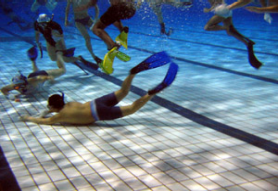
To jump-start my foray into the sport, Samuel gave me a short tutorial on the easiest method to dive to the bottom of the pool. Basically, while swimming on the surface, I should tuck my head down and bend my body at the waist about 90 degrees and fin my way to the bottom.
That was easy enough and the next step was to try pushing the puck around at the bottom of the pool to get a feel of it.
Excitedly, I dived again in search of the puck. But as it was right under me, I had some difficulty getting to it. I then picked up another useful tip - start diving with the puck positioned ahead of me so by the time I get to the bottom of the pool, the puck will be right where I want it.
I got into the game proper right after that and the plan was to get a touch of the puck in a real game. I figured I would just plough ahead and follow what the rest of my team mates were doing.
Unfortunately, it was easier said than done. Like a deer caught in headlights, I was not too sure which direction to swim to or how best to help my team mates. I ended up hovering at the surface a lot or hanging too far back initially, trying to protect the goal.
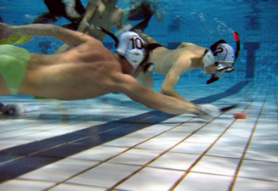
I will never forget coming stick-to-stick with an opposing team member as we pushed the puck in between us. I was literally pushed backwards as I relied on my arm strength instead of finning forward to stop the charge forward.
I was already panting after the first few plays, with each time that I finned furiously to the surface to purge the water in my snorkel with a mighty "whoosh".
How to play
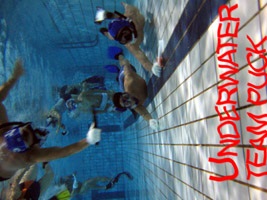
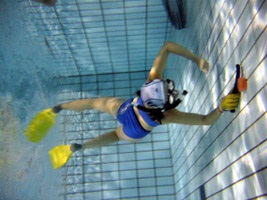
There are two teams, one wielding 30cm-long black sticks and the other, white. Each team has 10 players (of which four are substitutes). At any one time, only six players from each team are in the water.
The game is played in a pool with a length that ranges from 21 to 25m, a width of 12 to 15m and a depth of 2 to 3.5m.
Two canal-like troughs measuring 3m wide, 18cm high and 30cm deep are placed separately at opposite ends of the playing arena and the objective is to push or flick the puck into the opponent's goal as many times as possible within the regulation time of two 15-minute halves with a three-minute half-time interval.
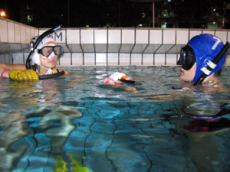
Players don water polo caps, masks, snorkels, gloves and fins while playing.
The two teams start off each play at opposing ends of the playing arena and swim towards the rubber-coated lead puck that lies right at the middle, at the bottom of the pool, when the referee gives the cue.
When someone scores, the play ends and the next one is started with the puck back in the middle again.
I now knew what the players meant by good cardiovascular exercise!
It was exhausting, but the bewildering thing was, everyone including me just kept going back down to get into the thick of action. The game in motion was really quite mesmerising, as you see bodies simultaneously diving and ascending all at the same time.
I was quite pleased that I managed to reach the puck a few times, and even managed a complete pass once or twice to a team mate in sight before running out of air.
Unfortunately, the only 'goal' I scored that night was while posing for our photographer. But hearing that satisfying "thunk" when the puck hit the trough made me understand why some players will choose scoring over breathing.
Before I got into the pool at 8pm, I had planned to just try the game out for five minutes or so. By the time I got out of the water, the clock read 9pm.
From being apprehensive about holding my breath and using a snorkel and fins, I ended up raring for more and moaned at how early the pool lights went out.
Need I say more?





ALSO READ IN COMMUNITY
MINDEF launches new network for volunteers to contribute to national defence
12 May 2026
Whether you’re young or old, a Singaporean, PR, new citizen or foreigner, the Singapore Defence Volunteer Network offers new and expanded opportunities to take part in the nation’s defence.
Letters from my mum
06 May 2026
This Mother’s Day, servicemen share the heartfelt letters they received from their mums during their BMT field camp.
Every Singaporean Son IV: Meet our Specialist Cadets
09 Feb 2026
Who are the sons (and daughters) hoping to earn their chevrons? Watch the latest season of Every Singaporean Son, as they enter Specialist Cadet School on their way to becoming leaders in the SAF.