
TECHNOLOGY
TRANSFORMING THE DEFENCE ECO-SYSTEM
03 May 2006
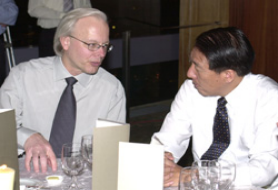
Defence establishments must transform to reap greater efficiencies and value, but how can they do so while staying open to international reactions, yet without risk to national security and interest?
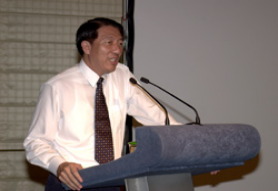
Minister for Defence Teo Chee Hean raised this question during the opening of the third Island Forum at the Raffles City Convention Centre on 2 May.
Using ecology as a metaphor, Mr Teo said viewing the defence establishment as an eco-system was a useful first step towards looking at the challenges it faced as it transformed.
"In a defence eco-system, two types of interactions or flows are critical: the flow of information and ideas, and the flow of talented people," said Mr Teo.
Will the quality and quantity of ideas and information suffer if organisations are set up to compete instead of collaborating with each other, asked the minister. As for the flow of talent, Mr Teo also wondered if it was more fruitful to have people specialise in a particular area, or to develop generalists who could move through different parts of the system.
"One unique feature is that the defence eco-system is torn between embracing globalisation on one hand, and remaining fiercely nationalistic on the other hand," said Mr Teo.
He added: "Age-old concepts like nationalism and sovereignty have no meaning for information-age businesses. Yet for defence industries, this does not appear possible. There is always a good reason to retain some indigenous capability."
Offering a possible solution to this dichotomy, Mr Teo suggested international collaboration. Using the example of the Typhoon Eurofighter, which is built in four participating countries, Mr Teo said such a co-operation cut down risks, yet enabling the different countries to hold on to important technological capabilities they would otherwise be unable to do so alone.
With so many questions raised, Mr Teo said the discussion on such matters was still ongoing. And this was where the Island Forum had a significant role to play.
Over the next two days, 15 leading thinkers, top business practitioners and defence experts from Australia, France, India, Israel, the United Kingdom and the United States attending this forum will exchange ideas on such issues with senior officials from the Ministry of Defence and the Singapore Armed Forces (SAF).
The wide spread of international perspectives will, in turn, offer useful insights and ideas to draw upon for the development of Singapore's defence and military capability, particularly the SAF's transformation to a third generation force.
Prominent figures at this year's forum include Mr Ray Ozzie, Chief Technical Officer of Microsoft; Mr S Gopalakrishnan, Chief Operating Officer and Co-founder of Infosys; and Mr James Rasulo, Chairman of Walt Disney Parks and Resorts.
02 May 2006 - Island Forum 2006
Minister for Defence Teo Chee Hean raised this question during the opening of the third Island Forum at the Raffles City Convention Centre on 2 May.
Using ecology as a metaphor, Mr Teo said viewing the defence establishment as an eco-system was a useful first step towards looking at the challenges it faced as it transformed.
"In a defence eco-system, two types of interactions or flows are critical: the flow of information and ideas, and the flow of talented people," said Mr Teo.
Will the quality and quantity of ideas and information suffer if organisations are set up to compete instead of collaborating with each other, asked the minister. As for the flow of talent, Mr Teo also wondered if it was more fruitful to have people specialise in a particular area, or to develop generalists who could move through different parts of the system.
"One unique feature is that the defence eco-system is torn between embracing globalisation on one hand, and remaining fiercely nationalistic on the other hand," said Mr Teo.
He added: "Age-old concepts like nationalism and sovereignty have no meaning for information-age businesses. Yet for defence industries, this does not appear possible. There is always a good reason to retain some indigenous capability."
Offering a possible solution to this dichotomy, Mr Teo suggested international collaboration. Using the example of the Typhoon Eurofighter, which is built in four participating countries, Mr Teo said such a co-operation cut down risks, yet enabling the different countries to hold on to important technological capabilities they would otherwise be unable to do so alone.
With so many questions raised, Mr Teo said the discussion on such matters was still ongoing. And this was where the Island Forum had a significant role to play.
Over the next two days, 15 leading thinkers, top business practitioners and defence experts from Australia, France, India, Israel, the United Kingdom and the United States attending this forum will exchange ideas on such issues with senior officials from the Ministry of Defence and the Singapore Armed Forces (SAF).
The wide spread of international perspectives will, in turn, offer useful insights and ideas to draw upon for the development of Singapore's defence and military capability, particularly the SAF's transformation to a third generation force.
Prominent figures at this year's forum include Mr Ray Ozzie, Chief Technical Officer of Microsoft; Mr S Gopalakrishnan, Chief Operating Officer and Co-founder of Infosys; and Mr James Rasulo, Chairman of Walt Disney Parks and Resorts.
02 May 2006 - Island Forum 2006

ALSO READ IN TECHNOLOGY
Locked & Loaded: SAF Shooting Contingent weapons
26 Nov 2025
Take a closer look at the weaponry at this year’s ASEAN Armies Rifle Meet.
AI joins the fight in national cyber defence exercise
12 Nov 2025
AI and closer collaboration among agencies and industry are taking centre stage in this year’s Critical Infrastructure Defence Exercise (CIDeX).
They built this city
01 Oct 2025
Turning vision to reality: the team behind SAFTI City clinches the Defence Technology Prize 2025 Team (Engineering) Award!