
TECHNOLOGY
TANDEM-SEATS FIGHTERS A BOOST FOR INTEGRATED STRIKE OPERATIONS
25 May 2006
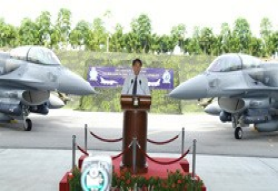
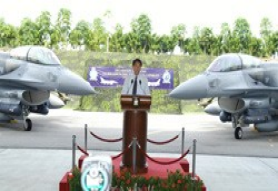
The F-16D Block 52+ fighter jet and its dual crew concept herald a new phase in the Republic of Singapore Air Force's (RSAF) fighter capabilities.
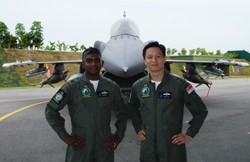
Operated by a paired crew of pilot and Weapon Systems Officer (Fighter) from 145 Squadron, the multi-role fighter can conduct both air combat and ground attack missions with precision, day or night.
"With the aircraft's system design and the Pilot-WSO(Fighter) dual crew, the F-16D Block 52+ can undertake very complex missions in which the pilot and WSO (Fighter) handle completely separate tasks at the same time," explained Minister for Defence Teo Chee Hean, during 145 Squadron's Full Operational Capability (FOC) declaration ceremony held at Changi Air Base (East) on 24 May.
"The dual crew concept - which the RSAF first experimented with six years ago - has transformed the way our fighter jets are employed," he said.
"This has enhanced the RSAF's contribution to the increasingly complex way in which the 3G SAF will have to operate in a tightly integrated manner in a networked environment which brings together the air, land and maritime dimensions."
The F-16D Block 52+ aircraft operated by 145 Squadron is the newest and most advanced multi-role fighter in the RSAF.
Equipped with Conformal Fuel Tanks (CFTs) and Litening III targeting pods, the F-16D Block 52+ is endowed with extended endurance and precision strike capability. The improved radar also allows a greater detection range and its ground-tracking capability enables air-to-ground weapon delivery under all weather conditions.
Commanding Officer, 145 Squadron, Lieutenant-Colonel (LTC) Lim Tuang Liang said the combination of these system capabilities has enabled the aircraft to be assigned deep penetration missions to take out targets that are critical to the SAF.
"We specialise in taking out targets with pin-point accuracy," LTC Lim said.
"This is accomplished both with the proficiency of the pilots enabling the aircraft to penetrate the enemy's air defence, and also the WSO (Fighters) in their expertise in working the targeting pods and as well as the precision weapons, so that all missions are accomplished with one shot, one kill."
The pilot-WSO synergy is critical to the success of the mission, and according to WSO (Fighter) Captain (CPT) Suresh Haridas, it is very much enforced in 145 Squadron.
"We have to work hand-in-hand in everything. If we lacked one guy, the mission would most likely be compromised," he said.
"In strike missions, the pilot is responsible for flying the aircraft my main role is to specialise in air-to-ground roles and of course, to also serve as an extra pair of eyes during the air-to-air combat arena to look out for aggressors."
Overall, CPT Suresh relishes the role he plays and declared it was a great feeling to fly the "renowned best fighter".
The squadron took delivery of the first batch of the F-16D Block 52+ fighters in July 2004.
It marked the first time that the RSAF's aircrew ferried their own aircraft home halfway across the globe, from Texas to Changi.
The journey took them over the Pacific Ocean and spanned over 16,000km, with a total flight time of 21 hours and seven mid-air refuelling sessions for each aircraft.
Even as the squadron was receiving its jets in several batches, there was an intensive operationalisation programme going on simultaneously. The squadron has participated in numerous multilateral exercises and was also given the honour of leading the National Day Parade flypast last year. Since it started operations in Changi, the crew has chalked up more than 4,400 flying hours in 16 months.
This enabled the squadron to achieve FOC status within 10 months from the delivery of the last of the 20 aircraft in June last year.
Established on 1 Apr 1984 at Tengah Air Base, 145 Squadron first started flying the A4 Skyhawks. After nearly two decades of service, the Squadron retired its ageing A-4 fleet in April 2003 and prepared for re-location to the new Changi base, and for the arrival of the state-of-the-art F-16D Block 52+ fighters.
Visit the F-16D Block 52+ Fighting Falcon website for more information.
Operated by a paired crew of pilot and Weapon Systems Officer (Fighter) from 145 Squadron, the multi-role fighter can conduct both air combat and ground attack missions with precision, day or night.
"With the aircraft's system design and the Pilot-WSO(Fighter) dual crew, the F-16D Block 52+ can undertake very complex missions in which the pilot and WSO (Fighter) handle completely separate tasks at the same time," explained Minister for Defence Teo Chee Hean, during 145 Squadron's Full Operational Capability (FOC) declaration ceremony held at Changi Air Base (East) on 24 May.
"The dual crew concept - which the RSAF first experimented with six years ago - has transformed the way our fighter jets are employed," he said.
"This has enhanced the RSAF's contribution to the increasingly complex way in which the 3G SAF will have to operate in a tightly integrated manner in a networked environment which brings together the air, land and maritime dimensions."
The F-16D Block 52+ aircraft operated by 145 Squadron is the newest and most advanced multi-role fighter in the RSAF.
Equipped with Conformal Fuel Tanks (CFTs) and Litening III targeting pods, the F-16D Block 52+ is endowed with extended endurance and precision strike capability. The improved radar also allows a greater detection range and its ground-tracking capability enables air-to-ground weapon delivery under all weather conditions.
Commanding Officer, 145 Squadron, Lieutenant-Colonel (LTC) Lim Tuang Liang said the combination of these system capabilities has enabled the aircraft to be assigned deep penetration missions to take out targets that are critical to the SAF.
"We specialise in taking out targets with pin-point accuracy," LTC Lim said.
"This is accomplished both with the proficiency of the pilots enabling the aircraft to penetrate the enemy's air defence, and also the WSO (Fighters) in their expertise in working the targeting pods and as well as the precision weapons, so that all missions are accomplished with one shot, one kill."
The pilot-WSO synergy is critical to the success of the mission, and according to WSO (Fighter) Captain (CPT) Suresh Haridas, it is very much enforced in 145 Squadron.
"We have to work hand-in-hand in everything. If we lacked one guy, the mission would most likely be compromised," he said.
"In strike missions, the pilot is responsible for flying the aircraft my main role is to specialise in air-to-ground roles and of course, to also serve as an extra pair of eyes during the air-to-air combat arena to look out for aggressors."
Overall, CPT Suresh relishes the role he plays and declared it was a great feeling to fly the "renowned best fighter".
The squadron took delivery of the first batch of the F-16D Block 52+ fighters in July 2004.
It marked the first time that the RSAF's aircrew ferried their own aircraft home halfway across the globe, from Texas to Changi.
The journey took them over the Pacific Ocean and spanned over 16,000km, with a total flight time of 21 hours and seven mid-air refuelling sessions for each aircraft.
Even as the squadron was receiving its jets in several batches, there was an intensive operationalisation programme going on simultaneously. The squadron has participated in numerous multilateral exercises and was also given the honour of leading the National Day Parade flypast last year. Since it started operations in Changi, the crew has chalked up more than 4,400 flying hours in 16 months.
This enabled the squadron to achieve FOC status within 10 months from the delivery of the last of the 20 aircraft in June last year.
Established on 1 Apr 1984 at Tengah Air Base, 145 Squadron first started flying the A4 Skyhawks. After nearly two decades of service, the Squadron retired its ageing A-4 fleet in April 2003 and prepared for re-location to the new Changi base, and for the arrival of the state-of-the-art F-16D Block 52+ fighters.
Visit the F-16D Block 52+ Fighting Falcon website for more information.

ALSO READ IN TECHNOLOGY
Locked & Loaded: SAF Shooting Contingent weapons
26 Nov 2025
Take a closer look at the weaponry at this year’s ASEAN Armies Rifle Meet.
AI joins the fight in national cyber defence exercise
12 Nov 2025
AI and closer collaboration among agencies and industry are taking centre stage in this year’s Critical Infrastructure Defence Exercise (CIDeX).
They built this city
01 Oct 2025
Turning vision to reality: the team behind SAFTI City clinches the Defence Technology Prize 2025 Team (Engineering) Award!