
PEOPLE
SAFTI MILITARY INSTITUTE - DEVELOPING 3G OFFICERS
17 Oct 2005
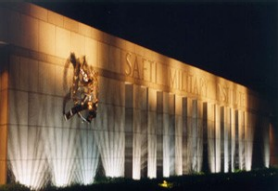
Celebrating its 10th anniversary this year, SAFTI Military Institute's mission remains the same: to train and educate officers in the SAF. However, the demands on officers of the 21st century have certainly evolved and the premier Tri-Service institute spares no effort in ensuring that it keeps one step ahead in order to remain relevant in this new security environment.
From United Nations peacekeeping efforts in the Gulf to the more recent Operation Flying Eagle, the Asian tsunami relief operation, it is clear to see that demands on the SAF officer have become more diversified.
In the past, the focus was largely on fighting a conventional war, or a 'hot war'. With time, the role of the military has expanded to include peacekeeping and now, humanitarian assistance and disaster relief as well.
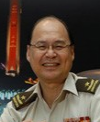
"To the credit of everyone in the SAF, we were never caught unprepared and the reason is that we were able to forecast into the future and examine what the requirements of the young officers will be years from today," said former Commandant SAFTI, BG Eric Tan Huck Gim (left)."This prepares us to mentally adjust and shift from our present focus to what is possibly a completely different one," he added."To bring in certain lessons from other militaries, from open documentation, and also to develop our own doctrine and understanding in those areas."
The 3G Officer
SAFTI is preparing its officers for challenges in the future that will come with very short notice.
"In the case of the tsunami, there's not much time to sit down and gather your thoughts or to appreciate your situation sufficiently."
"You have to decide quickly and when a person decides quickly, the risks are higher because there may not be enough time to consolidate all the relevant facts," explained BG Tan.
Thus, he feels there is a need to emphasise three particular areas that will help make the officer more well-rounded and prepared to face whatever challenges that come along.
The first area is the ability to handle uncertainty, which we can expect with environments that change at increasing speed.
"The way to address uncertainty, we find, is through good use of methodologies. They allow us to understand the situation we are in, and figure out what the best solution is."
"And when the situation changes, we change the solution to suit the need," said BG Tan.
The next area that officers need to focus on is the conducting of operations, which involves vocational competencies.
These skills will stretch across a wider spectrum, and with the 3G SAF, there will be new platforms as technology is enhanced and harnessed.
Officers must be proficient users of technology.
The third element is to ensure the strong foundation of values that will act as a moral compass when officers make decisions in the field.
"Officers need to be very clear about what they believe in, which is inscribed in the Officer's Creed and the SAF core values," said BG Tan.
"So when things are not so clear-cut, the officer will be able to make decisions that serve the SAF well, serve the mission of the SAF as well as the national interests of Singapore."
School rules
There are a total of five schools in SAFTI: the Officer Cadet School (OCS) for cadets, SAF Advanced Schools (SAS) one for each Service for Captains, and the Singapore Command and Staff College (SCSC) for Majors and Lieutenant-Colonels.
To meet changing needs, curriculum and various exercises of the schools go through major revamps about once every five years. The first revamp was in 1999, led by then-Permanent Secretary Peter Ho, and the most recent was led by BG Tan and his team in 2004.
In between the five years, there were smaller reviews to maintain currency. For example, after missions like Operation Flying Eagle, some of the course content in SCSC and other schools was tweaked.
New doctrine is also infused into the curriculum by SAFTI after various exercises carried out by the SAF.
Leadership development is the means by which SAFTI tries to inculcate values, and better align the values in officers.
"People don't come in with zero values, all of us have values from our parents, our upbringing, from the schools that we have attended. With this set of values, it is now a question of reaffirming some of them and realigning some of them to the SAF's core values which have been in place since the late 1980s," said BG Tan.
SAFTI has a branch called the Centre of Leadership Development (CLD).
This is a full-time SAF centre with psychologists and headed by a former brigade commander. These people focus their entire attention on how to develop officers in leadership. As for helping officers in handling uncertainty, a lot of different methodologies are incorporated in courses.
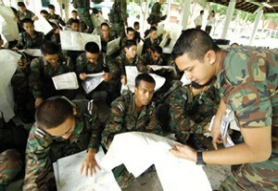
At OCS, for example, cadets go through this process of tactical decision-making games. These games are designed to be very easy to employ, with just a sheet of paper and a map, and the cadet has to go through in his mind how he would deploy his forces and how to tackle the enemy.
The purpose of this is to build a set of patterns that the cadet can use in the field.
Up at the SCSC level, more complex methodologies are used. One of them is the Systemic Re-framing Thinking (SRT) that allows us to frame a particular situation and to re-frame it as the situation changes.
Instead of providing students with a solution, a setting to the problem is established, so it allows the user to understand the problem very well.
Exciting prospects ahead
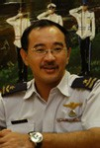
As for upcoming projects and programmes, SAFTI Commandant BG Jimmy Tan (left) highlights two new courses that emphasise 'jointness' of the three Services.
In the SAS, the current Tri-Service Staff course will be replaced by the Tri-Service Warfighter course that will begin next year.
The new course will focus more on "jointness", operations and operations other than war, such as humanitarian assistance and peace support.
The Command and Staff course (CSC) conducted by SCSC is now completely 'joint' in outlook, with the new curriculum launched this year with the 36th CSC cohort that graduated on 7 Sep.
"We are also trying to see if SAFTI can play a bigger role not just in training, but also doctrine development," added BG Tan.
"Essentially, it is about how we expedite the transfer of operational knowledge into lesson plans, so that it can be disseminated down quickly."
"I am trying to encourage the instructors here to not just teach, but also to be involved in the creation of knowledge. So SAFTI is not just a teaching institution, but also an institution for creating knowledge relevant for the SAF."
"We can look into research, tap the databases on the Internet, run experimentation and simulations to refine processes to the SAF before it gets tested out in an operational environment," he said.
In order to maximise resources across SAFTI, BG Tan is also looking into creating a directing body in the headquarters of SAFTI, one that is more focused and able to link up with joint operational units, so the institute knows what the SAF requires and directs its efforts accordingly.
Standing in good stead
SAFTI has come a long way since its inception. Today, it networks with a lot more partners and these partners have the potential of enriching SAFTI's development while avoiding expensive duplication of those capacities in-house.
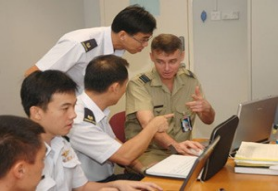
Two of the three new partners are Singapore's institutes of higher learning and the other one, a major military institution, the Australian Defence Force (ADF).
"The ADF operates in places such as Iraq and Afghanistan, and this will give us access to current operational knowledge and experiences," said BG Eric Tan.
"Already, as we were preparing to go to Timor-Leste in 2000, the ADF were very much instrumental in making sure that we were able to do our work. With the Australians, we stand a very strong chance of learning without having to experience what they have experienced, and this has always been one of the ways that SAF imports knowledge and transfers that to the ground."
The other major milestone is that courses in SAFTI have all been rationalised, so that they can remain relevant to the future needs.
"I think for the next five to six years, before another major review, we will be in good stead and what programmes that BG Jimmy Tan will implement will actually provide the 3G SAF with a good starting point," said BG Tan.
"The 3G SAF is designed by the SAF officer, so by coming to SAFTI and getting the right exposure to the right ideas, the officer is then more prepared to go back to the staff headquarters and operational units and write papers and make changes that will eventually result in the 3G SAF."
So what's BG Jimmy Tan's take on leading SAFTI into the future?
He believes the basis for SAFTI continues to be relevant: to be the military institution for training and educating SAF officers and the spiritual home of the officer corps.
"The original vision continues to hold and I hope to continue upholding it. I think these two aspects are important."
"We need to have officers who are vocationally competent in their own particular areas and strongly founded on the value system of the SAF," he said.
"We have put a lot of investment in technology and systems, and the SAF has always been investing in its people training and education are key ways to do that."
"The returns may not be very visible; nonetheless, it is important that we do this because to deal with change, people, technology and concepts must work together in tandem."
In a bid to expand cooperation in professional military education and training with similar institutions throughout the world, SAFTI Military Institute signed two memoranda of understanding (MOU) with the Australian Defence College (ADC) and the Nanyang Business School of the Nanyang Technological University (NTU) on 24 Aug.
The MOU with ADC is the first between SAFTI and a foreign military institution. It was signed by BG Eric Tan, outgoing Commandant SAFTI, and RADM Marcus Bonser, Commander ADC.
It was RADM Bonser who mooted the idea of an MOU with SAFTI at the 8th ASEAN Regional Forum for Heads of Defence Universities, Colleges and Institutions in Sep 04.
RADM Bonser's suggestion was prompted by the complex security environment that we live in today. He felt that to make the region more secure, countries that share similar visions need to work together.
"It has always been my view that military leaders of the future need to be able to work and learn together, so that they can know each other and understand each other's viewpoints," he said.
"So when they need to do these things in the future, whether it is dealing with the 'war on terror' or helping another nation that has a national disaster like a tsunami, they can get together quickly and do the necessary," he added.
The formal agreement will bring about opportunities for joint research as well as shared programmes and courses in military leadership, strategic studies, and professional military knowledge in areas such as peacekeeping, humanitarian assistance and disaster relief, and joint operations.
In a bid to expand cooperation in professional military education and training with similar institutions throughout the world, SAFTI Military Institute signed two memoranda of understanding (MOU) with the Australian Defence College (ADC) and the Nanyang Business School of the Nanyang Technological University (NTU) on 24 Aug.
The MOU with ADC is the first between SAFTI and a foreign military institution. It was signed by BG Eric Tan, outgoing Commandant SAFTI, and RADM Marcus Bonser, Commander ADC.
It was RADM Bonser who mooted the idea of an MOU with SAFTI at the 8th ASEAN Regional Forum for Heads of Defence Universities, Colleges and Institutions in Sep 04.
RADM Bonser's suggestion was prompted by the complex security environment that we live in today. He felt that to make the region more secure, countries that share similar visions need to work together.
"It has always been my view that military leaders of the future need to be able to work and learn together, so that they can know each other and understand each other's viewpoints," he said.
"So when they need to do these things in the future, whether it is dealing with the 'war on terror' or helping another nation that has a national disaster like a tsunami, they can get together quickly and do the necessary," he added.
The formal agreement will bring about opportunities for joint research as well as shared programmes and courses in military leadership, strategic studies, and professional military knowledge in areas such as peacekeeping, humanitarian assistance and disaster relief, and joint operations.
In a separate ceremony, BG Tan also signed an MOU with Professor Hong Hai, Dean of NTU's Nanyang Business School.
This MOU strengthens the existing cooperation between the two institutions and will allow them to identify and develop joint research projects on ethics, values, and other aspects of leadership development and education.
One of the areas they will be collaborating in is the development of an assessment tool for self-awareness and leadership development.
SAFTI and Nanyang Business School plan to create a 360-degree feedback tool that will be organic to the SAF.
It will allow SAF officers to gather feedback on how their peers, superiors and subordinates view them.
From these surveys, the officer will have a better idea of his characteristics and abilities and the SAF can also use the data to help develop him to his fullest potential.
"With the 360-degree feedback tool, I think we will be much stronger in being able to develop our people," said BG Tan.
"We believe that over the next couple of years, we will see some tangible outcomes to the projects that we are working on and this will augur well for SAFTI. We will then have the means to develop officers for the third-generation SAF."
Capturing the spirit of SAFTI
Renowned watercolour artist, Mr Ong Kim Seng, presented a portrait of SAFTI to Chief of Defence Force LG Ng Yat Chung on 25 Aug as a memento to commemorate the institute s 10th anniversary.
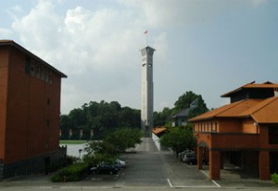
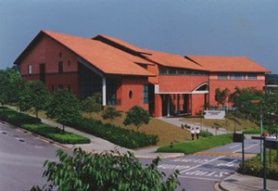
The actual painting took about four weeks to complete and depicts all the institute's significant architecture the corridor, ceremonial hall, tower, entrance to the parade ground, and stadium.
"SAFTI is where we train our fighting men who defend Singapore, who guard our territorial waters, boundaries and airspace. So I think you have to put that kind of discipline and seriousness into the painting," said Mr Ong, who has painted other buildings, including Singapore Polytechnic and the Istana.
"This is done by using colours. To symbolise a bright future, strong colours are used. You can see the building is red, it is different the kind of energy, the type of energetic colours that is incorporated into the painting," he said.
"The message that I want to put across is that this is SAFTI, something that gives you the latest in military technology and military education. It is the nerve centre of military training and when you are here, you can see all aspects of military training."
SAFTI MI 10th Anniversary Website

ALSO READ IN PEOPLE
Brewing up the perfect blend for a hit comedy
09 Sep 2026
The cast of microdrama Hard Mode are bringing Singapore life to the world with a simple question: “Do you want your iced yuan yang hot or cold?”
Stepping up for the place he calls home
02 Sep 2026
From getting his pink IC in early 2024 to becoming an NSF of the Year and embarking on a career in the SAF, OCT Bandaru Yashwanth Naga Sai didn't just find his place in Singapore, he found his calling.
Paw-tners in service
24 Aug 2026
This International Dog Day, we meet four canine-and-handler duos to find out what goes on behind the scenes in the SAF's Military Working Dog Unit.