
TECHNOLOGY
SAF TO ENHANCE NS SYSTEM & TRAINING SAFETY: BUDGET DEBATE
05 Mar 2015
Even with the most advanced military technology and equipment, national servicemen remain our greatest and most indispensable asset.
Said Minister for Defence Dr Ng Eng Hen at the 2015 Budget debate on 5 Mar: "It is ultimately the strong fighting spirit of our soldiers, airmen and sailors, as well as the quality of leadership, that will allow the SAF (Singapore Armed Forces) to deter aggression and when that fails, prevail over potential aggressors."
To boost this commitment to defence, "we must train our servicemen well, train them safely, be good stewards of their time and talent, and last but not least, give due recognition to our national servicemen where it is due," added 2nd Minister for Defence Chan Chun Sing in his speech to Parliament at the debate.
Making NS more efficient & effective
Following announcements at the Budget debate last year to implement the Committee to Strengthen National Service (CSNS) recommendations, Dr Ng revealed that the initiatives were well in progress.
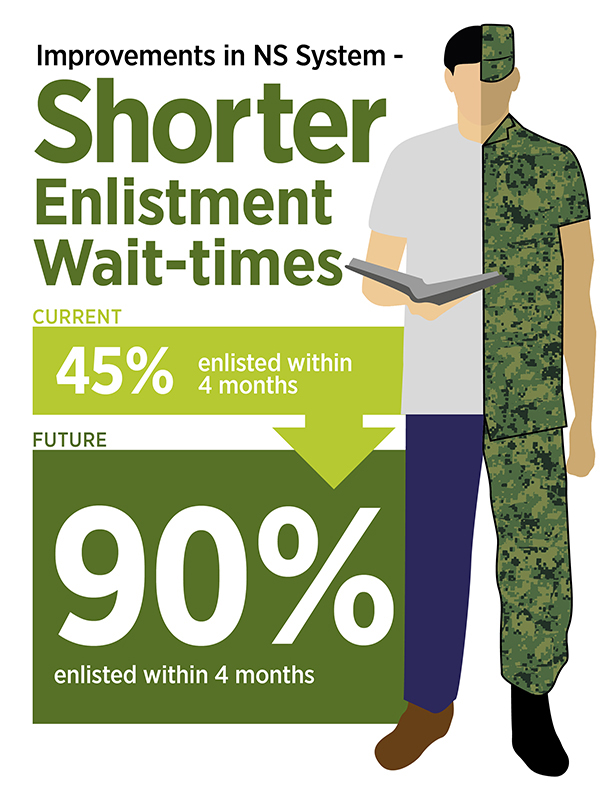
One significant proposal was the reduction of waiting time for NS enlistment to not more than six months from the completion of their post-secondary education.
Mr Chan elaborated that the Ministry of Defence (MINDEF) and the Ministry of Home Affairs (MHA) were working to double the number of pre-enlistees enlisted within four months of leaving school from 45 to 90 percent.
And as time progresses, so must the SAF's training strategies evolve. Mr Chan noted that MINDEF would continue to widen the use of LEARNet to save up to 20 percent of learning time, which can then be used for hands-on practical learning. LEARNet is a Web-based system which allows trainees to quickly access learning.
To give servicemen more time to focus on their training rather than on administrative duties, the new Tactical Engagement System (TES) equipping station that will be rolled out this year will allow the SAF to fully equip an infantry or armour battalion within half a day as compared to 24 hours in the past.
Time taken to mobilise and equip soldiers will also be reduced from 24 hours to just a few hours, said Mr Chan.
Boosting training safety
Improvements have also been made to the SAF's training and medical systems to take better care of soldiers.
The newly-opened SAF Cardiac Fitness Centre, for instance, is integrated with the National Heart Centre to provide centralised and dedicated specialist cardiac care for all SAF personnel and pre-enlistees.
The new SAF Emergency Ambulance Service (EAS) was also operationalised in January this year, said Mr Chan. With this, training activities outside SAF camps are now supported by ambulance evacuation services using both SAF and EAS ambulances.
The SAF has also leveraged the Soldier Tracker System to keep track of soldiers during difficult terrain and small unit operations. The system is linked to satellite services that are networked to exercise control headquarters, providing real-time information on the location of its soldiers.
Not only is this system operationally useful, it also builds greater confidence in our evacuation system, explained Mr Chan.
Other safety initiatives include the introduction of heat stress monitors to closely monitor localised weather conditions and reduce heat injuries.
IPPT initiatives
In the area of fitness, the Individual Physical Proficiency Test (IPPT) system will evolve to a three-station format from 1 Apr, to make it easier for servicemen to train and excel. Operationally Ready National Servicemen (NSmen) will have a year to transit to the new format, and can choose to do either the older five-station IPPT or the new IPPT till March 2016. More time - 12 months - has also been given for NSmen to train, prepare and meet their fitness standards.
Initiatives like IPT-in-the-Park were also introduced to make IPPT Preparatory Training (IPT) more convenient for NSmen. They were also encouraged to take greater ownership of their fitness through trial use of fitness-tracking devices like iDAT and FitBit, said Mr Chan.
Additional Medisave grant
To strengthen the recognition of NSmen, the NS Recognition Award has evolved into the NS Housing, Medical and Education (NS HOME) Award.
Previously, an NSman would receive $9,000 to $10,500 across three milestones in his NS journey. But now, he will receive an additional Medisave grant of $6,000.
Mr Chan also revealed that more than 56,000 NSmen have benefitted from the NS HOME Awards since its implementation in September last year. He added that from this September, Full-time National Servicemen (NSFs) would receive part of this additional grant to help cover their MediShield Life premiums while they are serving full-time NS.
SAF Volunteer Corps
Mr Chan also announced that the first intake of the SAF Volunteers Corps (SAFVC) would begin training in March. The Corps was set up last year following the implementation of the CSNS recommendations.
Since the launch of its recruitment last October, the SAFVC has received about 900 applications, and will take in about 100 to 150 volunteers in the first year.
"What (these volunteers) bring to the table are not just operational capabilities for the defence of the country. As importantly, if not more they demonstrate their willingness to go that extra mile to defend what is ours," explained Mr Chan.
And while NSmen form the backbone of the SAF, there must be adequate SAF Regulars to train units and build capabilities, said Dr Ng. There are plans to double the number of Regular trainers at the Basic Military Training Centre from the middle of this year.
He added that the SAF would also be recruiting more women as more opportunities opened up in different vocations due to advanced platforms.
ACCORD recommendations
Another CSNS recommendation implemented last year was the restructuring of the Advisory Council on Community Relations in Defence (ACCORD) into three councils - the Employer and Business Council (E&B), Families and Community Council (F&C) and Educational Institutions Council (EI).
Mr Chan, who co-chairs the E&B Council, revealed that one of the recommendations the council had come up with was to revamp the Total Defence Awards to recognise more people and organisations who have contributed to the defence of Singapore.
" instead of just recognising the employers and companies, we should also recognise the colleagues and immediate superiors who are supportive and made a difference to the national servicemen when they answer the call of duty," explained Mr Chan.
The council also proposed a closer working relationship between MINDEF and employers to keep them informed of their employees' In-Camp Training call-ups for both parties to plan ahead and make work arrangements. This would give NSmen greater "peace of mind in preparing and discharging their NS duties," said Mr Chan.
Minister of State for Defence Dr Mohamad Maliki Bin Osman, who co-chairs the F&C Council and the EI Council, gave an update on the recommendations that the two councils proposed.
While NSmen can now enrol in special enrichment and refresher modules before they start their university courses, the EI Council will look into how these modules can be enhanced to better meet the learning needs of the students, as well as explore other efforts which further support NSmen.
Members of the F&C Council will collaborate with the People's Association (PA) and SAFRA to offer more benefits and discounts to servicemen. PA will be looking at how they can offer privileges for use of facilities at Community Centres to servicemen and women, while SAFRA is looking at enhancing their membership privileges.
In an effort to reach out to women, the F&C Council also recommends partnering the Singapore Council of Women's Organisation and PA's Women Integration Network to conduct sessions for mothers to share their experiences in supporting their children through NS, as well as engaging young women and wives of NSmen.
In collaboration with the Ministry of Education under the SAF-Schools Partnership Programme, 33 Post-Secondary Education Institutions were paired with 47 SAF units to co-organise activities such as unit visits for their students.
Dr Maliki noted that the restructured ACCORD was taking a proactive approach: "The members are actively leading in various initiatives and such ground-up efforts will have significant impact on our outreach and engagement with various stakeholders to increase commitment to defence and support for NS."
Thanking SAF pioneers
As the SAF marks its 50th anniversary this year, a series of events has been lined up to recognise and honour the contributions of all who have served in the defence of Singapore.
SAF50 is a way of saying "thank you" to the pioneers and all the men and women who dedicated themselves to preserving our sovereignty and defending our way of life, said Dr Maliki. "What the SAF lacked in resources in its early years, our pioneers made up for with their fortitude and determination."
Celebrations kicked off last month with SAF50@Vivo, which attracted more than 87,000 visitors. The event was anchored on an exhibition that featured SAF stories of pioneers' convictions and sacrifices. These stories will also be published in a commemorative book.
To be launched in July this year, the book is a collection of over 70 stories that showcase many aspects of the SAF, ranging from diplomacy, defence technology and operations to family and community support, media and entertainment, said Dr Maliki.
SAF pioneers will be invited to key events such as the SAF50 Parade, SAF50 Commemoration Dinner and SAF50@Istana presidential garden reception. Those invited will include Officers and Warrant Officers from the first batch of national servicemen and pioneers who served before 1965.
SAF formations and units will also engage SAF pioneers as part of their own celebrations.
Explained Dr Maliki: "We want to bring our pioneers and previous batches of ex-servicemen closer to our younger generation. They inspire us with their experiences, memories and motivations."
In addition, the SAF launched the Commitment to Defence Ambassadors' Programme, where some of the pioneers and ex-servicemen will engage younger Singaporeans to share with them their early struggles, experiences and accomplishments in the face of adversity.
"I hope these stories will help inspire younger Singaporeans, and give them the spirit and strength to do their part for Singapore," said Dr Maliki.
"As we celebrate SG50 and SAF50 this year, we must remember this spirit and strength exemplified by our pioneers. We must harness it and work towards building a more secure and prosperous future for Singapore."

ALSO READ IN TECHNOLOGY
Locked & Loaded: SAF Shooting Contingent weapons
26 Nov 2025
AI joins the fight in national cyber defence exercise
12 Nov 2025
AI and closer collaboration among agencies and industry are taking centre stage in this year’s Critical Infrastructure Defence Exercise (CIDeX).
They built this city
01 Oct 2025
Turning vision to reality: the team behind SAFTI City clinches the Defence Technology Prize 2025 Team (Engineering) Award!