
COMMUNITY
OUTWIT, OUTLAST, OUTRIGGERS GO!
23 Mar 2006
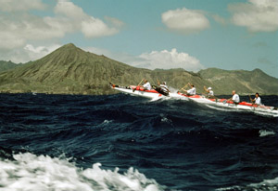
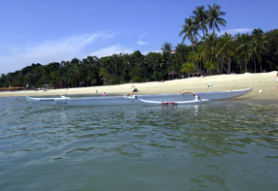
The expansion of settlers from coast to coast may never have been possible without them. Easy to build, lightweight, with minimal resistance to water and yet stable and equipped with a great load-bearing capacity, it is no wonder the immigrants of yore chose the wooden outrigger canoe (OC) to ferry them to new lands. Today, South East Asia's first modern OCs have surfaced in Singapore. Recast in fibre glass or carbon fibre, the canoes are now largely used for recreational purposes. Imbued with rich traditions and with the ocean as its playing field, this endurance sport is certainly in a class of it own.
Contemporary OC racing originated in the Hawaiian Islands and is now unofficially considered its national sport. Outrigger canoeing has spread to all parts of the Pacific and also to countries such as Australia, Hong Kong, South Africa, Sweden, the US and the UK.
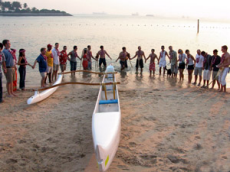
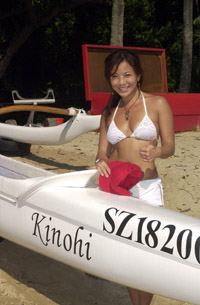
Singapore Paddle Club (SPC) is currently the only club in South-east Asia that offers outrigger canoeing to its members. It was set up in October 2004 by Stuart Smith, an OC enthusiast, and Nick Yap, who was then looking to expand his dragon boating club, and a number of other dragon boat and outrigging enthusiasts. SPC now has a membership of close to 70 paddlers and is based at Sentosa's Tanjong Beach.
Paddles up
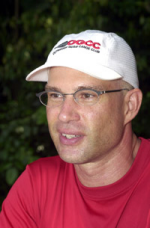
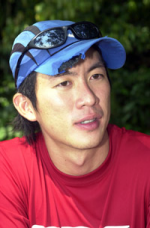
According to Stuart (left), you only need to be able to swim and have a passion for the sport to get into an OC.
"It is unique in that it is an open ocean team sport that requires great strength - both mentally and physically - as well as astute sea skills. You must understand the ocean, your boat, and trust the people sitting in the boat with you," he explained.
"So it combines a lot of aspects of sailing and more traditional endurance sports, like running and cycling. It is a great sport. There is nothing else like it!"
For Nick (left below), the allure of outrigger canoeing lies in the calming journey through the vast openness of the sea.
"When we go out to sea, there is nothing, no urbanisation. Although it is a lot of hard work, your mind is relaxed. You can really focus on just paddling alone instead of thinking about work. You also get to ride nice waters, big waves," he said.
The ripple effect
Although run by volunteers, SPC is professionally managed. It has a stable of 12 one-man racing canoes (all owned by club members), three one-man training canoes, two six-man canoes and two dragon boats, which are owned by the club.
The club is also guided by their constitution to see to the development and expansion of outrigger canoeing in Singapore and the region.
"We are very proud of the fact that we have taken a lot of rookies, who have never been inside an outrigger, and took them round the islands. Some have even paddled to Indonesia and back!" said Stuart.
Relative newcomer Erny Pontoh (right) was introduced to the sport seven months ago, and she enjoys the teamwork involved in outrigger canoeing and the challenge of adapting to the sea state.
"It is really dynamic, how the boat works and the movement of the waves. It is always different, never monotonous," she said.
"I think it is a global sport, you train hard and go out to race with the rest of the world."
Who does what
Unlike dragon-boat races, which are considered sprint events as they are about 500 to 1,000m-long, OC races are tests of endurance as the distances can go up to 80km.
For the big races hosted globally, the six-man OC race is where the action is.
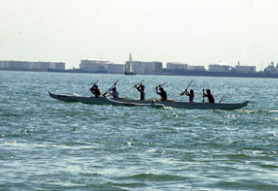
It involves strategic teamwork as each crew member has a specific role to play. The person in the first seat sets the pace and assists the helm in catching waves, but he is also responding to someone in the middle of the boat who will be calling ratings, power pieces and change-overs. The two paddlers in the middle are usually the heaviest and strongest, and comprises the boat's 'engine room'.
The sixth person in the boat steers with a special paddle that has a stronger and larger blade. He will be independent and will read the waves and direct his teammates - like when there are waves coming and when they should ride them so the boat can go faster.
Everyone has only one paddle and they alternate strokes. For example, the first person will start paddling on the right side first and the second one on the left, and so on. After every 15th stroke, everyone swops sides.
Surfing the waves with an iron will
Depending on water conditions and currents, the speed of an OC can go up to 20 knots when surfing, and above 10 knots when powering up and sprinting.
"It is just a question of how long you can keep that speed up. There are 80km races, so you are obviously not going to be doing 10 knots for 80km with the same people," explained Stuart.
For longer races, there are 'sea changes'. About nine people make up a racing crew, including three who will first be in the support boat. Every twenty minutes or so, they will swop places with three in the boat - and during a well-executed exchange, the boat does not slow down at all.
"The mental strength required in outrigger canoeing is immense. You really need a very strong mind to complete seven hours of paddling. You can be doing it non-stop, all the way, so when you are in this sport, you need a lot of commitment," Nick said.
"Go to the gym, do cardio work and get your aerobics system up. Technique is also very important for long distance races because you need to sustain your energy and have very efficient strokes throughout."
Stuart believes outrigger canoeing is perfect for Singapore since it is an island country surrounded by "really nice waters".
"I think people here actually don't get out on their water as much as they should because it is very nice, and outrigging offers a great, low-cost way to get out and enjoy what Singapore offers," he said.
For more information on outrigger canoeing and how to get started in the sport, visit the Singapore Paddle Club website at www.singaporepaddleclub.com, or email Nick with your queries at [email protected].
What is an OC?
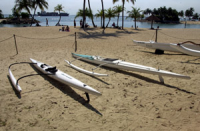
It is defined by the inclusion of an outrigger rigged out from the side of the canoe's hull, which acts as the counterpoise or balance.
A number of spars (usually two but could be as many as 10, depending on the canoe's size and purpose) are lashed across and to the canoe gunwales, extending outwards and attached to a flotation device that rests on the surface of the water.
Some configurations include one-man, two-man, four-man and six-man boats.
Why not two outriggers, one on each side?
With two outriggers instead of one, the hull will be suspended in the air when the outer floats are in contact with large waves and swell, causing immense pressure on the spars that could result in them breaking.
How does the canoe remain stable with only one outrigger?
Flexibility is the key behind the design of the OCs. The spars are made of timber and possess inherent flex, as the float travels up and down over the waves. The movement is absorbed along the length of the spar and back to the hull, like shock absorbers.
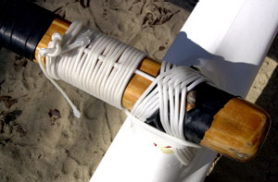
The lashing used to attach the spar to the hull should also have some degree of flexibility to further absorb movement. Plant fibre was one of the earliest material used and the lashing is woven in a special pattern (below), so it will not unravel itself even if one of the ropes break.
As the Hawaiian OC is mainly used internationally for racing, original Hawaiian names are used to label the parts of the OC.
Some part names, in the order of English Hawaiian Maori (The W is pronounced as V ).
| English | Hawaiian | Maori |
|---|---|---|
| Float | AMA | AMA |
| Spar/Strut | IAKO | KIATO |
| Hull | KA'LE | HIWI |
| Spreader | WAE WA'A | TAUMANU |
| Gunwale | MO'O | RAUWA |

ALSO READ IN COMMUNITY
Happy 61st birthday, Singapore!
09 Aug 2026
Experience the magic of Singapore’s 61st birthday: Returning to the National Stadium after 10 years, NDP 2026 dazzled the crowds with an unforgettable show.
Your backstage pass to NDP 2026
06 Aug 2026
Ever wondered what goes on behind the scenes of NDP? We take a peek behind the curtain to uncover the hard work that this year’s performers have put in since rehearsals began months ago.
What it takes to be a viral NDP mascot
25 Jul 2026
They’ve been stealing hearts as the lovable mascots at the National Day Parade (NDP). Meet the NSFs behind the costumes and high-energy dance moves.