
TECHNOLOGY
OPERATIONALISING AIR-LAND INTEGRATION
31 Jan 2008
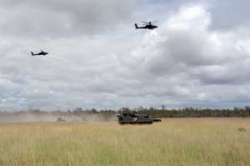
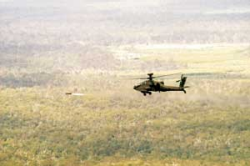
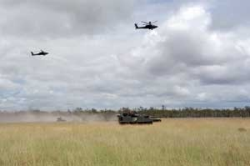
With Apache Longbow attack helicopters raining rocket fire and Hellfire missiles at 'enemy' targets, the charging Armoured Battle Group surged forward with guns blazing to capture key 'enemy' terrain.
A scene from the latest Hollywood military action flick? Not quite.
PIONEER brings you all the action from Down Under during Exercise Wallaby 2007 - a showcase of seamless air and land integration in operation, thanks to an increasingly networked fighting force.
Unlike the days of the first- and second-generation SAF, where servicemen fought only with platforms, the third-generation SAF heralds a new era: one of systems fighting and combined training, where the complete capabilities from air and land platforms, can be harnessed.
"In Exercise Wallaby, we have taken enormous steps to train as a total system," said exercise director BG Philip Lim, Chief Armour Officer.
"This exercise significantly enhances the confidence of our troops in our combat systems. Previously, all they could see were platforms fighting. Today, they see that they are able to bring together the capabilities of air, as well as land, in a close and coordinated manner."
Establishing the aerial picture
One of the key factors for integration to succeed is undoubtedly greater situational awareness. That means empowering everyone - from commanders to soldiers on the ground - by giving them an updated battlefield picture that tracks both friendly and 'enemy' forces.
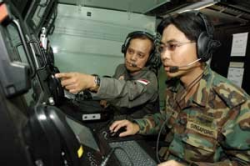
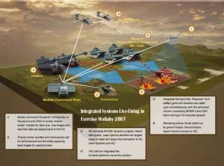
The Air-Land Tactical Control Centre (ALTACC) was pivotal in providing control over all aircraft involved in air participation missions and ground-based air defence.
"In the past, the absence of a common operating picture and the force structure meant that air space control in the area of operations was very procedural and, hence, very restrictive in nature," explained MAJ Chew Ann Liang, Deputy Detachment Commander, ALTACC.
Sensing the ground
Similarly, mobile armour and artillery forces on the ground are equipped with the Battlefield Management System (BMS), which tracks both friendly and 'enemy' troops on the move.
"The potential of IKC2 is indeed exciting and seemingly limitless. It allows me to see more, understand better and react faster to use precise firepower at the right time on the enemy," Commanding Officer of 21st Battalion, Singapore Artillery, MAJ Dinesh Vasu Dash, told PIONEER.
"It's equally important to understand where all the other friendly units are, to prevent fratricide."
According to him, this is especially pertinent in armoured operations, where troops are highly mobile and potentially interspersed with civilians.
"IKC2 and the BMS in particular, help us make sense of a rather cluttered battlespace," MAJ Dinesh added.
Combining forces for maximum power
After the air and land picture is established, the stage is set for air-land manoeuvres and tie-ups.
Integration starts right from the planning phase, where there are liaison officers at the HQ to advise how best to utilise the Apaches. Once the mission is crafted, it is sent through the system to the specific squadron with all the necessary tie-ups done digitally.
The pilots then launch and head out to the area of operations, linking up with the unit on the ground, which will provide the latest information. Finally, the pilots will go into their designated engagement area to carry out the mission.
"The ground controllers talk to us and give us the final position of the 'enemy', helping us minimise the time we spend in a hostile area," explained Apache pilot LTC Ng Wei-Jin.
"Once we are updated, we go in and spend the least amount of time to identify that they are enemies and not friendly forces. Once certain parameters are ascertained, we will engage them and quickly get out of the area."
Pinpoint accuracy
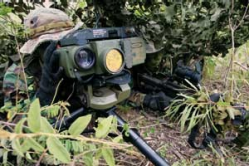
To minimise collateral damage and reduce outward exposure within a hostile area, further collaboration is sought in the form of 'Commando lasing' in precision attacks.
"With the increased precision fire, the possibility of mission accomplishment is much higher," said CPT Alvin Tjioe, Officer Commanding of the Commando unit.
"We increase the chances of acquiring targets and we shorten the OODA (observe-orient-decide-action) loop as well. We used to rely only on radio sets and verbal description to the pilots. Now, we have the computer systems and software as direct links with the pilots, so it really speeds things up and helps the mission proceed smoothly."
Integration in motion
The build-up towards synchronised delivery of precision fire by air and land fighting platforms culminated in the integrated systems live-firing during the exercise.
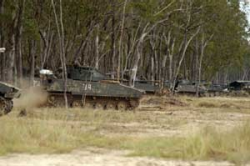
Over 20 BIONIX II and SM1 tanks carried out a mounted assault on 'enemy terrain' at the Shoalwater Bay Training Area (SWBTA) in Queensland, after heavy artillery shelling.
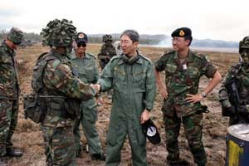
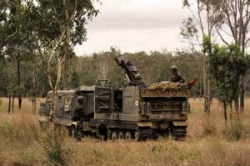
Witnessed by Minister of State for Defence Koo Tsai Kee, the live-firing also featured artillery platforms such as the PRIMUS and the Mortar Tracked Carrier.
"This air-land integration is the development of all the Services in the SAF, to function together as 'One SAF'," concluded exercise air director COL Yeo Yee Peng, Commander Tactical Air Support Group.
"We see the integration as a seeding ground, in terms of being able to train comfortably at the Service command post level, down to the last fighting unit."
"We can bring all the air capabilities together, but what is important is that we are able to develop the confidence and trust between the two Services, in this case, the Air Force and the Army," he added.
The driving core of networked force
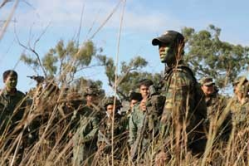
About 3,600 SAF troops comprising Operationally Ready National Servicemen, Full-time National Servicemen and SAF regulars participated in the exercise, which was held from 12 Oct to 25 Nov last year.
The ground troops moved over extended distances despite running on a very tight schedule, bearing testament to the servicemen's professionalism and commitment to training.
"Our people remain the underlying strength upon which all these capabilities are being built," said MAJ Dinesh.
"As a highly intelligent, motivated and tech-savvy lot, the ability to assimilate such new technologies is much easier. And with the correct aptitude and attitudes in place, these technologies can then be harnessed as a force multiplier on the battlefield."

ALSO READ IN TECHNOLOGY
Locked & Loaded: SAF Shooting Contingent weapons
26 Nov 2025
AI joins the fight in national cyber defence exercise
12 Nov 2025
AI and closer collaboration among agencies and industry are taking centre stage in this year’s Critical Infrastructure Defence Exercise (CIDeX).
They built this city
01 Oct 2025
Turning vision to reality: the team behind SAFTI City clinches the Defence Technology Prize 2025 Team (Engineering) Award!