
TECHNOLOGY
NAVAL EXERCISE SHOWS NIMBLE AND INTEGRATED FLEET
15 May 2012
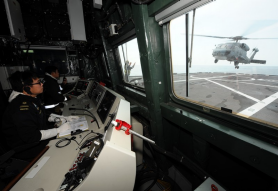
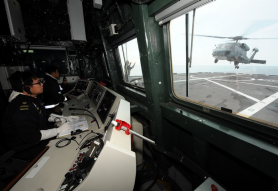
Naval helicopters working seamlessly alongside Formidable-class frigates, and missile corvettes operating unmanned aerial vehicles. All these assets and systems came together in a Fleet Exercise, held some 80 nautical miles away from Singapore in the South China Sea.
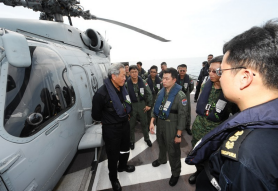
Minister for Defence Dr Ng Eng Hen, who visited the Republic of Singapore Navy (RSN) on 15 May, observed the exercise from the Formidable-class frigate RSS Stalwart.
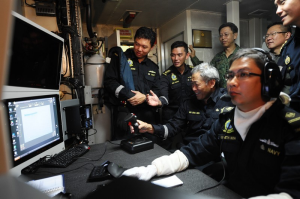
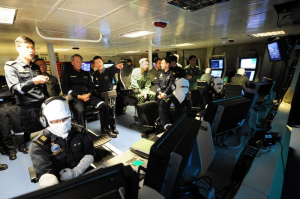
In the Combat Information Centre (CIC) of RSS Stalwart, Dr Ng witnessed integrated operations between the naval helicopters and the frigates, as well as a multi-dimensional exercise encompassing anti-air, anti-surface and anti-submarine warfare.
This exercise demonstrated the RSN's abilities to operate as a highly-networked task group that is integrated into the wider Singapore Armed Forces' (SAF's) Integrated Knowledge-based Command and Control network.
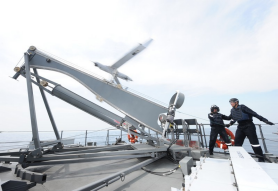
Dr Ng also went on board the Victory-class missile corvette (MCV) RSS Valiant where he was updated on the ScanEagle Unmanned Aerial Vehicle (UAV) system that was acquired as part of the MCV upgrade programme.
The MCVs are being upgraded so that they have the capability and flexibility to meet new and evolving operational demands. To date, three of the RSN's six MCVs have completed their upgrades.
Colonel (COL) Frederick Chew, who commands the frigate squadron, 185 Squadron, commented on the significance of the exercise: "We conduct fleet exercises regularly so that we maintain our operational readiness.
"On top of warfare competencies which we are honing, we are also working out our seamanship competencies (through this exercise)," he added.
During the exercise, Dr Ng took the opportunity to announce the RSN's achievement of Full Operational Capability for the naval helicopters, which were inaugurated in early 2011.
First-time participant in the exercise Captain Wesley Hum, who has been flying the naval helicopter in 123 Squadron for the past three years, spoke about his journey working with frigate crew.
"The integration has come a long way," he said. "The first day, we were very green, because naval aviation is new to the SAF. Three years on, we (naval helicopter and frigate crew) have come to understand each other better and we have synchronised our procedures."
He added: "It used to feel very foreign operating on the ship, but now we feel at home and we're confident to operate on the ship."
Speaking to local media after viewing the exercise, Dr Ng noted the SAF's ability to integrate new and existing platforms, which boosts its overall fighting capabilities.
"The general point about our Army, Navy and Air Force is that now we're fighting as a system, rather than as individual compartments, and that makes us very much more effective," he said.
He continued: "Overall, I think it gives us a sense that we have very strong defences. As a maritime nation, we have many challenges and threats, but we must ensure that our sea lines of communication remain open.
"I'm happy to say that our Navy has kept up and this has expanded our ability to defend ourselves."

ALSO READ IN TECHNOLOGY
Locked & Loaded: SAF Shooting Contingent weapons
26 Nov 2025
AI joins the fight in national cyber defence exercise
12 Nov 2025
AI and closer collaboration among agencies and industry are taking centre stage in this year’s Critical Infrastructure Defence Exercise (CIDeX).
They built this city
01 Oct 2025
Turning vision to reality: the team behind SAFTI City clinches the Defence Technology Prize 2025 Team (Engineering) Award!