
TECHNOLOGY
GUIDING YOUNG MINDS IN DEFENCE SCIENCE
18 Apr 2017

A hacker has entered the premises. He finds a circuit board with a blinking LED that transmits Morse code. The code does not make sense but it turns out to be a cipher encryption.
Decrypting the code, he enters the network. Cracking puzzles are no problem but he meets a roadblock when he has to contact another human, the server administrator, for the next password.
He tricks the administrator into giving him the password. Finally, he reaches a "file dump", a large collection of data that he scans to uncover valuable, sensitive information.
Little does the hacker know that his Internet Protocol (IP) address is being traced and his location tracked down.
This is the "honeypot" system that was coded in three days by a team of five young scientists as part of the Young Defence Scientists (YDSP) Science & Technology Camp.
"The most important thing about the 'honeypot' is that it needs to be interesting to attract the hacker's attention or he could exit at any time," explained Yam Hong Meng from NUS High School of Mathematics and Science.
For their engaging programme, Hong Meng and his team emerged as the Integrated Programme Year 2 (IP2) winning team in the Cybersecurity Camp category.
The team of 15-year-olds presented their findings at the YDSP Congress at Sands Expo and Convention Centre on 18 Apr.
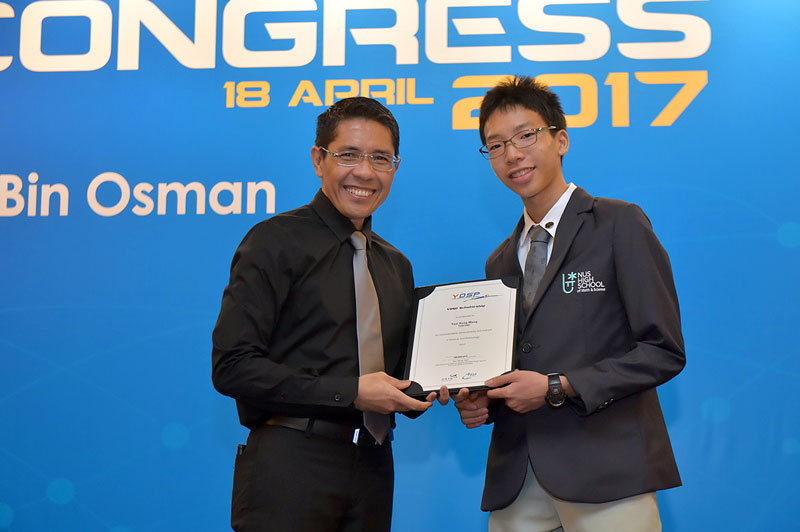
Speaking at the event, Minister of State for Defence Dr Maliki Bin Osman said that technology is a "game-changer" that has to be embraced for the nation's defence.
He presented 30 YDSP scholarships and 90 YDSP academic awards to students this year. The YDSP is an initiative by the Defence Science & Technology Agency (DSTA) and DSO National Laboratories which aims to cultivate students' interest in defence science and technology.
To a 500-strong crowd, Dr Maliki credited the Defence Technology Community as "the brains behind the many capabilities of the Singapore Armed Forces".
Citing examples such as the Republic of Singapore Air Force's (RSAF's) Networked Island Air Defence System which was designed and developed locally, Dr Maliki said that such technologies help change the way the RSAF commands and controls its units.
"It will help us to overcome the limitations of physical space and manpower, and enable our troops to see further and respond faster to a wide spectrum of air threats."
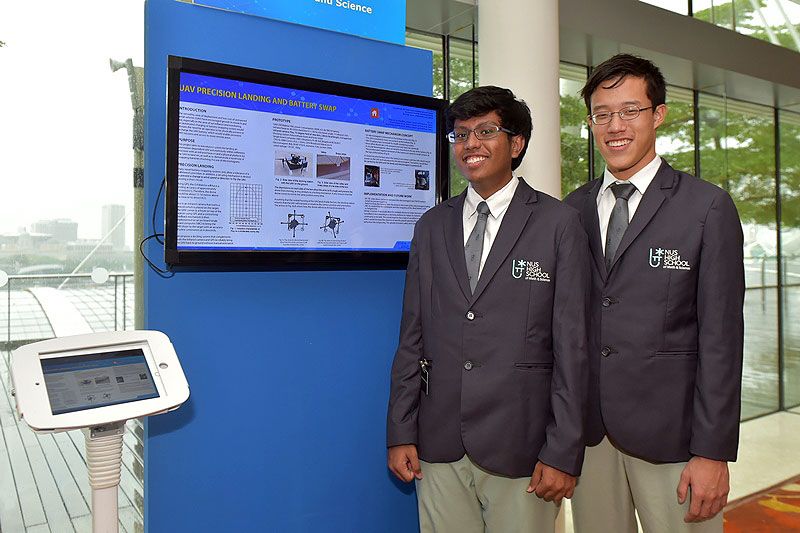
Another YDSP project that has real-life applications explored ways to improve the landing precision of Unmanned Aerial Vehicles (UAVs) in order for them to recharge on their own.
"If a surveillance UAV is travelling behind enemy lines and it needs to recharge, we can't have someone go and recharge it," explained Muhammad Hanif Bin Muhammad Kamal from NUS High School.
"We want UAVs to operate as autonomously as possible," he added.
By using infrared signals combined with a constructed docking platform, Muhammad Hanif and his teammate Huang Xinyuan, both 18, found a way to guide the UAV for a more precise landing.
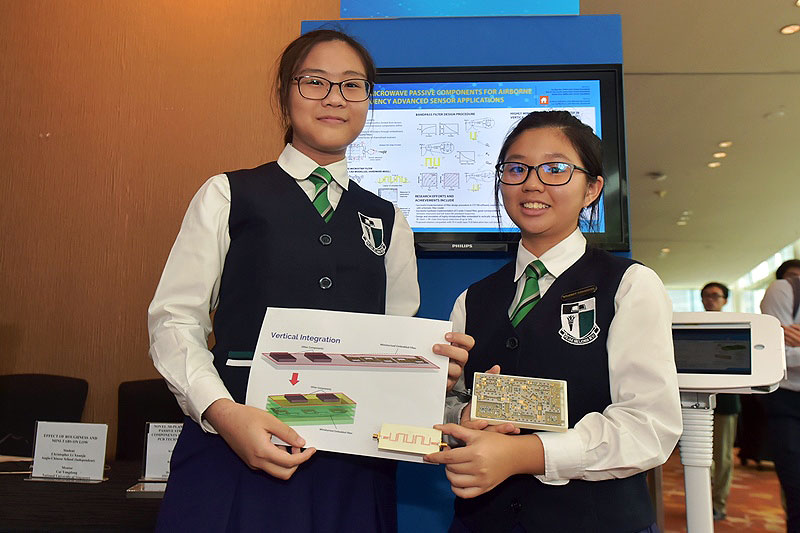
For the Raffles Girls School trio of Tan Xiao Wei, Arielle Koh and Nicole Zhao, it was a limitation with airborne sensor systems that had them working on their project.
Finding that the system was too large, the students rearranged its components so that it would only take up half the space. The new design allows for increased functionality of the aircraft and could be applied to smaller carriers such as drones.
Although airborne systems were new to them, their hard work paid off within a year, said their mentor, Kevin Ho.
Working with the 16-year-olds has even given the senior research engineer in DSO a fresh perspective of looking at things. "It has allowed me to relook at some of our traditional procedures."


ALSO READ IN TECHNOLOGY


Locked & Loaded: SAF Shooting Contingent weapons
26 Nov 2025
AI joins the fight in national cyber defence exercise
12 Nov 2025
AI and closer collaboration among agencies and industry are taking centre stage in this year’s Critical Infrastructure Defence Exercise (CIDeX).

They built this city
01 Oct 2025
Turning vision to reality: the team behind SAFTI City clinches the Defence Technology Prize 2025 Team (Engineering) Award!