
COMMUNITY
FUTURE GENERATIONS OF DEFENCE LEADERS SHOULD CONTINUE FORGING STRONG PUBLIC SUPPORT, DEFENCE TIES: DR NG
21 Aug 2015
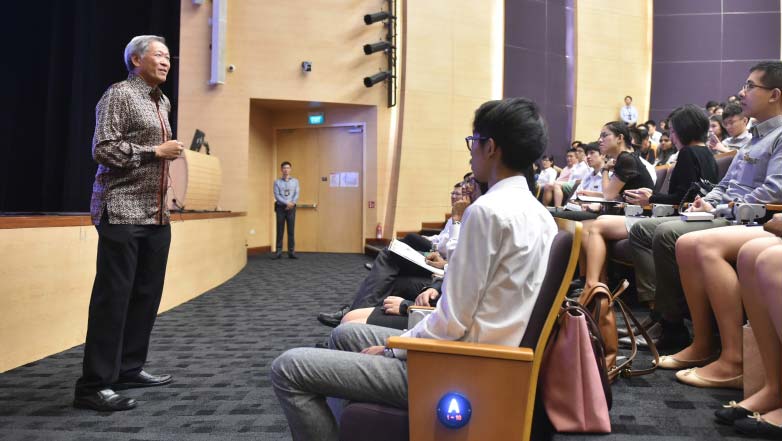
Future generations of defence ministers should continue to forge strong public support for defence, and to maintain good defence relations with other countries, in order to secure peace for Singapore over the next 50 years and beyond.
This was the answer given by Minister for Defence Dr Ng Eng Hen when asked by an undergraduate what advice he would give to today's youths if they were the future defence ministers.
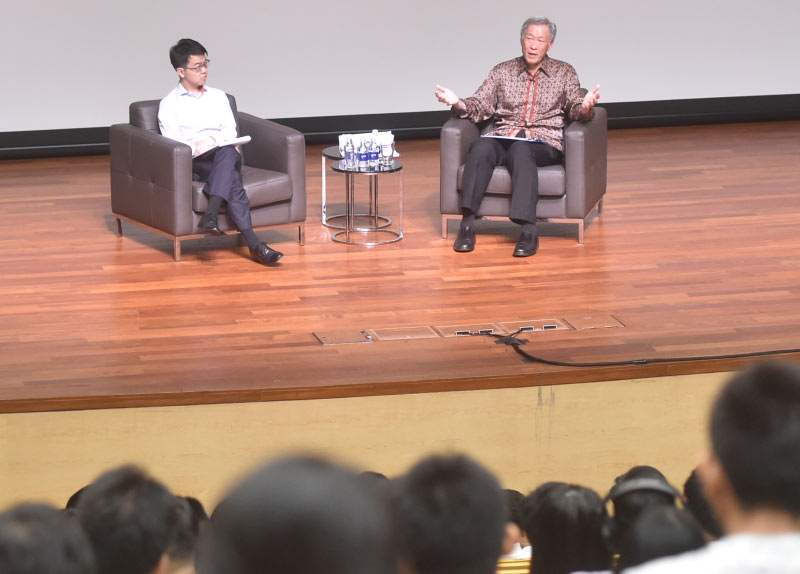
Dr Ng was fielding questions from some 160 undergraduates, mostly from the National University of Singapore (NUS), at the Kent Ridge Ministerial Forum on 20 Aug, after his keynote presentation on Singapore's nation-building journey.
The discussion was centred on Singapore's future challenge in areas such as economy, population, and security.
Noting that 97 percent of Singaporeans had expressed confidence in the country's defence, according to a recent survey by MediaCorp, Dr Ng said: "Certainly, I am gratified that there is such a strong belief You've got to continue to work at it to maintain that support."
"We are only as strong as Singaporeans are willing to support defence. Our boys going for two years (of National Service) is a significant commitment," explained Dr Ng, adding that the Republic also spent a large proportion of the government budget on defence.
On forging strong defence ties, Dr Ng said Singapore had been taking part in defence dialogues, and partnering with countries to foster mutual trust.
He cited how Singapore had offered assistance to Brunei in hosting over 3,000 troops from 18 countries for a large-scale Humanitarian Assistance and Disaster Relief (HADR) exercise in 2013.
"For the first time, you had Chinese, Japanese, American soldiers conducting exercises in a humanitarian setting. And that's what we should be doing more of," said Dr Ng.
"At the same time, you can never be certain you are safe; you must be fully (prepared with a) capable deterrence force," he added.
In response to a question about Singapore's position on the on-going territorial dispute in the South China Sea, Dr Ng said the Republic was not a claimant state, but was concerned about possible disruption to the vital international waterway.
He said: "It shows you that our external environment can be unpredictable, and that we are wise to have a strong SAF (Singapore Armed Forces) that can help pacify things, help to ease tension."
Threats from hybrid warfare
When asked by another student if cyber warfare would become a reality in the near future, Dr Ng said it had already taken place when Russia annexed Crimea from Ukraine last year.
He described Russia's strategy as hybrid warfare: The use of propaganda and disinformation to break the population's will to fight for their country, before launching an invasion.
Singapore is not immune to such threats, Dr Ng said.
The Islamic State in Iraq and Syria (ISIS) has been conducting "a facet of hybrid warfare" through the use of social media to radicalise people worldwide.
The way to respond is through Total Defence where every citizen plays a part, Dr Ng said. Adopted by Singapore, it is a comprehensive strategy consisting of military, civil, economic, social and psychological defence.
Dr Ng gave the example of 19-year-old Arifil Azim Putra Norja'I, a self-radicalised Singaporean who harboured the intention to conduct attacks in the country. His arrest was made possible because his friend noticed the change in him, and alerted the authorities.
"This is something which is occurring here and now, something that has changed the battlefield. So it's a battle over mind, it's a battle over ideology," said Dr Ng.
"Militarily, we also have to respond, (and) that's why we have our cyber defence, and information defence," he added.
Females to do NS?
Asked if females would be enlisted for National Service (NS) in the foreseeable future, in view of the declining birth rate in Singapore, Dr Ng said there was no need to do so, as technology had enabled the SAF to provide the same kind of firepower with less manpower.
For example, it used to take 12 men to operate an artillery gun, but today, only three men are needed to run the High Mobility Artillery Rocket System.
The SAF had also planned for its manpower need, factoring in declining birth rates, till 2050, Dr Ng added.
While there have been calls for females to do NS as nurses or teachers, Dr Ng said there was no strong justification for it.
He explained: "There are very few circumstances where you can say to anybody, whether male or female, that I want you to give up two years of your life to do something.
"And that critical need is (the) defence of Singapore. I can't bring you in to be a nurse or to be teacher. It is a social good, but (an) inadequate justification."
Even if there is a need to conscript females for defence needs, it has to be done carefully because "it changes the whole complexion of your military force", he added.
Held at the University Town, the forum was organised by the NUS Students' Political Association.
Loading the player ...

ALSO READ IN COMMUNITY

Happy 61st birthday, Singapore!
09 Aug 2026
Experience the magic of Singapore’s 61st birthday: Returning to the National Stadium after 10 years, NDP 2026 dazzled the crowds with an unforgettable show.
Your backstage pass to NDP 2026
06 Aug 2026
Ever wondered what goes on behind the scenes of NDP? We take a peek behind the curtain to uncover the hard work that this year’s performers have put in since rehearsals began months ago.
What it takes to be a viral NDP mascot
25 Jul 2026
They’ve been stealing hearts as the lovable mascots at the National Day Parade (NDP). Meet the NSFs behind the costumes and high-energy dance moves.