
DIPLOMACY
DPM TEO PROPOSES MILITARY TRANSPARENCY TO ENHANCE REGIONAL DEFENCE COOPERATION
31 May 2009
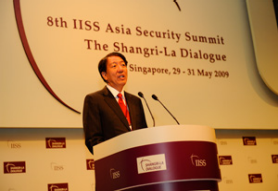
In the Asia-Pacific, as more states grow in their economies, their spectrum of strategic interests, including trade interests, energy and resource needs, also widens. To safeguard these interests, military spending and territorial disputes stemming from claims to strategic locations may also increase.
Amidst such strategic uncertainties, the objectives of countries in the region are to work together towards achieving peace and stability. One of the steps towards this goal is military transparency.
Deputy Prime Minister and Minister for Defence Teo Chee Hean shared this view with defence ministers and delegates from 27 countries, during his plenary session at the 8th Shangri-La Dialogue on 31 May.
Expanding on the notion of transparency, Mr Teo posited three levels of transparency. The first level is a disclosure of one's armaments and arsenal. The disclosure of a country's military programme, expenditure and its import and export of arms can reduce the likelihood that such programmes will be "destabilising".
Mr Teo added that such disclosure can be made by visits to military facilities, regular public statements about military procurements and plans, and through official defence websites, with regular updates on military activities and programmes.
However, knowledge of each other's capabilities is insufficient to instil confidence with regard to defence intents. This necessitates a second level of transparency, which is the expression of each country's security concerns and strategic intent.
In order to avoid suspicion and miscalculation, "states need to articulate their security concerns and strategic intent in clear and convincing ways that can reassure others", explained Mr Teo.
"When we better understand the concerns that we might have about each other, we can more confidently find ways to take these concerns into account and reassure each other. Where we have common concerns, we can find ways to cooperate meaningfully."
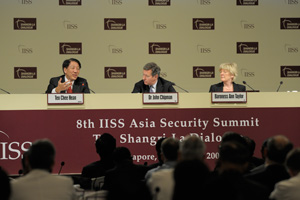
Mr Teo fielding questions from the floor after his plenary speech. To his left are Dr John Chipman, Director-General and Chief Executive, IISS, who chaired the plenary session, and Baroness Ann Taylor, Minister for International Defence and Security, Ministry of Defence, United Kingdom. She also spoke on military transparency at the plenary session.
Commitment to resolve disputes peacefully based on dialogue and international law, and not on military might can further bolster regional trust. Mr Teo made mention of the UN Convention on the Law of the Sea (UNCLOS), saying that it provides a framework in which countries can make claims to territorial waters, and the framework to access the legitimacy of such claims.
Some examples of second level transparency shared by Mr Teo are government statements and dialogues between states, such as the Shangri-La Dialogue, which serves as a platform for states to share information, exchange views and voice concerns.
The third level of transparency refers to states taking cooperative action that contributes more directly to regional security.
Mr Teo noted that this is especially important for the Asia-Pacific as the region faces multi-faceted and transnational security challenges that require international cooperation to resolve. Also, it is a politically and economically diverse region, where regional security dialogue and cooperation are still "works in progress".
"Concrete action and cooperation among all the regional stakeholders, in a step-by-step manner, are necessary for stable relations and for the region to work together to tackle common threats," he said.
Citing examples of operational cooperative mechanisms, Mr Teo referred to the the current cooperation in the Gulf of Aden to combat piracy and the Malacca Strait Patrols, which have had a positive effect on regional security and enhancing trust between the participating states of Malaysia, Indonesia, Singapore and Thailand.
Concluding his plenary speech, Mr Teo emphasised that military transparency is not an end in itself, but a means to peace and stability, adding that "the increasing acceptance and practice of these three levels of transparency have enabled the Asia-Pacific region to gradually foster a norm of dialogue, a culture of defence cooperation".
"If we get it right, the region can harness its cooperative energies to mitigate differences that may arise from time to time, and achieve our objective of enduring stability and cooperation," he said.
"We need to do this not just to overcome security challenges and secure our homelands, but also to work together to build a new prosperity and secure better lives for our people."
Organised by the International Institute for Strategic Studies (IISS), the Shangri-La Dialogue is the only forum that brings together defence ministers from the Asia-Pacific region to discuss regional security issues and defence cooperation.
During the three-day event from 29 to 31 May, Mr Teo also met with various ministers and officials, including Australian Prime Minister Kevin Rudd, Indonesian Minister for Defence Professor Dr Juwono Sudarsono, Malaysian Minister of Defence Dato' Seri Dr Ahmad Zahid Hamidi, and United States Secretary of Defense Robert Gates.

ALSO READ IN DIPLOMACY
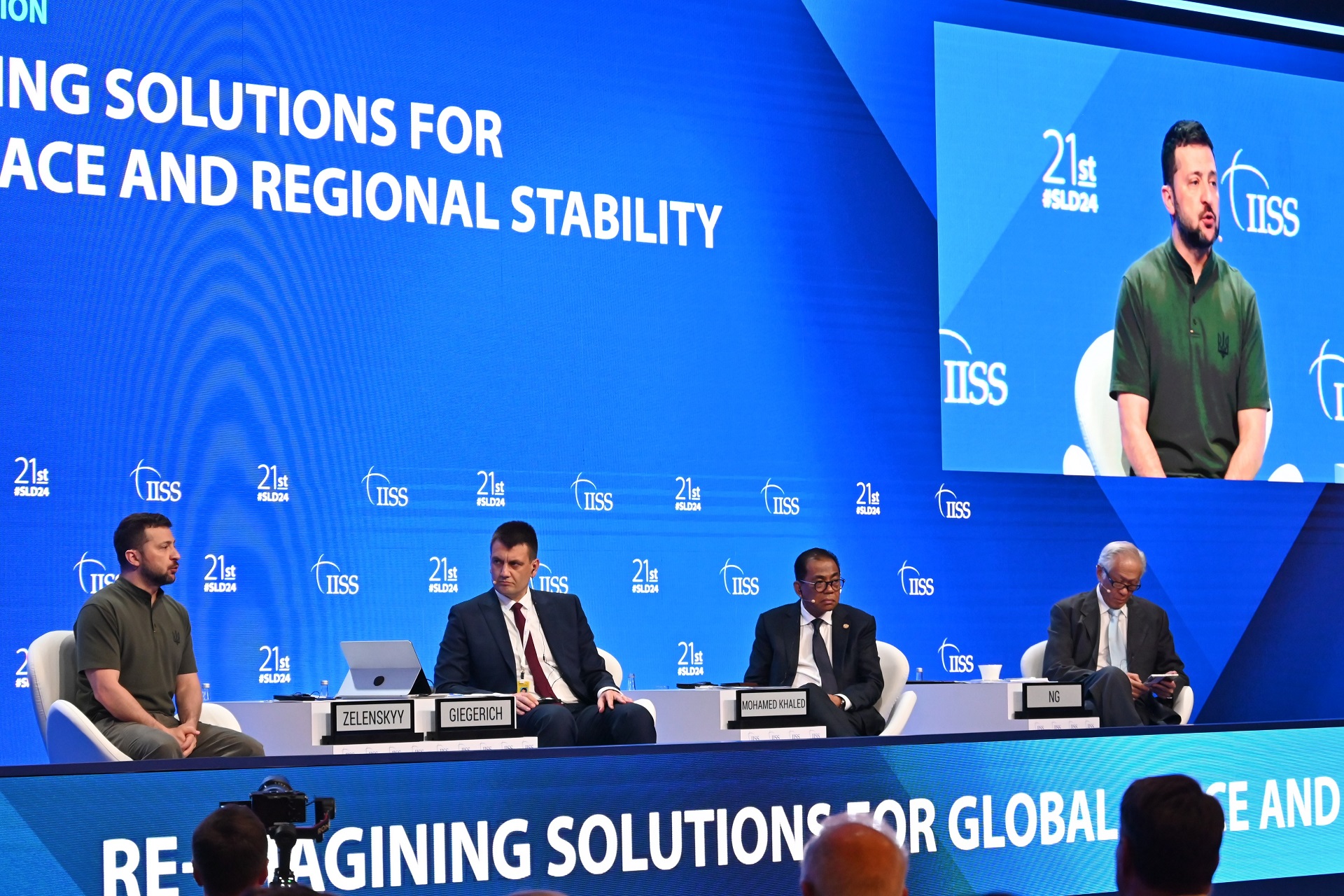
A call for peace at Shangri La Dialogue
02 Jun 2024
A repeated call for peace, especially in Asia. This was Minister for Defence Dr Ng Eng Hen's central message at the 21st Shangri La Dialogue (SLD), held from 31 May to 2 Jun.
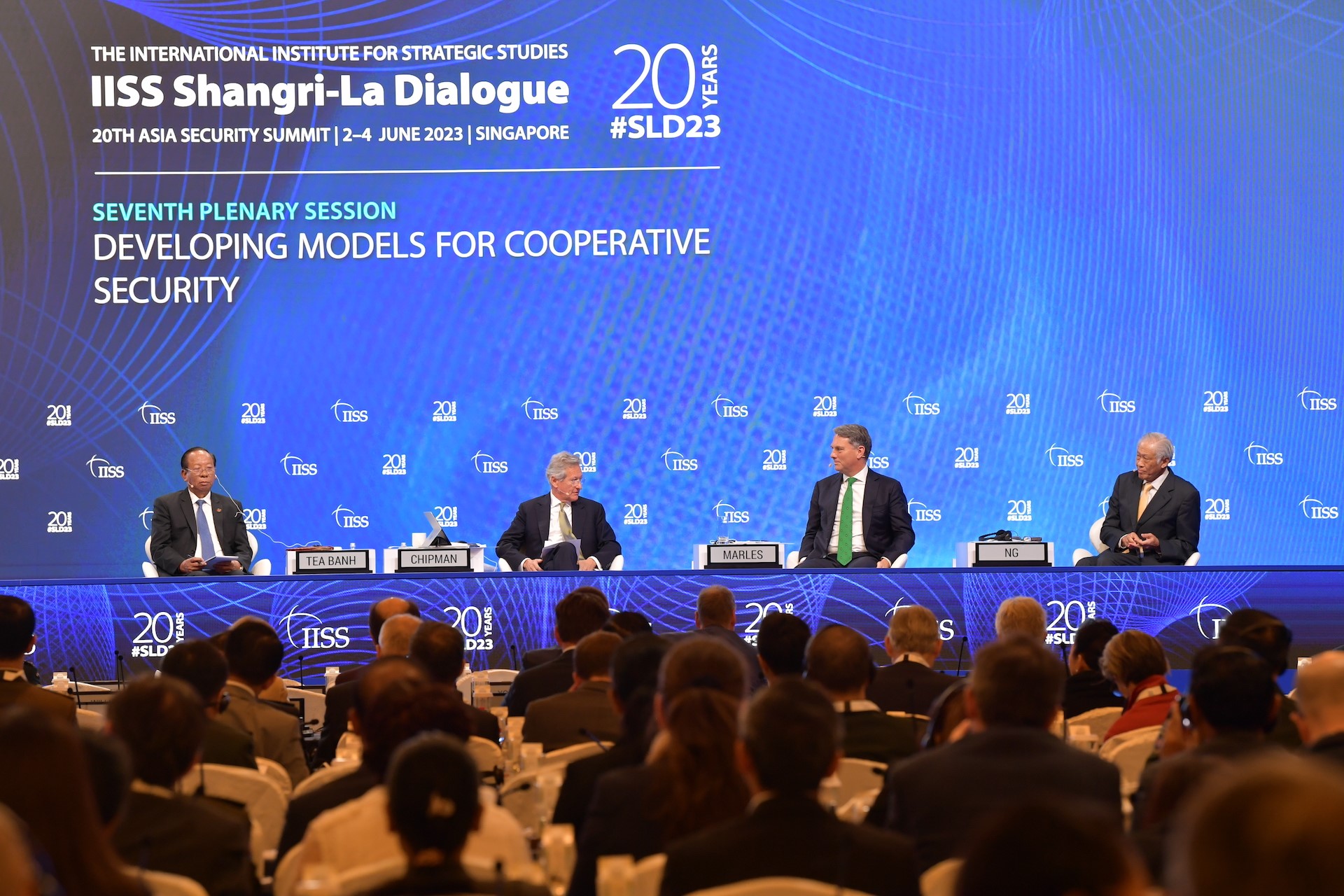
Shangri-La Dialogue sees frank discussion of security issues
04 Jun 2023
The 20th Shangri-La Dialogue, held from 2 to 4 Jun, saw ministers from around the world meet in Singapore to discuss key defence and security issues.
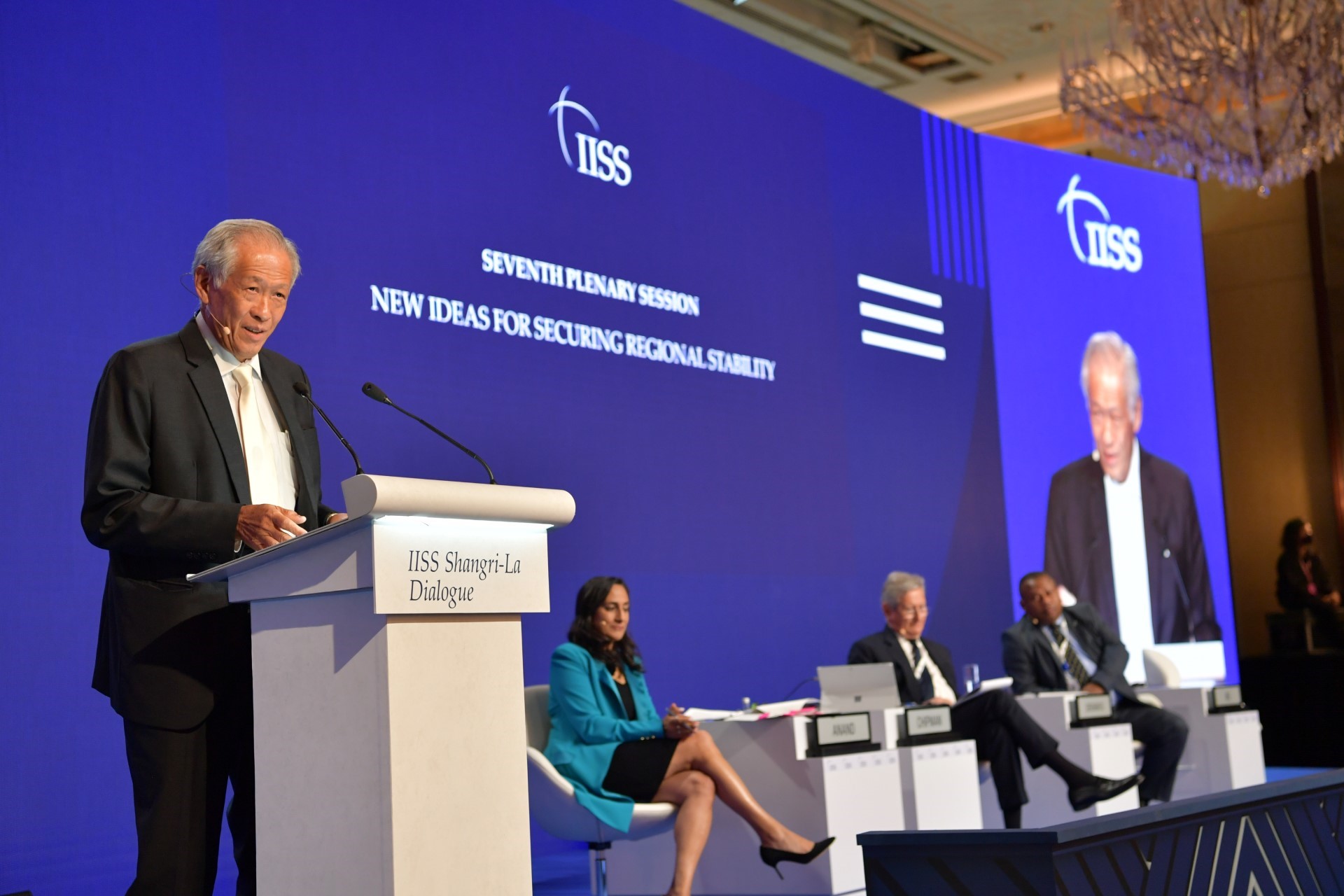
SLD remains valuable platform for crucial discussions: Dr Ng
12 Jun 2022
Minister for Defence Dr Ng Eng Hen spoke on the US-China relationship, the importance of a rules-based order and the role of ASEAN as a regional security platform at the 19th Shangri-La Dialogue (SLD).