
TECHNOLOGY
ARMY UNVEILS NEW FIELD 'HOSPITAL'
05 May 2006
At first sight, they look like ordinary containers. But do not be fooled by initial appearances.
In less than 20 minutes, these four containers can be 'converted' into a mini-outfield hospital, complete with two operating theatres, an intensive care unit, X-ray and laboratory facilities and even a ward for recovering patients!
Chief of Army Major-General (MG) Desmond Kuek launched these new medical containers at the Army Medical Command in Nee Soon Camp on 28 Apr.
Each air-conditioned container, measuring 6.1 by 2.4 by 2.4 metres (or 20 by 8 by 8 feet), can be expanded to increase its size three-fold. One major and a minor surgery can be performed simultaneously in the enlarged operating theatre within one of the containers.
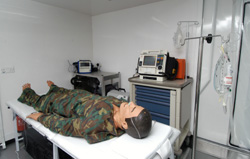
The other three containers can be expanded to include X-ray facilities and a laboratory to conduct clinical investigations, a six-bed general ward, and a high dependency care unit stocked with equipment like those in an intensive care unit in a hospital (see below).
When these containers are deployed in the field, the critically-ill can be treated almost immediately, without wasting time transferring them to the nearest hospital, thereby greatly enhancing the work of the Singapore Armed Forces (SAF) in socio-civic missions, international humanitarian assistance and disaster relief operations.
Head laboratory technician Second Sergeant (2SG) Alex Tan, who works in the x-ray and laboratory container, was involved in the SAF's humanitarian relief efforts in Indonesia after the 2004 tsunami.
"In Meulaboh, we had to set up a small lab workstation in a room in the hospital there. Although we cleaned it as best as we could, it was still difficult to keep the environment clean as the room was not air-conditioned," recalled 2SG Tan.
"Hence these containers are wonderful, as some of our medical equipment work better in air-con rooms, and the contamination of samples is greatly reduced in a clean environment," he added.
Nursing Officer Captain (CPT) Lim Poh Thiam (left) was also full of praises for the containers.
"Previously, when deployed outfield, we would work in tents, often over uneven terrain. Though the tents were air-conditioned, we could only set up one operating theatre."
"But now, with these containers, they can be opened up, allowing us to set up two operating theatres," said CPT Lim.
Another advantage is that the containers are linked to each other via inter-connecting units. The sheltered walkways allow medical personnel to move from the different containers easily.
Laboratory results can thus be delivered to medical officers quickly, allowing for smoother casualty flow and treatment management.
Setting up these containers is also relatively easy.
For each container, CPT Lim said four to six personnel are required. They take no more than 20 minutes to open up the flaps of the container, put jacks in place to keep the box stable on uneven ground, plug in a power generator and get the equipment within the box ready for use.
CPT Lim said: "The men feel even more confident that they can do a good job with these containers."
"All our equipment are already packed and ready for use in these containers which means we can be deployed more quickly than in the past. So we are ready to go anytime!"
The air-conditioned expandable containers can be used for:
1. Operating theatre
With conditions and equipment comparable to those of a hospital, eight personnel, including surgeons, anaesthetists and nurses, can conduct complex surgery like laparotomy (the opening up of the stomach walls) on patients. Two operations can be conducted simultaneously in the enlarged container box.
2. High Dependency Care
Functioning like the intensive care ward in a hospital, up to four patients can receive the best post-surgery care here. They are closely monitored by state-of-the-art equipment that check for their heart rate, blood pressure and respiratory rate.
3. X-ray and Laboratory
Samples drawn from patients can be accurately tested without much risk of contamination in this sterile and temperature-controlled environment.
The close proximity of X-ray facilities to the operating theatre and ward also mean patients need not travel far for their X-ray examinations.
4. General Ward
Up to six patients can rest here comfortably in this container, with peace of mind that medical staff are on hand to provide assistance when required.
The four container boxes can be deployed separately depending on what is required. They can be transported by land on trucks or trailers, and by air in a Hercules C-130 transport plane, or ferried in a Landing Ship Tank.
Lorry cranes and side loaders are used to lift and place the containers onto the ground.
In less than 20 minutes, these four containers can be 'converted' into a mini-outfield hospital, complete with two operating theatres, an intensive care unit, X-ray and laboratory facilities and even a ward for recovering patients!
Chief of Army Major-General (MG) Desmond Kuek launched these new medical containers at the Army Medical Command in Nee Soon Camp on 28 Apr.
Each air-conditioned container, measuring 6.1 by 2.4 by 2.4 metres (or 20 by 8 by 8 feet), can be expanded to increase its size three-fold. One major and a minor surgery can be performed simultaneously in the enlarged operating theatre within one of the containers.
The other three containers can be expanded to include X-ray facilities and a laboratory to conduct clinical investigations, a six-bed general ward, and a high dependency care unit stocked with equipment like those in an intensive care unit in a hospital (see below).
When these containers are deployed in the field, the critically-ill can be treated almost immediately, without wasting time transferring them to the nearest hospital, thereby greatly enhancing the work of the Singapore Armed Forces (SAF) in socio-civic missions, international humanitarian assistance and disaster relief operations.
Head laboratory technician Second Sergeant (2SG) Alex Tan, who works in the x-ray and laboratory container, was involved in the SAF's humanitarian relief efforts in Indonesia after the 2004 tsunami.
"In Meulaboh, we had to set up a small lab workstation in a room in the hospital there. Although we cleaned it as best as we could, it was still difficult to keep the environment clean as the room was not air-conditioned," recalled 2SG Tan.
"Hence these containers are wonderful, as some of our medical equipment work better in air-con rooms, and the contamination of samples is greatly reduced in a clean environment," he added.
Nursing Officer Captain (CPT) Lim Poh Thiam (left) was also full of praises for the containers.
"Previously, when deployed outfield, we would work in tents, often over uneven terrain. Though the tents were air-conditioned, we could only set up one operating theatre."
"But now, with these containers, they can be opened up, allowing us to set up two operating theatres," said CPT Lim.
Another advantage is that the containers are linked to each other via inter-connecting units. The sheltered walkways allow medical personnel to move from the different containers easily.
Laboratory results can thus be delivered to medical officers quickly, allowing for smoother casualty flow and treatment management.
Setting up these containers is also relatively easy.
For each container, CPT Lim said four to six personnel are required. They take no more than 20 minutes to open up the flaps of the container, put jacks in place to keep the box stable on uneven ground, plug in a power generator and get the equipment within the box ready for use.
CPT Lim said: "The men feel even more confident that they can do a good job with these containers."
"All our equipment are already packed and ready for use in these containers which means we can be deployed more quickly than in the past. So we are ready to go anytime!"
The air-conditioned expandable containers can be used for:
1. Operating theatre
With conditions and equipment comparable to those of a hospital, eight personnel, including surgeons, anaesthetists and nurses, can conduct complex surgery like laparotomy (the opening up of the stomach walls) on patients. Two operations can be conducted simultaneously in the enlarged container box.
2. High Dependency Care
Functioning like the intensive care ward in a hospital, up to four patients can receive the best post-surgery care here. They are closely monitored by state-of-the-art equipment that check for their heart rate, blood pressure and respiratory rate.
3. X-ray and Laboratory
Samples drawn from patients can be accurately tested without much risk of contamination in this sterile and temperature-controlled environment.
The close proximity of X-ray facilities to the operating theatre and ward also mean patients need not travel far for their X-ray examinations.
4. General Ward
Up to six patients can rest here comfortably in this container, with peace of mind that medical staff are on hand to provide assistance when required.
The four container boxes can be deployed separately depending on what is required. They can be transported by land on trucks or trailers, and by air in a Hercules C-130 transport plane, or ferried in a Landing Ship Tank.
Lorry cranes and side loaders are used to lift and place the containers onto the ground.

ALSO READ IN TECHNOLOGY
AI joins the fight in national cyber defence exercise
12 Nov 2025
AI and closer collaboration among agencies and industry are taking centre stage in this year’s Critical Infrastructure Defence Exercise (CIDeX).
They built this city
01 Oct 2025
Turning vision to reality: the team behind SAFTI City clinches the Defence Technology Prize 2025 Team (Engineering) Award!
Operating over skies & seas
22 Aug 2025
This gear is designed to help a Sensor Supervisor survive emergencies in the air and at sea.